The constellation Orion
What's that bright star overhead? Which star is the North Star? Is Mars really red? If you wish you knew more about the night sky, it's easier than you think to get started. Here are some basics for you.
A telescope
Good news. You don't need a telescope to get started. There are lots of things visible to the unaided eye. However, a good pair of binoculars can be an asset.
A star map
You wouldn't try to find your way around a new place without a map or guide. The same goes for finding your way around the sky. If you have a guidebook, such as the Monthly Sky Guide, you're ready to go. If not, look online for a star map. I like the sky map (old version) on Heavens-above.com which can be set to your location and date, and printed in black on white.
Stars are shown as dots of different sizes. The bigger the dot, the brighter the star. It should also show you the Moon and any planets that are visible.
There's something unexpected about a star map. If north is at the top and south at the bottom, unlike a road map, west is to the right and east is to the left. But to use the star map, you need to hold it above your head with it pointing in the direction you're facing. If you're facing north and pointing the map north above you, west is to the left and east to the right.
The center of the map shows what's directly overhead. The edges are the horizon, so the objects there are low in the sky.
Where's the North Star (Polaris)?
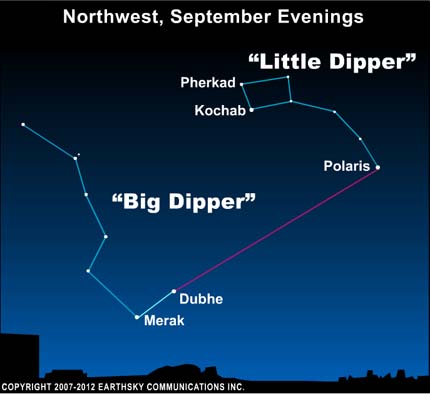
One of the most useful objects in the night sky is Polaris, the North Star. You can find it by using one of the best known star groupings, the Big Dipper (the Plough in Britain). It's not a constellation, but part of the constellation Ursa Major. As shown in this diagram, two stars in the bowl of the Big Dipper point to Polaris. It's the end of the handle of the Little Dipper, part of the constellation Ursa Minor.
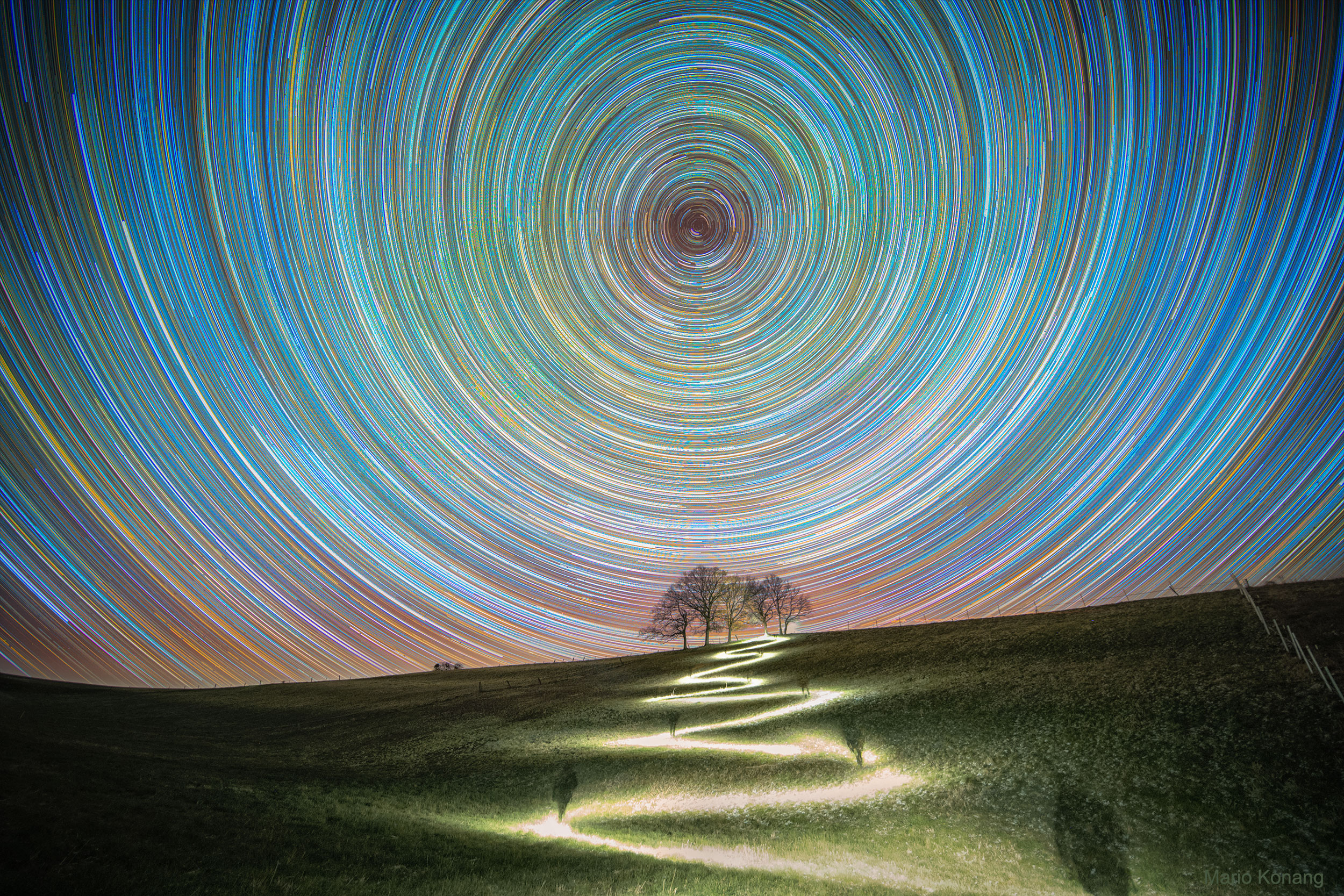
During the night, as the Earth rotates from west to east, the constellations rise in the east and set in the west. In the northern hemisphere, the stars seem to revolve around Polaris because it's almost directly above the North Pole. Although you wouldn't see this movement, astrophotographers capture it by with their cameras and long exposures. A series of stacked images over time produced these star trails. Polaris is at the center. [Image Credit & Copyright: Mario Konang]
Stars and planets
Unlike planets, stars often seem to twinkle. They're a long way off and the point of light that arrives tends to be disturbed by our atmosphere. Our neighbors the planets have discs which aren't affected so noticeably.
Five planets have been known since ancient times. The most spectacular one is Venus which is so bright, usually only the Moon outshines it. You can often see it at sunset or in the predawn sky. When it's very bright, there may be an increase in UFO reports! Mercury is more elusive. It's always close to the Sun, so can be difficult to spot. Mars does have a reddish tone to it. We can also often see Jupiter and Saturn.
The planets aren't scattered randomly around the sky. They're all located on the ecliptic, a line that may be shown on your star map.
People often think of all stars as white, but they come in different colors. The color depends on the temperature, with blue stars being hotter than white stars, which in turn are hotter than red ones.
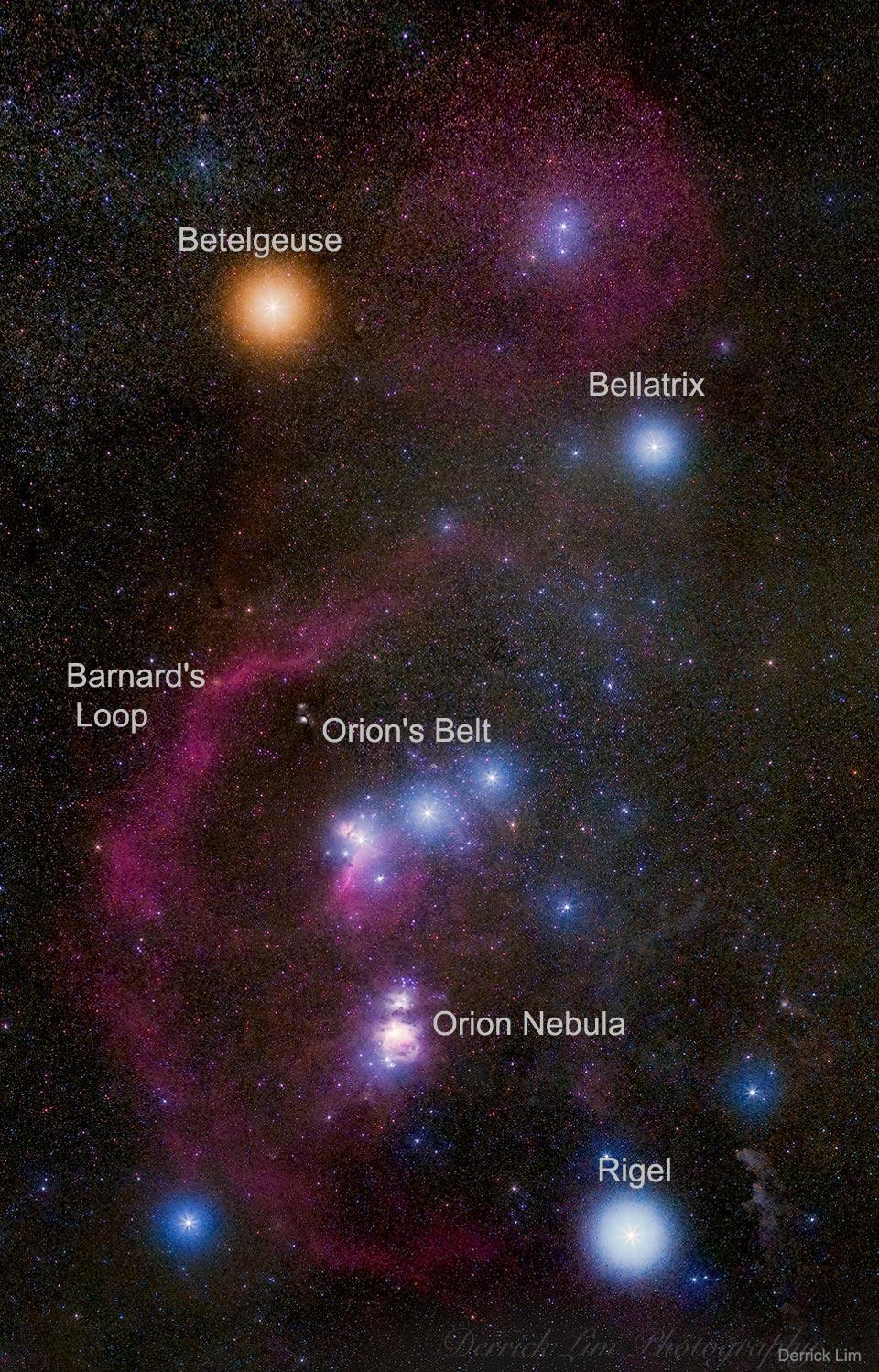
Even with your unaided eye you can see some star colors. For example, the constellation Orion's brightest stars are Betelgeuse, with a reddish tinge and Rigel which is blue. [Image credit: Derrick Lim/nasa.gov]
More heavenly sights
There are a number of websites, such as https://www.cfa.harvard.edu/skyreport, that tell you what you might see in the sky. It notes the visible planets, Moon phases, meteor showers, and if we're lucky, bright comets. But you may also see the International Space Station (ISS) and artificial satellites overhead. Heavens-above.com can tell you when and where these are visible from your location. The space station can be quite a lovely sight when it seems to glide through a field of stars.
A few hints for the beginner
When observing, your eyes need to adapt to the dark. You'll be surprised to see how many stars seem to have appeared after you've been outside for awhile! Red light will let you check your map without destroying your dark adaptation. If you can get a piece of red cellophane to put around your flashlight, that will do the job.
And do take all the security and safety precautions you'd take for any night-time activity. This includes some warm clothes, even in summer, and remember that even your own yard can be hazardous in the dark. It's also safer – and more fun – with a friend.

Printer Friendly Version