

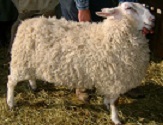
We know there are trends for just about everything. What is a must have one week is a has been the next. It is often the same with fibers. One of the most low key, but very wonderful spinning wools comes from the Border Leicester sheep. While they may not headline the fair, their fiber should be celebrated.
The Border Leicester breed is descended from the longwool breeds of Leicestershire England. The rest of the lineage is a bit unresolved as far as which other breeds were introduced to create today’s Border Leicester. The breed was established in 1767 by George and Matthew Culley.
As we head out to the Pennsylvania State Farm Show each year, I am always on the lookout for good fiber. I have found so many new local sources each year, but my best discovery so far has been the fleece of the Border Leicester.
They have a slightly looser lock structure that permits you to get a more accurate feel for the finished yarn by simply petting the sheep than most other breeds. The staple length is quite long can be 6 to 10 inches with one year of growth. This makes the fleece easy to spin into a very fine yarn. However, it is fine enough that if it is spun loosely into a thicker yarn, you won’t end up with a creation that resembles twine. Another option if you find a breeder who will accommodate is to get a half year fleece. It is my experience that you should purchase two half year fleeces so the breeder is not stuck with a fleece that is an off-length.
To spin the wool of the Border Leicester, wash the locks carefully to remove the grease and debris. I prefer to flick card the ends of the washed locks and spin from the shorn end. The fiber can also be milled into roving and spun. Either way, the natural luster of the wool makes for a very elegant finished garment.
From a shearing perspective, the Border Leicester is one of the few sheep breeds that I will consider shearing due to their not having wool on their heads and legs. They really look as though they are wearing wooly vests.
Why is the Border Leicester fleece such a bargain? The breed is kept for their meat producing ability as well as their fiber. Depending upon the focus of a particular farm, the price of the wool is lower because that is not the primary income generator for the farm. Nonetheless, Border Leicester is certainly a wool worth looking into.
