Witch Head Nebula (IC 2118). Image credit: Jeff Signorelli
If you're somewhere that Halloween is celebrated, you may be used to small ghosts and witches, and perhaps skulls and snakes and spiders. But if you knew that the sky contained such things, would you stay at home and hide? I hope not, because they represent interesting astronomical objects, and I assure you that our virtual tour will be quite safe.
Cosmic ghosts
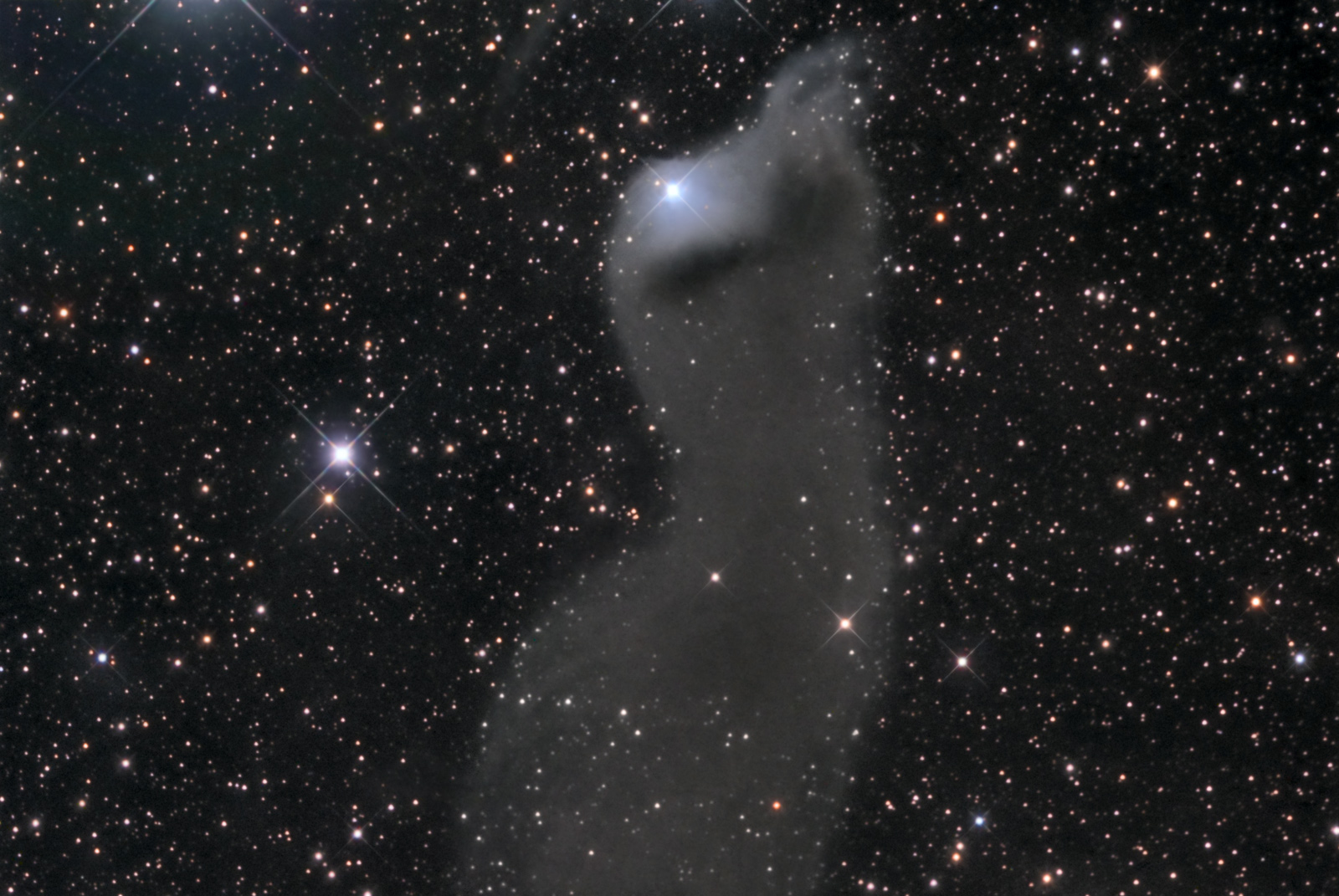
I don't think that I'd be happy meeting this cosmic ghost in a dark and lonely place. But it's actually some 1400 light years away in the constellation Cepheus. It'a Nebula, a giant cloud of gas and dust in the space between the stars. It's cataloged as vdB 152, and is often called a "ghostly apparition". Although it looks like the popular image of a ghost, it's a reflection nebulae. Dust absorbs red light and reflects blue light from nearby stars.
Cosmic witch
What is Halloween without a scary witch? The Witch Head is another reflection nebula. You can see her profile at the top of the page. The nebula is more intensely blue than vdB 152, as it's closer to us and is lit by a very bright star.
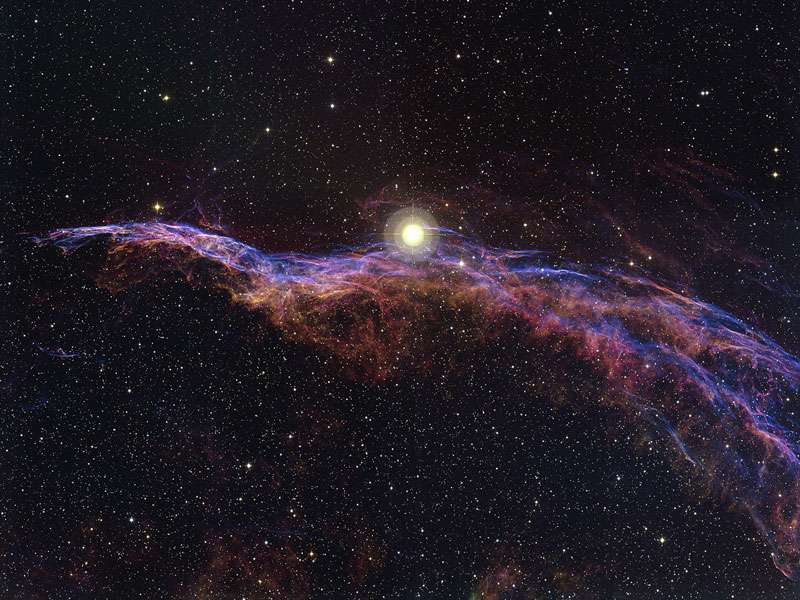
And of course a celestial witch needs celestial transport. The Witch's Broom Nebula (NGC 6960) is part of the Veil Nebula, an enormous supernova remnant. It formed from material thrown out when a massive star exploded at the end of its life. [Image credit: T.A. Rector (U. Alaska)]
Snakes and spiders
There are two snakes among the 88 constellations. In fact, the largest of all the constellations is Hydra the water snake. In Greek mythology, one of the labors of Hercules was to kill the hydra and put an end to its raids on the nearby countryside. The constellation has only one head and would scarcely have needed a hero like Hercules to deal with it. However the Hydra of myth had nine heads.
A second snake, the constellation Serpens, is quite benign. It's held in the sky by Ophiuchus, a constellation representing Asclepius, the god of medicine. His symbol is a rod with a snake twined around it.
Features that resemble spider webs are common. One example is the dramatic impact crater Apollodorus on the planet Mercury. It's nickname is Spider Crater. It's a feature in the Caloris Basin. [Image credit: NASA/Johns Hopkins University]
The fiery skull
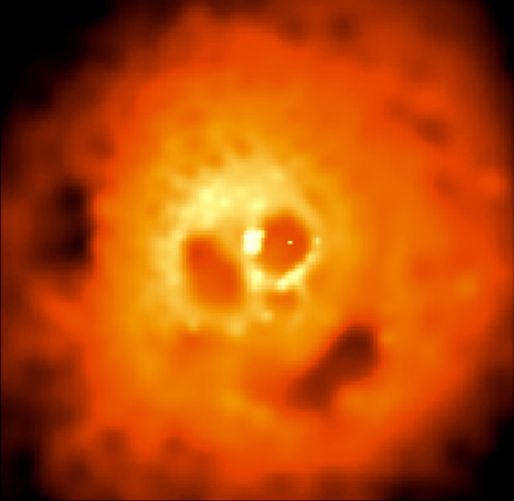
The final item seems to be a giant fiery skull with the eyes of a tormented being. But it turns out to be an X-ray picture of the Perseus Cluster of Galaxies. [Image credit: A. Fabian (IoA Cambridge) et al, NASA] It contains thousands of galaxies and is about a hundred thousand light years across. In fact, the picture isn't an image of the galaxies. It's of the X-rays given out by the gas between the galaxies. Bright areas, such as the one at the center, are regions of strong X-ray emission. Scientists think this one is likely to be a supermassive black hole.

Printer Friendly Version