Cepheus isn't a well known constellation, despite its prominent location near the north celestial pole and Ptolemy's (c.90-c.168 AD) describing it in the Almagest. Although its main stars are visible to the unaided eye, none is particularly bright. This makes it difficult to locate, especially in a city.
Cepheus is shaped like a pentagon, and when the stars are joined with lines, it looks like a child's drawing of a house. But Gamma Cephei isn't the king's crown. In this 19th century depiction of Cepheus you can see Gamma Cephei on the king's left knee, which is on the right of the picture.
Cepheus in myth
Cepheus, the mythological king of ancient Aethiopia, is near his wife Cassiopeia in the sky, and probably not too happy about it. Cassiopeia was beautiful, but vain and arrogant. She bragged that she and her daughter Andromeda were more beautiful than the nereids, the sea nymphs. This so annoyed the sea god Poseidon that he sent the monster Cetus to ravish the kingdom. And alas, it seemed that the only way to save the realm was to sacrifice Andromeda to the monster.
Poor Andromeda was chained to a rock and left for the monster's next meal. Fortunately, she was rescued in the nick of time by a passing hero named Perseus. He was on his way home after killing Medusa the Gorgon. Anyone looking at Medusa's face was turned to stone, so he had her head in a bag. Perseus had also been loaned a few handy accessories: sandals that flew and an invisibility hat. Finishing off the monster and rescuing the girl was all in a day's work for such a well-equipped hero.
Perseus claimed Andromeda for his bride. Since Cepheus had promised his daughter to her uncle, I imagine she thought that a young hero was a better deal. However the fiance turned up at the wedding feast with a number of armed followers to enforce his prior claim. (We might well wonder where they all were when Andromeda was chained to the rock!) But Perseus ended the ruckus with some fancy swordplay and Medusa's head.
Andromeda and Perseus are also constellations, as is Cetus, making this a very prominent story in the night sky.
Stars of Cepheus
The constellation's brightest star is Alderamin (Alpha Cephei). Twenty thousand years ago it was the north pole star and will be again in the long distant future. But before then it is Alrai (Gamma Cephei) that takes over from Polaris as the pole star.
Alrai is not just one star, but two. The visible star, called Gamma Cephei A, is an orange star nearly five times the radius of the Sun and coming to the end of its hydrogen fuel. It has a planet orbiting it, as well as a companion star. The other star is about half the Sun's mass, a faint red dwarf.
Delta Cephei is the prototype of the classical Cepheid variables. These are giant stars whose outer layers pulsate in a regular rhythm, causing changes in the star's brightness. Henrietta Leavitt (1868-1921), an assistant at Harvard College Observatory, discovered a relationship between the pulsation period and the star's luminosity. The luminosity is the amount of radiation a star emits. If you know this and how bright it seems from Earth, you can work out how far away it is. Edwin Hubble used a Cepheid variable to show that the Andromeda "nebula" was a galaxy beyond the Milky Way, not a nebula in our own galaxy.
One of the largest stars in the galaxy is Mu Cephei, known as the Garnet Star, because William Herschel (1738-1822) described it as the color of garnet. Mu Cephei is a red supergiant nearing the end of its life. It's so big that if it were in the Sun's place, if would fill the space almost to Saturn's orbit.
Other interesting objects in Cepheus
The Herschel family is connected to many objects in Cepheus, though of course they couldn't see them as we do with today's telescopes.
Caroline Herschel (1750-1848) was William's sister. She discovered NGC 7380, which is an open star cluster. An open cluster is a large group of stars that formed from the same nebula and are only loosely held together by gravity. This means that as it orbits the Galaxy the member stars tend to drift apart.
However not all open clusters drift apart. One of the oldest that we know of is NGC 188. It was discovered by John Herschel (1792-1871). He was William's son, and a prominent English scientist. Amazingly, NGC 188 is about 6.5 billion years old, much older than the Sun and the Solar System.
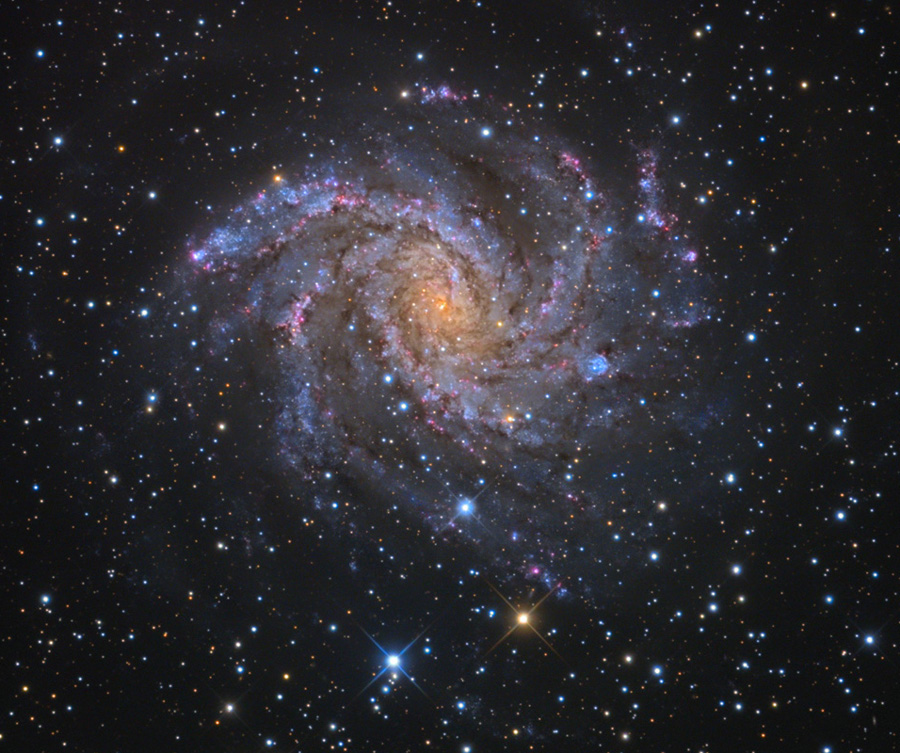
A supernova is a stupendous explosion occurring when a massive star runs out of fuel. They're rare in the Milky Way, with about one a century. However in NGC 6946, known as the Fireworks Galaxy, nine supernovae have been spotted in the last century. William Herschel discovered this exquisite face-on spiral galaxy in 1798. Contradictory as it may seem, the high supernova rate is evidence of a high rate of new star formation. It's young massive stars that end as supernovae, and the shock wave from such an explosion is often the trigger for new star formation.

Printer Friendly Version