Composite photo of Venus taken by the Japanese Akatsuki probe, the Venus Climate Orbiter.
Venus is usually the brightest heavenly body we see, except for the Moon.
The planet can be amazingly bright. It's easily mistaken for an aircraft coming towards you, and it often leads to UFO reports. Venus is covered in clouds that strongly reflect sunlight. We usually see it in the evening or dawn twilight, when it is called the morning or evening “star”, even though it is not really a star at all.
Venus was the Roman goddess of love and beauty, but the planet has also represented war.
We know that Venus represented the goddess of love for the ancient Greeks and Romans. However, not every civilization saw it that way. The Mayans of Central America associated Venus with war. And the Babylonians linked the planet with Ishtar, a goddess of both love and war. (Babylonia was an ancient civilization in the Middle East.)
Like the Moon, Venus has phases.
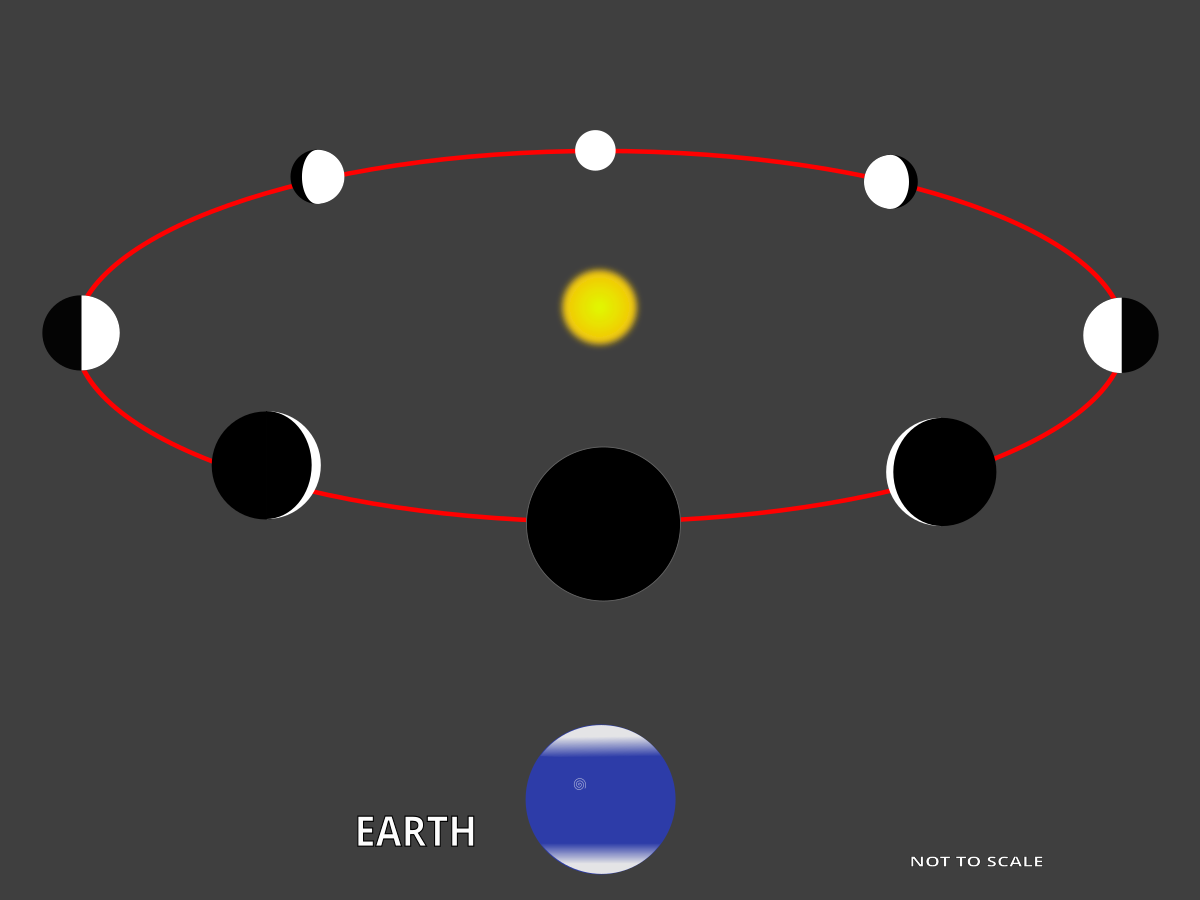
Venus shines by reflected sunlight, and it seems to change shape and size as it orbits the Sun. But you can only see the changes through a telescope or good binoculars. This diagram shows how the shape seems to change as Venus goes around the Sun. Unlike a crescent Moon, a crescent Venus is very bright because the planet is near to us. A full Venus is a long way off, and it isn't as bright. We can't see Venus when it's between us and the Sun.
Venus and Mercury are the only planets that don't have a moon.
Venus is sometimes called “Earth's twin”.
Venus and the Earth are rocky planets in the inner Solar System. Venus is only a bit smaller than the Earth. Its diameter is about 12,100 km (7500 mi) and Earth's is 12,740 km (7900 mi).
Yet Venus and Earth are very different.
Venus is smaller and slightly less dense than Earth, so the pull of gravity on Venus is less. Someone weighing 50 kg (110 lb) on Earth should weigh just 44 kg (97 lb) on Venus. But you wouldn't feel lighter on Venus. It has such a thick atmosphere that the air pressure is over 90 times more than on Earth. You would be squashed.
Venus has an atmosphere that's almost all carbon dioxide.
There's also some nitrogen, and a tiny bit of sulfur dioxide that makes the sky look yellow. Earth's atmosphere is mostly nitrogen, but 20% of it is the oxygen we can breathe.
Venus is the hottest planet in the Solar system, even though Mercury is closer to the Sun.
Clouds are like a blanket for keeping a planet warm. Its thick clouds keep the surface of Venus at around 460°C (860°F). That's hotter than a pizza oven – in fact, it's hot enough to melt some metals.
Venus rotates backwards.
All Solar System planets go around the Sun in the same direction, from east to west. Six of the planets also spin on their axes in that direction. But Venus spins in the opposite direction. If you could see the Sun through Venus's thick clouds, you would see the Sun rise in the west and set in the east. That's opposite to what we see on Earth.
On Venus a year is about two days long.
It takes Venus 225 Earth days to go around the Sun, but it rotates very slowly. Earth rotates once every 24 hours, but Venus takes 243 Earth days. Since the planet rotates backwards, a Venusian year isn't longer than its day. The time from one sunrise to the next one is 117 Earth days.
Most of the features on Venus have been named after women.
The mountains and craters and other features are named for goddesses and mythological figures, writers and scientists and other prominent women.

Printer Friendly Version