The Moon is our nearest neighbor in space, but there are a lot of myths and misconceptions about it. Here are ten of them.
1. Didn't people used to think the Moon was made of green cheese — how silly, it's not even green.
In the 16th century green cheese was cheese that hadn't matured. It was rather moonlike, being circular, mottled and a creamy color. It's not likely that anyone really thought the Moon was cheesy, and it was a way of suggesting that someone was gullible. Today instead of expressing doubt with “Yeah, right,” you could say “Uh huh, and the Moon is made of green cheese.”
2. The “dark side of the Moon” never gets any sunlight.
The “dark side” of the Moon is the side that is never seen from Earth, dark meaning unknown. More usefully, it's called the “far side“. As the Moon orbits, all parts of it get sunlight, but we always see the same side. Probes have studied it, but the only humans who've seen the far side with their own eyes are Apollo astronauts.
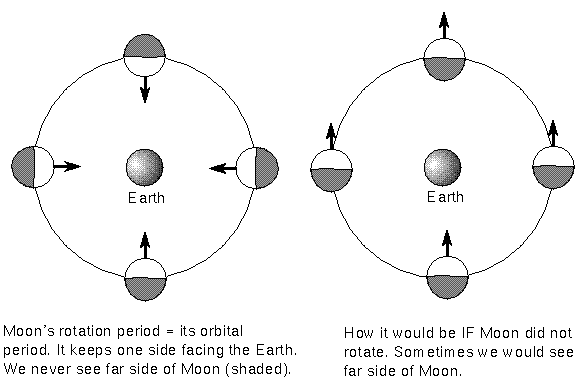
3. The same side of the Moon always faces us because the Moon doesn't turn on its axis.
It's just the opposite. The only way the same side can always face us is that the Moon rotates once in the time it takes to orbit Earth once. This simple diagram shows how the Moon's rotation keeps the same side turned our way.
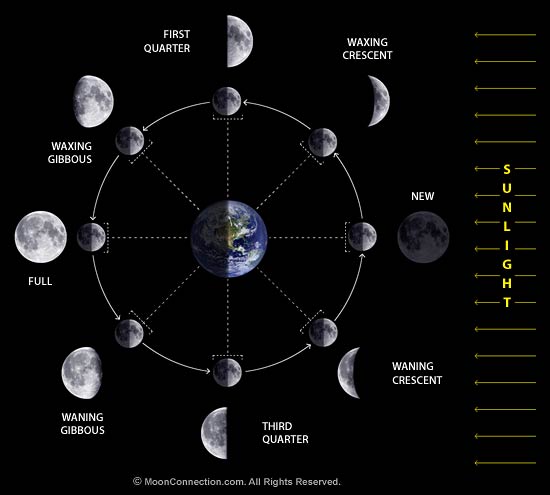
4. The phases of the Moon are caused by the Earth's shadow.
The Moon isn't in our shadow except during a lunar eclipse. It seems to change shape because as it orbits, the angle between us and the Moon and the Sun changes to give different views of the illuminated half of the Moon, as shown in this moon phase diagram.
5. Since the Moon is rarely blue, “once in a Blue Moon” refers to a rare event.
The English idiom does mean a rare occurrence. But a much earlier meaning was an event that never happens, or is obvious nonsense — rather like the green cheese. A modern meaning of a blue moon is the second of two full moons in a month, which happens every two or three years. This interpretation came from a misreading of a traditional almanac in which a blue moon was the third full moon in a season that had four of them. No one knows why such a moon would be “blue”. Atmospheric dust can make the Moon look blue, though the saying probably isn't about a Moon that's literally blue.
6. There is no gravity on the Moon.
If there were no gravity, there would be no Moon. Gravity is what holds heavenly bodies together. But gravity on the Moon is about one-sixth that on Earth. This meant that Apollo astronauts — even with heavy space suits — could jump and skip, but they didn't float.
7. There is more lunacy when the Moon is full.
The so-called lunar effect is well-known and medical staff and police attest to it. Nonetheless it doesn't seem to exist. An analysis of studies looking at a variety of behaviors — including crimes, psychiatric problems and suicides — didn't find anything related to the moon phase. Psychologists say that when we “know” something is true, we match what we see to what we expect. So people particularly notice certain events when the Moon is full without remarking on them at other times.
8. The Moon affects us because we are mostly water and the Moon's gravity causes tides.
Gravity itself doesn't cause tides. However the force of the Moon's gravity on the near side of Earth is greater than on the far side. It's the difference between these forces that causes ocean tides, so it works on a large scale. The difference between the Moon's force on your head and that on your feet is effectively zero. Not so, if you were diving into a black hole. The force on your head would be much bigger than that on your feet and you'd be stretched out like spaghetti.
9. When there is a supermoon the increased gravitational pull of the Moon triggers earthquakes, volcanic activity, extreme tides and severe weather.
The term “supermoon” was invented by someone with more imagination than understanding. The Moon's orbit isn't circular and a so-called supermoon is just a full moon at perigee, i.e., at its closest to Earth. One of these occurred on March 19, 2011. For the week around that date the number of earthquakes at or above 5 on the Richter scale was about average. There were no volcanic eruptions, unusual tides or severe weather events.
10. Apollo 11 didn't go to the Moon — it was all faked on a movie set.
There are claims that it was a hoax, but a notable lack of evidence. Dr. Phil Plait and others have looked extensively at these claims. I will just note that this was at the height of the Cold War. I could more easily believe that the Moon is made of green cheese than imagine getting a fake Moon landing past the Russians.
References:
(1) Deborah Byrd, “When Is the Next Full Moon?” http://earthsky.org/astronomy-essentials/when-is-the-next-blue-moon
(2) Scott O. Lilienfeld & Hal Arkowitz, “Lunacy and the Full Moon”, Scientific American http://www.scientificamerican.com/article.cfm?id=lunacy-and-the-full-moon
(3) Phil Plait, “Yes, We Really Did Go to the Moon!&rdquo http://www.badastronomy.com/bad/misc/apollohoax.html
(4) “Earthquake Facts and Statistics,” United States Geological Survey, http://earthquake.usgs.gov/earthquakes/eqarchives/year/eqstats.php and “Latest Earthquakes in the World 0 Past 7 days,“ http://earthquake.usgs.gov/earthquakes/recenteqsww/ (accessed 2011-03-23 00.18 UTC)

Printer Friendly Version