

Preparing Suri Fiber to Spin
Suri alpacas and llamas are a pleasure to watch in the field as well as in the show arena. Their long elegant locks flow with every little movement and add an element of luxury that inspires potential hobby farmers to want to add them to their pastures as soon as possible. However, as spinners, we often see those long pencil locks and cannot do anything but shudder. Without careful planning, a suri fleece can be ruined before you ever get to the spinning wheel.
Begin, outside if possible, by opening the fleece and spreading it out on a skirting table or a large holed screen. The fiber is extremely slippery and does not hold its form like a huacaya or sheep fleece. Carefully remove any second cuts and as much vegetative debris as you can. The fleece also tends to be very dusty. After this initial skirting, I like to place the fleece, either in part or whole depending upon its size, onto an old bed sheet that has been anchored at two corners. The next step is to give it a good shake to remove as much dust as you can. This will save time and wash water later.
Next, return the fleece to the skirting table to be prepared for washing. Suri fiber is so long and fine that I always bag it to wash it. Using small zippered laundry bags, carefully pick up the fibers keeping them aligned. Place them into the laundry bags and lay the bags flat. Fill two tubs with hot water. It does not have to be quite as hot as for grease wool, as there is no lanolin. Put shampoo in one tub and use the other tub for rinsing. I prefer to use baby shampoo because it is mild and won’t leave a residue. Do not agitate the fiber as you are washing it.
Once the fiber is rinsed, I keep it in the bags and place it out on a rack to dry in the sun. It may need to be turned over a time or two if it does not get good air movement.
After the fiber is washed and dried, use a lap board to open the locks for spinning. Hold the lock first by the tips to open the shorn ends, then by the shorn end to open the tips. This sequence will keep the fibers uniformly aligned for spinning and keep shorter fibers from escaping.
Suri fiber spins very nicely into a semi-worsted yarn. There is no need to draw it through a diz to keep the fibers aligned.
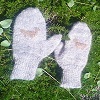
Suri llama mittens
Begin, outside if possible, by opening the fleece and spreading it out on a skirting table or a large holed screen. The fiber is extremely slippery and does not hold its form like a huacaya or sheep fleece. Carefully remove any second cuts and as much vegetative debris as you can. The fleece also tends to be very dusty. After this initial skirting, I like to place the fleece, either in part or whole depending upon its size, onto an old bed sheet that has been anchored at two corners. The next step is to give it a good shake to remove as much dust as you can. This will save time and wash water later.
Next, return the fleece to the skirting table to be prepared for washing. Suri fiber is so long and fine that I always bag it to wash it. Using small zippered laundry bags, carefully pick up the fibers keeping them aligned. Place them into the laundry bags and lay the bags flat. Fill two tubs with hot water. It does not have to be quite as hot as for grease wool, as there is no lanolin. Put shampoo in one tub and use the other tub for rinsing. I prefer to use baby shampoo because it is mild and won’t leave a residue. Do not agitate the fiber as you are washing it.
Once the fiber is rinsed, I keep it in the bags and place it out on a rack to dry in the sun. It may need to be turned over a time or two if it does not get good air movement.
After the fiber is washed and dried, use a lap board to open the locks for spinning. Hold the lock first by the tips to open the shorn ends, then by the shorn end to open the tips. This sequence will keep the fibers uniformly aligned for spinning and keep shorter fibers from escaping.
Suri fiber spins very nicely into a semi-worsted yarn. There is no need to draw it through a diz to keep the fibers aligned.
Suri llama mittens
This site needs an editor - click to learn more!

Related Articles
Editor's Picks Articles
Top Ten Articles
Previous Features
Site Map
Content copyright © 2023 by Laun Dunn. All rights reserved.
This content was written by Laun Dunn. If you wish to use this content in any manner, you need written permission. Contact
BellaOnline Administration
for details.
