

Sempervivums
 Sempervivums – if you know Latin, you know it means always living. These succulents don’t live forever, but they are frost hardy and survive in cold weather that would mean death to other succulents. They are referred to as Alpine succulents because they grow at altitudes between 3,00 and 8,00 feet, not only in the Alps, but also in mountains in central and southern Europe and some Mediterranean islands.
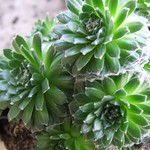
The rosette shape of Sempervivums can be from a half inch across to six inches in diameter. The leaves can be glossy or matte. Some even have hairlike structures. Sempervivum arachnoideum is called the cobweb plant because it looks like it has spiderwebs covering it. Sempervivums are also known as Hen and chicks plant and Houseleeks. The Hen and chicks name comes from the fact that Sempervivums produce offsets around the main plant. The original plant is the hen and the offsets are the chicks.
Sempervivums are monocarpic, which means they flower only once – then they die. Fortunately, it takes several years for a Sempervivum to flower. During that time it will produce many offsets which can be separated from the main plant and replanted separately.
If you want to try growing Sempervivums from seed, you can collect the star-shaped flower and separate out the seeds after it dries. Chilling the seeds before planting will improve germination. The seeds will not necessarily produce plants identical to the mother plant. Seeds are also available on the internet. Sempervivums have thousands of cultivars.
Being mountain growers, Sempervivums favor rocky fast-draining soil. They require little water and little or no fertilizer. They can be tucked into cervices in rock walls and grow quite nicely. Because of their ability to tolerate cold, they make ideal succulents to grow outdoors in the ground. You can even grow them indoors in containers. . In some parts of Europe they are grown as living roofs. Long ago superstitious people though the Sempervivums on their roof would protect them from lightning.
The many colors of Sempervivums lend themselves to being planted in patterns. They can be brown, orange, pink, red, or yellow in addition to the more common green. However, when grown out of the sun, many of the colored varieties will revert to green.
This site needs an editor - click to learn more!

Related Articles
Editor's Picks Articles
Top Ten Articles
Previous Features
Site Map
Content copyright © 2023 by Linda Genis. All rights reserved.
This content was written by Linda Genis. If you wish to use this content in any manner, you need written permission. Contact
BellaOnline Administration
for details.
