

Lazy Kates

Lazy Kates are spinning essentials. They are devices that hold your filled bobbins so that the individual thicknesses of yarn can be twisted together to form a multiple ply yarn.
When you begin to spin, you don’t often have a “sky’s the limit” budget to work with. Often times we are hesitant to buy spinning accessories because we are unsure about their use, or their necessity. Like many other spinners I have met, I started spinning on a shoestring, okay maybe a shipping twine, budget. I bought a broken wheel, had to figure out how to fix it. Then, before I bought anything else, I started drooling over all of the spinning fibers out there, and wanted to put what remaining budget I had into getting as much fiber as I could. I had not a clue as to what I was going to make out of the fiber, but that was beside the point.
So, as a new spinner who had never met another spinner, I did not realize how necessary a Lazy Kate is to a spinner. That changed very quickly once I figured out how to spin, and began filling bobbins with something almost uniform enough to call yarn. From my knitting experience, I knew that there was not much single ply knitting yarn on the market. I also knew that single ply yarn would not wear very well. So once again, I hit the books to figure out how to store my unfinished yarn, and keep it organized so I could ply it when I was ready to. My first system was to wind the singles into balls that I could fit into canning jars, but anyone who has ever tried to tame a freshly spun single can attest to the fact that it certainly has a mind of its own, and often refuses to cooperate.
So, there I was with all of this beautiful fiber I wanted to create knitting yarn from, and a few birds nests that were born in the bottoms of my canning jars. I began looking for a Lazy Kate. I found the gracefully arched styles from Schacht and Kromski, as well as the utilitarian designs from Ashford and Majacraft. These are all beautiful pieces, but I was still very much on a budget. As I was pouring over the catalogs once again trying to decide what features are necessary and which I can do without, my husband Mike came to my rescue as usual with his own original design. My kate holds three bobbins on their sides vertically, and then has pegs for two more to be stored on the base. It also has holes in the top to store my threading hook, and my oil.
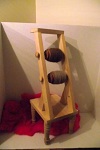
I did not have a tensioning system included on my kate. There are some designs that do include tension straps or springs, which I have yet to find necessary when plying. The weight of the bobbins and the natural drag on the dowel pegs seems to be enough to prevent the yarn from winding off too quickly. If you still have difficulty with overfeeding, try repositioning the kate further from the wheel. This will allow the twist in the yarn to even itself over a longer distance, as well as prevent bird nests.
When you begin to spin, you don’t often have a “sky’s the limit” budget to work with. Often times we are hesitant to buy spinning accessories because we are unsure about their use, or their necessity. Like many other spinners I have met, I started spinning on a shoestring, okay maybe a shipping twine, budget. I bought a broken wheel, had to figure out how to fix it. Then, before I bought anything else, I started drooling over all of the spinning fibers out there, and wanted to put what remaining budget I had into getting as much fiber as I could. I had not a clue as to what I was going to make out of the fiber, but that was beside the point.
So, as a new spinner who had never met another spinner, I did not realize how necessary a Lazy Kate is to a spinner. That changed very quickly once I figured out how to spin, and began filling bobbins with something almost uniform enough to call yarn. From my knitting experience, I knew that there was not much single ply knitting yarn on the market. I also knew that single ply yarn would not wear very well. So once again, I hit the books to figure out how to store my unfinished yarn, and keep it organized so I could ply it when I was ready to. My first system was to wind the singles into balls that I could fit into canning jars, but anyone who has ever tried to tame a freshly spun single can attest to the fact that it certainly has a mind of its own, and often refuses to cooperate.
So, there I was with all of this beautiful fiber I wanted to create knitting yarn from, and a few birds nests that were born in the bottoms of my canning jars. I began looking for a Lazy Kate. I found the gracefully arched styles from Schacht and Kromski, as well as the utilitarian designs from Ashford and Majacraft. These are all beautiful pieces, but I was still very much on a budget. As I was pouring over the catalogs once again trying to decide what features are necessary and which I can do without, my husband Mike came to my rescue as usual with his own original design. My kate holds three bobbins on their sides vertically, and then has pegs for two more to be stored on the base. It also has holes in the top to store my threading hook, and my oil.
I did not have a tensioning system included on my kate. There are some designs that do include tension straps or springs, which I have yet to find necessary when plying. The weight of the bobbins and the natural drag on the dowel pegs seems to be enough to prevent the yarn from winding off too quickly. If you still have difficulty with overfeeding, try repositioning the kate further from the wheel. This will allow the twist in the yarn to even itself over a longer distance, as well as prevent bird nests.
This site needs an editor - click to learn more!

Related Articles
Editor's Picks Articles
Top Ten Articles
Previous Features
Site Map
Content copyright © 2023 by Laun Dunn. All rights reserved.
This content was written by Laun Dunn. If you wish to use this content in any manner, you need written permission. Contact
BellaOnline Administration
for details.
