logo
g Text Version
Auto
Beauty & Self
Books & Music
Career
Computers
Education
Family
Food & Wine
Health & Fitness
Hobbies & Crafts
Home & Garden
Money
News & Politics
Relationships
Religion & Spirituality
Society & Culture
Sports
Travel & Leisure
TV & Movies

dailyclick
Bored? Games!
Postcards
Astrology
Take a Quiz
Rate My Photo

new
Journals
Folklore and Mythology
Business Coach
Marriage
Senior Living
Ethnic Beauty
Adolescence


dailyclick
All times in EST

Full Schedule
g
g Quilting Site
Judie Bellingham
BellaOnline's Quilting Editor

g

Weighted Blankets - Full Instructions

Weighted Blankets – Full Instructions


The Weighted Blanket top is quite different to a traditional quilt. It is important to remember that these blankets are going to be used as a tool. These weighted blankets are an important tool in the management of autistic people. It’s not that they need to be ugly, but there are a few criteria that need to be checked off.

Firstly, the top and backing fabric need to be extremely serviceable. These blankets are likely to receive lots and lots of laundering, as they will get used often. In fact, we’ve been told that these become the favorite possession of those who use them.

Secondly, it’s not necessary to spend a great deal of time cutting and piecing the blanket top. It is far more important to get these blankets made as soon as possible and be donated to those who need them the most.

The best success we’ve had is using fabrics with big prints, and lots of color. To that end you can source fabrics such as those that are used domestically as curtains, tablecloths etc. Dressmaking remnants, including polycottons will work well also. Make it as bright and happy as possible, but remember that the quilt top is not the big focus of this item.

When making the quilt top you can make it in anyway you like. You may have some orphan blocks that you want to use up, maybe join with some sashing. You do need to end up with a 40 inch square top. Because the blanket will be turned inside out a few times, you will need to make sure the outer edge is pretty stable by ensuring the outer border is on the straight of grain.

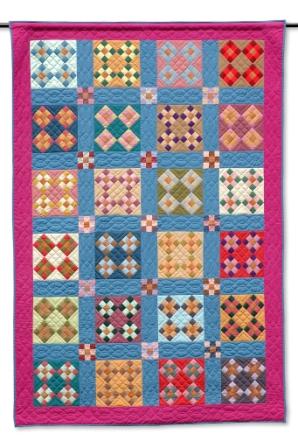
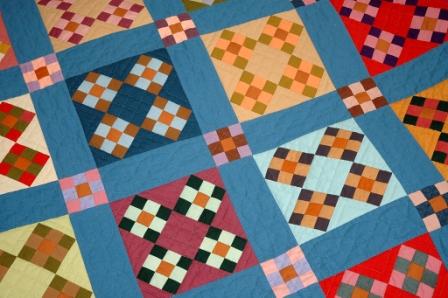
The four quilts above are pattern variations that I have used to make the weighted blanket tops. Simple squares, in simple patterns work best.

Fabric Requirements


  • Quilt top: roughly 1 ¼ yards of fabric to make the blanket top.

  • Quilt Backing: 40” x 40” of fabric

  • Quilt Pockets: 2 3/8 yards of fabric


  • Cutting Instructions


  • Quilt Backing:40” x 40” square
    Pockets:
  • Top and Bottom pockets : Two (2) strips measuring 8 ½” x 40”
  • Middle pockets : Five (5) strips measuring 13” x 40”


    Sewing Instructions:


    Step 1:
    Piece a 40 inch top. Any colors and any design. (I include some design ideas using sixteen 10 ½” blocks, which, when sewn together make a 40” top). See the variation patterns at the top of this article.


    Step 2: The five wider strips that measure 13” need a narrow hem on BOTH long sides. Wrong side facing up, turn over ¼” and zigzag or straight stitch as desired. Turn over the edge by 1/4” and stitch again. Do this on both long edges of all five 13” x 40” pieces. The two narrower strips that measure 8” need only ONE long edge hemmed. Repeat for both strips.


    Step 3: Place backing piece 40” x 40” on table wrong side facing up. Lay one of the narrower strips on top with its right side facing up (wrong sides will be facing each other). Line up the raw edge of the backing with the unfinished long side of the strip and align the short sides with the side edges of the backing. Baste or pin the raw edges together along the 40” edge.


    Step 4: Measure 2 ½” down from the top raw edge. Pin a 13” strip along this line. This strip will overlap the previous strip by 5 ½”. Pin through 3 pieces of fabric to hold it all in place. Measure 6 ½” down from the top edge of this second strip and mark the line across the 40”. Straight stitch on this line right across the blanket. Check that the previous strip to make sure you didn’t catch it in that line of sewing. Keep a few pins in the side of the blanket to stop the layers from flopping down. If your edges are a bit out of alignment on the sides, don’t worry, remember this isn’t a quilt. Just align them on one side and we’ll trim the other when finished.


    Step 5: Pin the next 13” strip in place 6 inches down from the top edge of the previous strip, concealing the stitching on the previous strip. Pin through three layers. Measure 6 ½ inches from the top edge of that strip and mark the line. Stitch through the layers right across the blanket, making sure not to catch the previous strip’s edge.


    Step 6: Hopefully you’ve got the idea. Repeat this process for the remaining 13 inch strips.


    Step 7: Pin the remaining strip on the bottom in place, concealing the stitching from the previous strip. Align the raw edge of the last (narrow 8 inch) strip with the raw edge of the backing.


    Step 8: If the sides of the strips are out of alignment, trim them up so the layers all line up. Don’t worry if this isn’t square, it isn’t a quilt and some child is going to love it to death, so it’s going to get some punishment!

    Step 9: Now you are ready to make the vertical stitching to form the pockets. Work out where the middle is and mark it on the pocket side. Stitch from last (bottom) strip to the top to stop it bunching as you stitch.


    Step 10: Now make two more lines equal distance apart of stitching each side of that middle line. Stitch form bottom to top. Now you have a backing with 36 pockets.


    Step 11: Place the pockets facing down on the table (backing facing up). Place you lovely 40 inch quilt top right side down on top (facing the backing). Find where the sides of the pockets are and work out a 15 inch opening along one of those sides. The wrist angle of this will hopefully stop little hand from getting the weights out.


    Step 12:.
    Stitch all around the edge, leaving that 15 inch opening.


    Step 13: Turn through to right side so now we can see your lovely quilt top. The opening now needs to be finished. This is going to be turned through a few times so it does need to be strong (kids might grab this edge also). You could use leftover binding or else cut strips of straight grain fabric for the facing. Please yourself. Topstitch around the outside of the blanket, leaving open free. Label your work if you wish or be anon if desired.


    Congratulations, you’re done!!

  • RSS | Related Articles | Previous Features | Site Map

    Add Weighted+Blankets+%2D+Full+Instructions to Twitter Add Weighted+Blankets+%2D+Full+Instructions to Facebook Add Weighted+Blankets+%2D+Full+Instructions to MySpace Add Weighted+Blankets+%2D+Full+Instructions to Del.icio.us Digg Weighted+Blankets+%2D+Full+Instructions Add Weighted+Blankets+%2D+Full+Instructions to Yahoo My Web Add Weighted+Blankets+%2D+Full+Instructions to Google Bookmarks Add Weighted+Blankets+%2D+Full+Instructions to Stumbleupon Add Weighted+Blankets+%2D+Full+Instructions to Reddit


    Content copyright © 2009 by Judie Bellingham. All rights reserved.
    This content was written by Judie Bellingham. If you wish to use this content in any manner, you need written permission. Contact Judie Bellingham for details.

    g


    For FREE email updates, subscribe to the Quilting Newsletter


    Past Issues


    print
    Printer Friendly
    bookmark
    Bookmark
    tell friend
    Tell a Friend
    forum
    Forum
    email
    Email Editor

    g features
    A Quilters Wish - Christmas Poem

    May I Introduce...... Jo Northcott

    Weighted Blankets

    Archives | Site Map

    forum
    Forum
    email
    Contact

    Past Issues
    memberscenter

    jobs
    what
    job title, keywords
    where
    city, state or zip
    jobs by job search


    vote
    Growing a Garden
    Veggies and Flowers
    Veggies Only
    Flowers Only
    No Garden

    g


    | About BellaOnline | Privacy Policy | Advertising | Become an Editor |
    Website copyright © 2009 Minerva WebWorks LLC. All rights reserved.


    BellaOnline Editor