logo
g Text Version
Auto
Beauty & Self
Books & Music
Career
Computers
Education
Family
Food & Wine
Health & Fitness
Hobbies & Crafts
Home & Garden
Money
News & Politics
Relationships
Religion & Spirituality
Society & Culture
Sports
Travel & Leisure
TV & Movies

dailyclick
Bored? Games!
Postcards
Astrology
Take a Quiz
Rate My Photo

new
Spirituality
Home Improvement
Vegetarian
NASCAR
Southcentral USA


dailyclick
All times in EST

Autism Spectrum Disorders: 4:00 PM

Full Schedule
g
g Chocolate Site
Deborah Markus
BellaOnline's Chocolate Editor

g

What is a Truffle?

My husband forwarded me an article he saw on Forbes Traveler.com about the world's most expensive desserts. Most of them were pricey because of what came along with them -- the Golden Opulence Sundae, for instance, which will set you back $1,000, is served on expensive crystal, eaten with an 18k gold spoon, and encrusted in edible gold leaf; while the Fortress Aquamarine ($14,500) comes with an 80-carat aquamarine that the diner may keep.

These desserts, and many others mentioned, are primarily amusing gimmicks. (No one has yet purchased an aquamarine, which makes one wonder exactly how many of these lovelies the chef keeps on hand at any given time. What if there's a sudden rush?)

But my husband was puzzled by one -- a $250 chocolate truffle. "No gold, no diamonds," he said. "Why would a single piece of candy cost so much?"

I turned my most glittering Ancient Mariner's eye on the entry. La Madeline au Truffe, created by Fritz Knipschildt (whose shop, Knipschildt Chocolatier, is in Norwalk, Connecticut), has a ganache (rich chocolate center) made of Valrhona dark chocolate. High-quality stuff, that, but no reason for one truffle to launch into the triple digits.

This ganache also contains heavy cream. Well, so do my handmade homemade truffles, and although my friends have often sworn that I could make my fortune selling them, I don't think even they believe I could ask a couple of hundred bucks apiece for the little darlings. Or even one hundred dollars.

What else was in it? Vanilla, truffle oil, a Perigord truffle...

I stopped short. An actual truffle inside a truffle?

Truffles are fungi, delicacies in the same way (and in the same family) that some mushrooms are. Perigord truffles, also known as black truffles, are far less expensive than their white cousins, but can still cost hundreds of dollars a pound.

Well, that explained the expense, anyway. What it didn't explain was what exactly a glorified mushroom was doing wrapped up in chocolate ganache.

Chocolate truffles have exactly nothing to do with the fungi for which they were named. They don't have the relationship that modern-day mincemeat pies have with their predecessors, which really did used to contain meat. It's not as if there was once a custom of foraging in the woods with well-trained pigs and dogs for the strange-looking yet edible growths, then taking them home and dumping them in a vat of chocolate. Making a truffle-flavored truffle seems like little more than a very expensive (and not particularly appealing) prank. What's next? Is Cadbury going to produce egg-flavored chocolate Easter Eggs one spring?

And yet it does bring up the question of why a sweet chocolate treat was named after a savory fungi that is, after all, kissing cousin to mold.

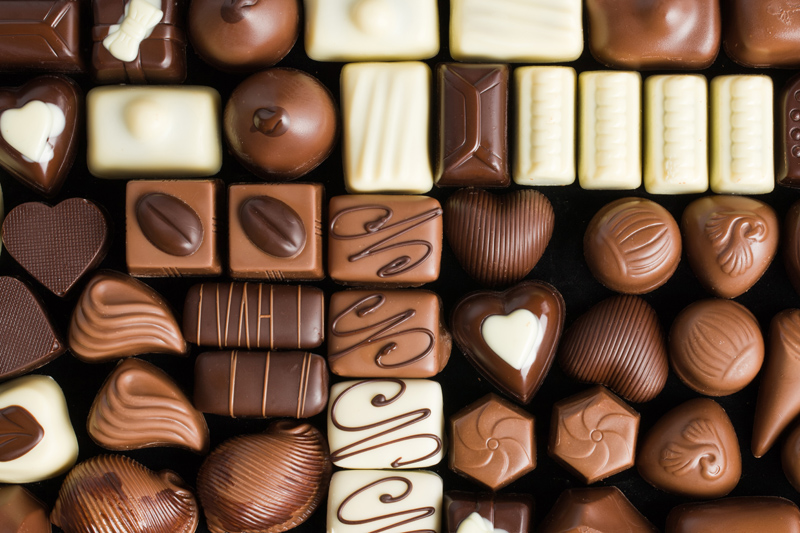
The most common answer is that chocolate truffles look like "real" truffles. This might just barely be true of some. Rose City's Belgian chocolate truffles, which are quirkily shaped and rolled in rough cocoa powder, seem to take pride in resembling their semantic ancestors. But what of the many truffles in America and elsewhere that are shaped like proud domes and wear a hard, sleek chocolate coat?

I did some hunting around. Fortunately, my local library gives its patrons access to the online edition of the Oxford English Dictionary, one of the greatest resources in the world for word lovers. The OED gives not only the definition of every word, but that word's history and the earliest known instances of its appearing in print.

The listing for "truffle" was perfectly adequate, but, for me, initially disappointing. It focused on the fungi at first, of course; then mentioned the chocolate candy in a matter-of-fact fashion.

Last of all, however, it mentioned the verb form of the word: to truffle. This can be applied to a literal hunt for truffles of the fungal variety. It can, however, also be used to mean any intense, absorbed search for desired goods or results.

Now, that makes sense in the context of chocolate. True truffles -- the really good ones made simply of chocolate, cream, and perhaps butter -- are costly, precious dainties that must be eaten within a few days of their creation if they are to be worth the eating at all. They will not mold so soon as that; they will simply dim, as I learned to my deep sadness when I made a lovely batch and tried to save some for later. And those who might purchase the expensive Knipschildt truffle-truffle are cautioned that they have a seven-day shelf life.

A truffle, then, is not simply a rough-hewn fungi or lump of chocolate. It is something worth truffling for.

Forbes Traveler.com
RSS
Related Articles
Previous Features
Site Map


Content copyright © 2008 by Deborah Markus. All rights reserved.
This content was written by Deborah Markus. If you wish to use this content in any manner, you need written permission. Contact Deborah Markus for details.

Digg! g delicious Save to Del.icio.us

g


For FREE email updates, subscribe to the Chocolate Newsletter


Past Issues


print
Printer Friendly
bookmark
Bookmark
tell friend
Tell a Friend
forum
Forum
email
Email Editor

g features
Pumpkin Chocolate Chip Bread Recipe

Chocolate-Chip Spice Muffins

Chocolate and Chronic Fatigue Syndrome

Archives | Site Map

forum
Forum
email
Contact

Past Issues
memberscenter


vote
Driving Amount
Much more
Slightly more
Slightly less
Much less

g


| About BellaOnline | Privacy Policy | Advertising | Become an Editor |
Website copyright © 2008 Minerva WebWorks LLC. All rights reserved.


BellaOnline Editor