

Some Spectacular Tree-Like Cacti and Succulents
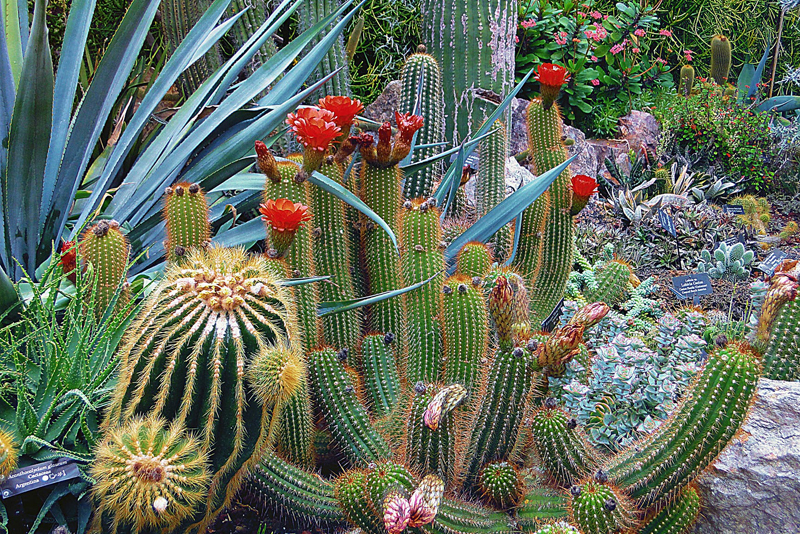
The world of cacti and succulents is full of curious plants, including ones with tree-like forms. Here are a few of these fascinating species.
Joshua tree
The picturesque Joshua tree is actually a large yucca. It is native to parts of the American Southwest where it grows in the high desert. Joshua tree has a tree-like trunk with branches that can be over four feet in diameter. Though it is a member of the Lily family, this species can be over 70 feet in height.
The branches produce short, stiff, lance-shaped leaves in rosettes. This plant blooms during the early spring, producing bell-shaped blooms that are whitish-green. Like other yuccas, these open in crowded clusters at the top of the long stalks.
Saguaro
This is by no means a tree though it has a tree-like appearance due to its tree-like columnar body with forking branches like those seen in woody plants.
The Latin name (gigantea) lets you know this is going to be a huge plant.
Native to parts of the American Southwest and Mexico, this slow growing plant can reach 65 feet in height. The ribbed columns grow to nearly two feet in diameter.
The spines may be different colors on different plants. The large white flowers open the day time during the spring. This species bears edible fruits.
Tree opuntia
Despite its common name, this plant isn’t in the same genus or group as the real Opuntias. Tree opuntia is a curious plant that is originally native to parts of Haiti.
With a sturdy, straight, trunk just like a tree, this grows to about ten feet in height. As with most trees, there is a crown of leaf-like joints. In fact, this tree has no leaves. But, the flat joints or slender pads forming the branches do give the plant at tree-like appearance. These pads have curved edges and tips that taper to a point.
Though the tree opuntia doesn’t have very many spines, there are knob-like structures on the pads that remotely resemble the clusters of spines seen on true opuntias.
Joshua tree
The picturesque Joshua tree is actually a large yucca. It is native to parts of the American Southwest where it grows in the high desert. Joshua tree has a tree-like trunk with branches that can be over four feet in diameter. Though it is a member of the Lily family, this species can be over 70 feet in height.
The branches produce short, stiff, lance-shaped leaves in rosettes. This plant blooms during the early spring, producing bell-shaped blooms that are whitish-green. Like other yuccas, these open in crowded clusters at the top of the long stalks.
Saguaro
This is by no means a tree though it has a tree-like appearance due to its tree-like columnar body with forking branches like those seen in woody plants.
The Latin name (gigantea) lets you know this is going to be a huge plant.
Native to parts of the American Southwest and Mexico, this slow growing plant can reach 65 feet in height. The ribbed columns grow to nearly two feet in diameter.
The spines may be different colors on different plants. The large white flowers open the day time during the spring. This species bears edible fruits.
Tree opuntia
Despite its common name, this plant isn’t in the same genus or group as the real Opuntias. Tree opuntia is a curious plant that is originally native to parts of Haiti.
With a sturdy, straight, trunk just like a tree, this grows to about ten feet in height. As with most trees, there is a crown of leaf-like joints. In fact, this tree has no leaves. But, the flat joints or slender pads forming the branches do give the plant at tree-like appearance. These pads have curved edges and tips that taper to a point.
Though the tree opuntia doesn’t have very many spines, there are knob-like structures on the pads that remotely resemble the clusters of spines seen on true opuntias.
This site needs an editor - click to learn more!

Related Articles
Editor's Picks Articles
Top Ten Articles
Previous Features
Site Map
Content copyright © 2023 by Connie Krochmal . All rights reserved.
This content was written by Connie Krochmal . If you wish to use this content in any manner, you need written permission. Contact
BellaOnline Administration
for details.
