

A Wildlife Garden of Cacti and Succulents
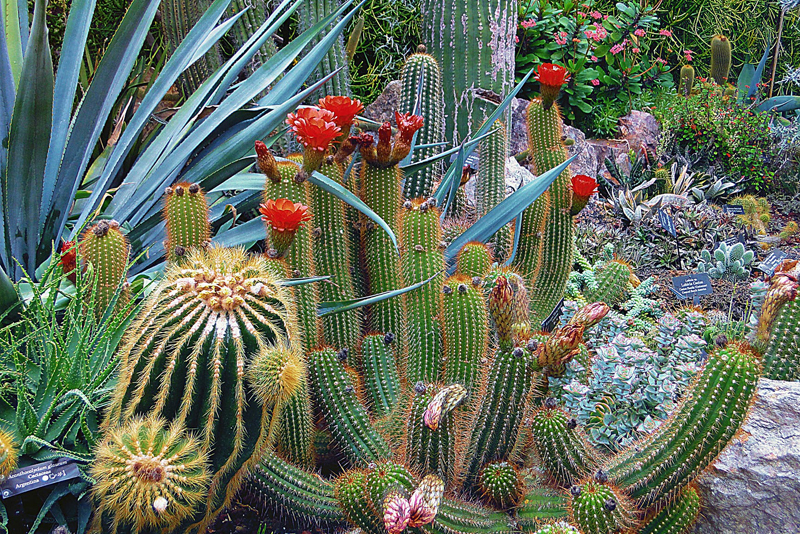
If you’re a cacti and succulent lover and want to attract butterflies, birds and other wildlife to your garden, you can have your cake and eat it too. A number of these plants are wildlife friendly. In fact, some of our most commonly grown cacti and succulents fit the bill.
Let’s start with the common moss rose or portulaca. I used to feel I needed to trim these back and deadhead the flowers. Then, I happened to read in one a bird book that some kinds of birds actually feed on these seeds. The flowers also provide nectar for butterflies and hummingbirds as well.
The ordinary sedums or stonecrops that we grow in our gardens are wonderful nectar sources for butterflies and hummingbirds. Depending on the species, these may bloom from late spring into the fall. In addition to the cultivated species, there are a number of native ones that serve as nectar sources. The native sedums would be especially suited to mixed borders and naturalistic gardens.
Both the agaves and yuccas are nectar sources. These are visited by hummingbirds. Agaves aren’t hardy in all areas of the U.S. But, there are usually hardy yuccas that are suitable for cold areas.
Prickly pears, which include a wide number of Opuntia species, are much loved by wildlife. Some of these are rather tender species that are suited only to warm areas. However, even in the East there are hardy species, some of which are actually native, such as Opuntia humifusa. When in bloom, the prickly pears are a wonderful nectar source. Later in the season when the fruits ripen, they are enjoyed by a number of bird species as well as other kinds of wildlife. Birds especially like the juicy fruits and the seeds.
There are a number of other cacti and succulents that serve as wildlife plants. Some of these are restricted to warmer regions. The aloes are one example. Their blossoms provide nectar for hummingbirds. The Christmas cactus does so as well.
In parts of the western U.S., the saguaro is a very friendly wildlife plant. During the spring when it produces blossoms, night flying bats flock to sip the nectar and eat the pollen from the flowers. Later when the fruits ripen, these are consumed by bats as they migrate south for the winter. Other species of wildlife also like the fruits as well. In addition, the saguaro is able to provide shelter and nesting sites to birds.
Let’s start with the common moss rose or portulaca. I used to feel I needed to trim these back and deadhead the flowers. Then, I happened to read in one a bird book that some kinds of birds actually feed on these seeds. The flowers also provide nectar for butterflies and hummingbirds as well.
The ordinary sedums or stonecrops that we grow in our gardens are wonderful nectar sources for butterflies and hummingbirds. Depending on the species, these may bloom from late spring into the fall. In addition to the cultivated species, there are a number of native ones that serve as nectar sources. The native sedums would be especially suited to mixed borders and naturalistic gardens.
Both the agaves and yuccas are nectar sources. These are visited by hummingbirds. Agaves aren’t hardy in all areas of the U.S. But, there are usually hardy yuccas that are suitable for cold areas.
Prickly pears, which include a wide number of Opuntia species, are much loved by wildlife. Some of these are rather tender species that are suited only to warm areas. However, even in the East there are hardy species, some of which are actually native, such as Opuntia humifusa. When in bloom, the prickly pears are a wonderful nectar source. Later in the season when the fruits ripen, they are enjoyed by a number of bird species as well as other kinds of wildlife. Birds especially like the juicy fruits and the seeds.
There are a number of other cacti and succulents that serve as wildlife plants. Some of these are restricted to warmer regions. The aloes are one example. Their blossoms provide nectar for hummingbirds. The Christmas cactus does so as well.
In parts of the western U.S., the saguaro is a very friendly wildlife plant. During the spring when it produces blossoms, night flying bats flock to sip the nectar and eat the pollen from the flowers. Later when the fruits ripen, these are consumed by bats as they migrate south for the winter. Other species of wildlife also like the fruits as well. In addition, the saguaro is able to provide shelter and nesting sites to birds.
This site needs an editor - click to learn more!

Related Articles
Editor's Picks Articles
Top Ten Articles
Previous Features
Site Map
Content copyright © 2023 by Connie Krochmal . All rights reserved.
This content was written by Connie Krochmal . If you wish to use this content in any manner, you need written permission. Contact
BellaOnline Administration
for details.
