

Fancy Fur Crocheted Rug
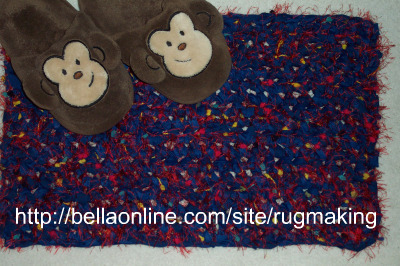
Quick, Easy and Fun to Make! The Fancy Fur yarn makes an ordinary rug special. Pattern and Instructions for crocheting a 15” X 24” or 38 cm X 61 cm rug.
Materials:
*Two yards 100% tightly woven, soft, polyester fabric,
width 45” (114 cm), Length 72” (183 cm), in your choice of color.
*Crochet hook, size Q (15.75 mm),
* 3 Skeins of Lion Brand Fancy Fur yarn or brand of your choice in a complimentary color. (If using a different brand, check care instructions before washing.)
Making the “Yarn”:
Wash and dry fabric.
Cut off selvages and discard.
Lay fabric out on a flat surface.
Fold fabric in half matching up edges of the fabric. The folded fabric should measure about 45” X 36” (114 cm X 91.4 cm).
Using matching thread, sew along the 45” (114 cm) width of the fabric about 3/8” (.5 cm) from the edge of the fabric.
Sew along the 45” (114 cm) width of the fabric a second time about 2/8” (.3 cm) from the edge of the fabric.
Starting at one of the open ends of the fabric, cut 3/4” (1.9 cm) into the fabric. Begin cutting one long fabric strip, working your way up to the other open end. No need to measure, just do your best to keep the strip 3/4” (1.9 cm) wide. Discard any fabric at the end that is not wide enough to make a 3/4” (1.9 cm) wide strip.
Crochet Instructions:
From start to finish, crochet both the fabric strip and the yarn together.
Chain 23 loosely.
Single crochet until you do not have enough fabric to finish a complete row.
Finish off and weave in loose fabric and yarn ends.
Care Instructions:
Shake to clean.
Hand wash, hang to dry.
A rug pad, cut to size, will help keep this rug from slipping.
I purchased fancy fur yarn, fabric and crochet hook at my local craft store. They can also be found online at amazon.com.
Find Fancy Fur Yarn - Rainbow Red at amazon.com

Find a 6" Plastic Crochet Hook Size Q at amazon.com
Enjoy your rug!
Materials:
*Two yards 100% tightly woven, soft, polyester fabric,
width 45” (114 cm), Length 72” (183 cm), in your choice of color.
*Crochet hook, size Q (15.75 mm),
* 3 Skeins of Lion Brand Fancy Fur yarn or brand of your choice in a complimentary color. (If using a different brand, check care instructions before washing.)
Making the “Yarn”:
Wash and dry fabric.
Cut off selvages and discard.
Lay fabric out on a flat surface.
Fold fabric in half matching up edges of the fabric. The folded fabric should measure about 45” X 36” (114 cm X 91.4 cm).
Using matching thread, sew along the 45” (114 cm) width of the fabric about 3/8” (.5 cm) from the edge of the fabric.
Sew along the 45” (114 cm) width of the fabric a second time about 2/8” (.3 cm) from the edge of the fabric.
Starting at one of the open ends of the fabric, cut 3/4” (1.9 cm) into the fabric. Begin cutting one long fabric strip, working your way up to the other open end. No need to measure, just do your best to keep the strip 3/4” (1.9 cm) wide. Discard any fabric at the end that is not wide enough to make a 3/4” (1.9 cm) wide strip.
Crochet Instructions:
From start to finish, crochet both the fabric strip and the yarn together.
Chain 23 loosely.
Single crochet until you do not have enough fabric to finish a complete row.
Finish off and weave in loose fabric and yarn ends.
Care Instructions:
Shake to clean.
Hand wash, hang to dry.
A rug pad, cut to size, will help keep this rug from slipping.
I purchased fancy fur yarn, fabric and crochet hook at my local craft store. They can also be found online at amazon.com.
Find Fancy Fur Yarn - Rainbow Red at amazon.com
Find a 6" Plastic Crochet Hook Size Q at amazon.com
Enjoy your rug!
This site needs an editor - click to learn more!
You Should Also Read:
Crocheted Rugs
Related Articles
Editor's Picks Articles
Top Ten Articles
Previous Features
Site Map
Content copyright © 2023 by Christine Dux. All rights reserved.
This content was written by Christine Dux. If you wish to use this content in any manner, you need written permission. Contact
BellaOnline Administration
for details.
