

Mawata: Handspinning Silk Caps & Hankies

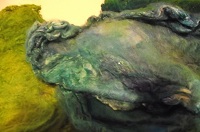
With all fiber, the best spinning comes in large part from the best preparation. Not only does the resulting yarn improve, but so does your mood as you are spinning. I find this to be especially true when spinning silk mawata.
Mawata are silk cocoons which have been boiled, opened and formed into squares. They can be dyed in this form prior to spinning to yield amazing results. Silk takes acid dye very well. The mawata can either be immersion dyed for a uniform color, or painted using squirt bottles for a variegated effect.
To spin silk, you really must put lotion on your hands first and check for any chipped nails that the fiber might catch on. It is so fine that it will catch on pretty much anything. I also find it helpful to use a smooth tea towel on my lap to hold the squares until I am ready to use them. This makes it easy to put the fiber aside if I need to get up from my spinning, and it also prevents the fiber from catching on my jeans.
Begin by separating a layer from the stack. Mawata are really numerous cocoons that have been opened, shaped and stacked. This process leaves them significantly thicker along the edges, so it is necessary to gently tease those edge fibers open until the entire square is a uniform thickness. It does not need to be held in a square form. Distorting the shape is entirely normal as you separate the fibers.
The next step is where I differ greatly from most spinners, but I believe it is a result of being self taught. To spin the mawata, most people stretch it over a swift that has been covered. I prefer to continue to work the mawata into a very long scarf and spin it from that form. This makes it easier to control the size of the drafting zone and gives a more consistent yarn thickness.
While silk behaves like a protein fiber in the dye pot, it is more akin to a plant fiber on the spinning wheel. It has no elasticity and therefore no memory. One of the most amazing things that I encounter as I am spinning silk is that it does not overspin. As I spin wool, or any other protein fiber, I periodically check it by allowing it to double back on itself to get an idea of what it will look like when it is plied and finished. This is not the case with silk. It just goes slack and does not spring at all.
Due to the less-than-lively nature of silk, it could be used as a tool to save an overspun yarn. Simply ply the silk with the overspun yarn in the opposite direction of the overspin. The resulting yarn will be balanced and beautiful.
This site needs an editor - click to learn more!

Related Articles
Editor's Picks Articles
Top Ten Articles
Previous Features
Site Map
Content copyright © 2023 by Laun Dunn. All rights reserved.
This content was written by Laun Dunn. If you wish to use this content in any manner, you need written permission. Contact
BellaOnline Administration
for details.
