

Make Your Own Yarn Swift

I have a windmill type winder to wind the yarn from the bobbin of the spinning wheel to form a hank. This is a great antique tool that serves it’s purpose well. However, once the yarn has been washed, dyed, or otherwise finished, it will no longer stretch onto the arms of the winder. Any fiber artist knows that without tension, even the most beautiful skein of yarn can easily become a knotted and tangled nightmare!
Like all knitters, I have enlisted my knees, my husband, the backs of two chairs, and anything else I could think of to keep tension on the skein so that it can be wound neatly into a ball. None of these were very convenient. So, I began to look for a swift.
Being on a budget, I found most commercially made swifts to be beyond my budget. As we all know, necessity is the mother of invention, so I began to look at all of the swifts in the catalogs and shops to see what household objects I could use to make my own. I noticed they were of two basic designs: umbrella type or windmill. These forms translate easily into other objects that are fairly easy to find. Next stop: Yard Sales!
I never expected to find a swift at a yard sale, though I did buy a loom at a yard sale once for a dollar. I was able to find the ingredients to make one, and all for under ten dollars. I found a lazy susan that originally held four small baskets. It was a homemade item that had some really nice bearings and turned very easily. To this I was able to add a sign holder that I bought from the hardware store for a mere 99 cents. The sign holder acts as a guide eye to keep the yarn feeding to the ball winder from a constant point. I also found four handles from an exercise machine that had threaded bolts to allow them to be moved from one part of the exerciser to another. Combine all of these items with a couple of pieces of 1 x 2 that I was able to get at the home center, and voila instant table top swift!
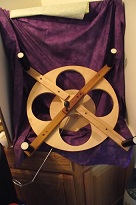
Be sure when making the arms to allow a ledge for the yarn to rest upon. This will prevent it from falling under the swift and becoming tangled in the turning mechanism.
A few other possible items that could be morphed into a swift are a wheel that is on an axle that could be clamped to a table top and arms added. An office chair that turns can be converted just by adding arms to hold the yarn. Wooden dowels can always be used as the posts for the yarn to be stretched over, just be sure to sand them first to prevent snags. Now if I can just figure out how to make a ball winder from an electric mixer!
Like all knitters, I have enlisted my knees, my husband, the backs of two chairs, and anything else I could think of to keep tension on the skein so that it can be wound neatly into a ball. None of these were very convenient. So, I began to look for a swift.
Being on a budget, I found most commercially made swifts to be beyond my budget. As we all know, necessity is the mother of invention, so I began to look at all of the swifts in the catalogs and shops to see what household objects I could use to make my own. I noticed they were of two basic designs: umbrella type or windmill. These forms translate easily into other objects that are fairly easy to find. Next stop: Yard Sales!
I never expected to find a swift at a yard sale, though I did buy a loom at a yard sale once for a dollar. I was able to find the ingredients to make one, and all for under ten dollars. I found a lazy susan that originally held four small baskets. It was a homemade item that had some really nice bearings and turned very easily. To this I was able to add a sign holder that I bought from the hardware store for a mere 99 cents. The sign holder acts as a guide eye to keep the yarn feeding to the ball winder from a constant point. I also found four handles from an exercise machine that had threaded bolts to allow them to be moved from one part of the exerciser to another. Combine all of these items with a couple of pieces of 1 x 2 that I was able to get at the home center, and voila instant table top swift!
Be sure when making the arms to allow a ledge for the yarn to rest upon. This will prevent it from falling under the swift and becoming tangled in the turning mechanism.
A few other possible items that could be morphed into a swift are a wheel that is on an axle that could be clamped to a table top and arms added. An office chair that turns can be converted just by adding arms to hold the yarn. Wooden dowels can always be used as the posts for the yarn to be stretched over, just be sure to sand them first to prevent snags. Now if I can just figure out how to make a ball winder from an electric mixer!
This site needs an editor - click to learn more!

Related Articles
Editor's Picks Articles
Top Ten Articles
Previous Features
Site Map
Content copyright © 2023 by Laun Dunn. All rights reserved.
This content was written by Laun Dunn. If you wish to use this content in any manner, you need written permission. Contact
BellaOnline Administration
for details.
