

Ficus Elastica, the Rubber Tree

Ficus elastica goes by several common names, including Rubber Tree, Rubber Plant, and Indian Rubber Bush. It is in the fig family and is native to northeast India, the eastern Himalayas, and south down through Malaysia and Indonesia. It is hardy in USDA zones 10 and 11 but can be grown outdoors during the warmer months in many other zones, as well as grown indoors.
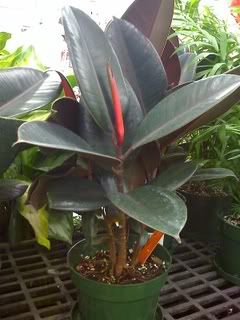 Ficus elastica is popular because it is very easy to grow and care for. They can get big pretty quickly, as they are vigorous growers and don�t ask for much attention. If all of their needs are met, Rubber Trees can be a long-lived addition to your family�s home and help provide a pleasant atmosphere.
Rubber Tree is a great choice for one of those shadier corners in your home. Try to avoid really dark places, as this will cause the plant to become weak and spindly. Light to full shade is recommended, but some light is still desirable. Brown, dead spots on leaves are usually scorching, a sign that your plant is getting too much light. These plants can grow ten or more feet high indoors, so pruning is advisable to keep it in an attractive form and acceptable size.
Ficus elastica does best in a well-drained soil. Avoid over-watering, but don�t let it dry out either. It is a good idea to observe the plant and its soil to determine when you should water. Symptoms of over-watering and under-watering are similar, such as leaf yellowing and leaves falling off. You should be able to tell which one is the issue if you consider how often you have been watering. Watering once a week is a good place to start, but adjust your schedule depending on how quickly the soil dries out. You should also water slightly less often in the cooler months when the plant slows down its growth.
Fertilization is not really necessary, but can be done once a month with a water soluble fertilizer, if you like. Slow release fertilizers are also nice and when applied at the beginning of the growing season you should only need to use it once a year.
Propagation of Ficus elastica is usually done by cuttings or air layering. It is common for people to propagate new Rubber Trees from the leftover scraps after a pruning session. It is quick and simple to do, and you would then be able to share your plant with others. Be aware that the milky sap of Ficus elastica is toxic if ingested and that handling of the plant may cause an allergic reaction, for some. If you don�t know how you will react to Rubber Tree, it is advisable to use gloves when handling it. Also, this plant is not a good idea if you have pets that like to chew on your houseplants or small children who may put things in their mouth.
Rubber Trees are pretty tough as far as diseases go. You rarely, if ever, see them. Insects aren�t particularly attracted to Ficus elastica, either, but it�s always good to keep an eye out. Some of the more likely invaders you might find are mealy bugs and spider mites, with an occasional visit from aphids or scale.
Some other stresses your Rubber Tree might encounter are a change of location (such as a move from the outside to the inside) or temperature stress. Both of these things could cause yellowing of leaves or leaf drop. The problem with a move from the outside is often related to a drop in humidity, and the plant will recover eventually. You can ease this transition by placing the plant on a humidity try or misting it lightly every other day, or so. Cold drafts can cause leaf drop, so take note of the placement of your plant.
Ficus elastica is a great plant for anyone that doesn�t have pets or small children to worry about, and wants an easy to care for plant. This plant can be an attractive focal point in a room, or just a bit of ambiance.
Rubber Tree is a great choice for one of those shadier corners in your home. Try to avoid really dark places, as this will cause the plant to become weak and spindly. Light to full shade is recommended, but some light is still desirable. Brown, dead spots on leaves are usually scorching, a sign that your plant is getting too much light. These plants can grow ten or more feet high indoors, so pruning is advisable to keep it in an attractive form and acceptable size.
Ficus elastica does best in a well-drained soil. Avoid over-watering, but don�t let it dry out either. It is a good idea to observe the plant and its soil to determine when you should water. Symptoms of over-watering and under-watering are similar, such as leaf yellowing and leaves falling off. You should be able to tell which one is the issue if you consider how often you have been watering. Watering once a week is a good place to start, but adjust your schedule depending on how quickly the soil dries out. You should also water slightly less often in the cooler months when the plant slows down its growth.
Fertilization is not really necessary, but can be done once a month with a water soluble fertilizer, if you like. Slow release fertilizers are also nice and when applied at the beginning of the growing season you should only need to use it once a year.
Propagation of Ficus elastica is usually done by cuttings or air layering. It is common for people to propagate new Rubber Trees from the leftover scraps after a pruning session. It is quick and simple to do, and you would then be able to share your plant with others. Be aware that the milky sap of Ficus elastica is toxic if ingested and that handling of the plant may cause an allergic reaction, for some. If you don�t know how you will react to Rubber Tree, it is advisable to use gloves when handling it. Also, this plant is not a good idea if you have pets that like to chew on your houseplants or small children who may put things in their mouth.
Rubber Trees are pretty tough as far as diseases go. You rarely, if ever, see them. Insects aren�t particularly attracted to Ficus elastica, either, but it�s always good to keep an eye out. Some of the more likely invaders you might find are mealy bugs and spider mites, with an occasional visit from aphids or scale.
Some other stresses your Rubber Tree might encounter are a change of location (such as a move from the outside to the inside) or temperature stress. Both of these things could cause yellowing of leaves or leaf drop. The problem with a move from the outside is often related to a drop in humidity, and the plant will recover eventually. You can ease this transition by placing the plant on a humidity try or misting it lightly every other day, or so. Cold drafts can cause leaf drop, so take note of the placement of your plant.
Ficus elastica is a great plant for anyone that doesn�t have pets or small children to worry about, and wants an easy to care for plant. This plant can be an attractive focal point in a room, or just a bit of ambiance.
This site needs an editor - click to learn more!
You Should Also Read:
Plants for Dark Corners
Summering Houseplants Outdoors
Houseplants Newsletter 
Related Articles
Editor's Picks Articles
Top Ten Articles
Previous Features
Site Map
Content copyright © 2023 by Lisa Beth Voldeck. All rights reserved.
This content was written by Lisa Beth Voldeck. If you wish to use this content in any manner, you need written permission. Contact
BellaOnline Administration
for details.
