Clara Haase pats #1 #5
Needlecraft Magazine October 1925
Tatting Patterns by Clara Haase
Needlecraft Magazine published in the first half of the 20th century in Augusta, Maine was one of many publications designed for women. It featured everything from recipes to home remedies, practical linens and clothes repairs to delicate laces. The earliest issue that I have is from 1912. It continued in publication under that name until about 1933 when the name was changed to Needlecraft Home Arts Magazine. It last appeared in the early 1940's under the name of Home Arts Magazine. It had monthly issues and specialty publications.

This is the earliest issue that I have that actually shows tatting on the cover.
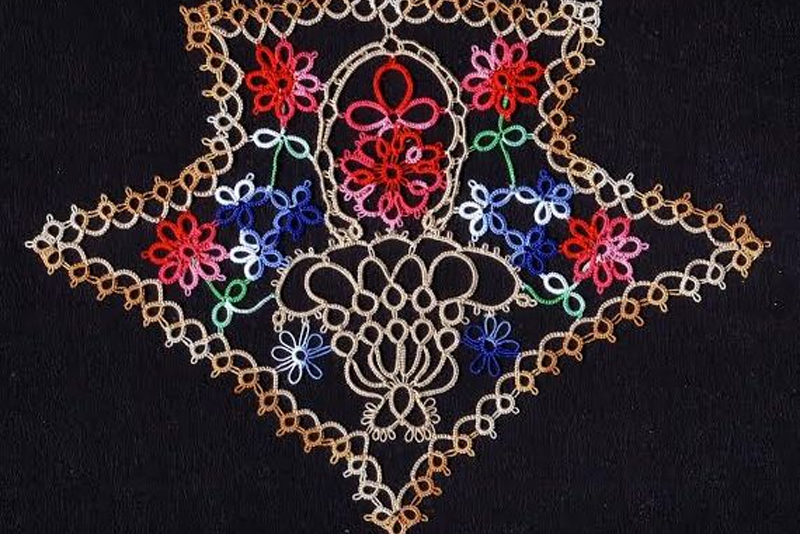
These designs are by Clara Haase. Her name appears more than once in Needlecraft Magazine. I also believe that this same set of patterns was reprinted 48 years later in "Olde Time Needlework Patterns and Designs: Exquisite Designs and Patterns Out of the Glorious Past " in the March 1973 issue. And, now, 89 years after they first appeared, the patterns are still ever fresh.
R = Ring CH = Chain clr = close ring rw = reverse work dnrw = do not reverse work - = picot + = join

Pattern 1
*RA 6 - 6 - 5 - 2 - 5 clr dnrw. CH 8 + (join to first picot of ring)
RB 5 - 5 - 5 - 5 clr dnrw. Continue CH 8 + (join to first picot of previous ring) 2 - 2 - 2 - 1 + (join to second picot of same ring) 1 - 2 - 2 - 2 - + (join to third picot of same ring) 8 + (join to base of same ring) CH 8 + (join to second picot of initial ring.)
RA 6 - 6 - 5 - 2 - 5 clr dnrw. CH 8 + (join to first picot of ring)
CH 9 + (join to last picot of chain around initial ring A) 6 - 6 - 9 + (join to first picot of ring B at the same spot where this chain began) CH 8 + (join to second picot of ring )
Repeat from * for length desired and finish off ends.
Or,
At end of row make that last chain which has no inner ring, a split ring and exit through the middle picot. Then begin the return pass of all tatted chains.
CH 8 - 8 + (join to previous row) 8 - 8 and repeat.

Pattern 5
Begin this straight chain with a starter picot.
CH 8 - repeat for desired length. At end turn and work back the opposite direction.
CH 8 - 8 + (join to picot of straight chain); when you reach the beginning of the chain join to the starter picot with an 8 ds split chain. This brings you into the last pass.
CH 7 + (join to next freestanding picot) 5, using picot gauge create 9 picots, 5 + (join to next picot) continue to end and finish off ends.
Additional patterns from this set will be posted in upcoming articles. I would love to have a new model of this lace to illustrate this pattern. If you would like to submit photo please send jpg to me through the tatting editor page https://www.bellaonline.com/about/tatting. To view the photos more easily, open them in a new window or right click and save to your computer graphics program.
You Should Also Read:
Clara Haase pats #2 and 4
Planning for the End

Related Articles
Editor's Picks Articles
Top Ten Articles
Previous Features
Site Map
Content copyright © 2023 by Georgia Seitz. All rights reserved.
This content was written by Georgia Seitz. If you wish to use this content in any manner, you need written permission. Contact Georgia Seitz for details.