

Food in Poetry
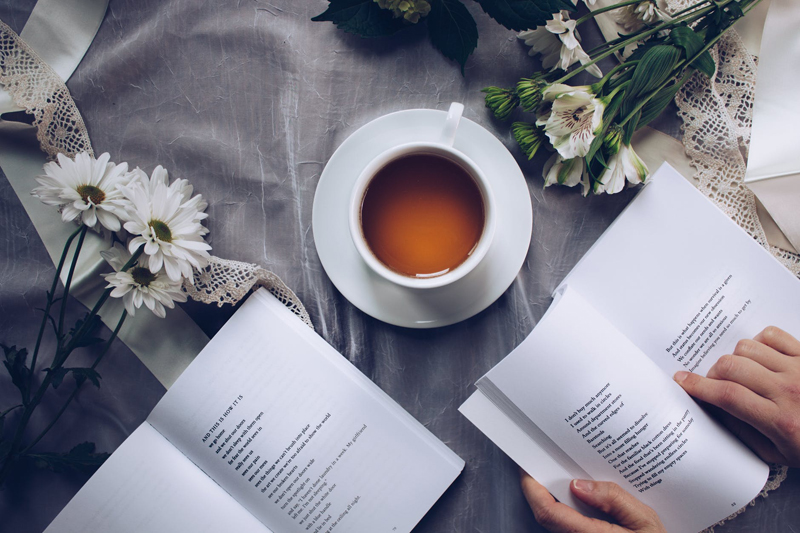
In Maslow’s famous Hierarchy of Needs, hunger is at the forefront of issues that human beings need to confront before they can achieve contentment or even happiness. No one can deny that food plays an essential role in every living being’s life. In fact, it ranges from the most primitive need (hunting to escape starvation) to the most subtle intricacies of our modern lives (cultural practices, emotional gestures, intense memories). Thus it should be no surprise to find food themes in poetry. Following are some examples of the various ways that food appears in poetry.
Description of Food
Robert Frost’s poem “Blueberries” is a short, descriptive vision of blueberries gathered into a pail. Anyone who has ever picked berries can relate to the “real sky-blue” look, “heavy” feel, and “ready to drum / In the cavernous pail” sound of collected blueberries. This is an example of a descriptive poem, using the senses to create a strong image in the mind. Another beautiful example is “Onions” by William Matthews, in which every step of cooking onions is described in mouth-watering detail. From the chopping block to the frying pan to the plate, Matthews follows the onion’s journey with thoughtful, modest description. One can almost hear, smell and taste them in each step of the process.
In Recipe Form
Instead of describing the product, some poets instead describe the process of creating food. One example is “Bread Soup: An Old Icelandic Recipe” by Bill Holm. The poem is just like a recipe, describing the ingredients used and steps taken to make the bread soup. Holm adds in description to make it more poetic. The ‘recipe’ is extremely sensory, particularly in the realm of touch and texture, as he describes ingredients “coarse,” “dense,” and “thick”. In the end, the recipe unfolds into the finished product which is “alive as any animal”, and “will sing inside you” upon consumption.
Just for Fun
Because food can be messy, food poems are perfect for children. It seems that kids enjoy talking about making messes almost as much as they enjoy making them. Plus, food and eating lends itself to some great onomatopoeia. Shel Silverstein and Jack Prelutsky have various enjoyable poems involving food. Another food poem that is considered quite whimsical is William Carlos William’s “This Is Just To Say.” Written in the form of a note taped to a refrigerator, the speaker of the poem admits to stealing plums that someone else had saved inside. The speaker apologizes, but cannot help adding “they were delicious.”
As Related to Emotions
As something so essential to our lives, food is often deeply connected with our emotions. The particular smell or taste of a certain type of food is enough to conjure up intense memories, thoughts, and faces from the past. In his poem “Corned Beef and Cabbage,” George Bilgere describes a woman cooking. Her actions intertwine with her emotions as “everything was simmering,” and she “boiled the beef into submission”. There is also slicing, chopping, pulsing and chewing, all actions to describe someone moving about in anger or frustration, through the medium of preparing a meal. In “Eating Alone” by Li-Young Lee, a young man reminisces about his late father while working in the garden, and then eating his meal alone. On the other hand, Gregory Djanikian’s “I Ask My Grandmother If We Can Make Lahmajoun” depicts an entire family preparing a culturally specific food. This poem is all about the process, how it brings the family together, puts them in touch with their culture, and in the end creates something precious (“you would swear / it [the dough] is valuable parchment”), something more than food.
Deeper Insights
Sometimes, food leads to thoughts, ideas and themes that go deeper than just the surface, our stomachs, or even our memories. “Eating the Pig” by Donald Hall offers a mesmerizing view of dinner in relation to the feelings of the main course (in this case, a roast suckling pig). The speaker, who has been served a pig at a large dinner, ruminates on the pig and its life while eating it. He considers how he is connected with the pig, before and now and after, and what the act of eating it truly means.
Whether you’re reading it for primal (description-hungry), emotional (personal fulfillment), entertainment (onomatopoeia) or philosophical reasons, food poetry can be enjoyed on all levels.
Description of Food
Robert Frost’s poem “Blueberries” is a short, descriptive vision of blueberries gathered into a pail. Anyone who has ever picked berries can relate to the “real sky-blue” look, “heavy” feel, and “ready to drum / In the cavernous pail” sound of collected blueberries. This is an example of a descriptive poem, using the senses to create a strong image in the mind. Another beautiful example is “Onions” by William Matthews, in which every step of cooking onions is described in mouth-watering detail. From the chopping block to the frying pan to the plate, Matthews follows the onion’s journey with thoughtful, modest description. One can almost hear, smell and taste them in each step of the process.
In Recipe Form
Instead of describing the product, some poets instead describe the process of creating food. One example is “Bread Soup: An Old Icelandic Recipe” by Bill Holm. The poem is just like a recipe, describing the ingredients used and steps taken to make the bread soup. Holm adds in description to make it more poetic. The ‘recipe’ is extremely sensory, particularly in the realm of touch and texture, as he describes ingredients “coarse,” “dense,” and “thick”. In the end, the recipe unfolds into the finished product which is “alive as any animal”, and “will sing inside you” upon consumption.
Just for Fun
Because food can be messy, food poems are perfect for children. It seems that kids enjoy talking about making messes almost as much as they enjoy making them. Plus, food and eating lends itself to some great onomatopoeia. Shel Silverstein and Jack Prelutsky have various enjoyable poems involving food. Another food poem that is considered quite whimsical is William Carlos William’s “This Is Just To Say.” Written in the form of a note taped to a refrigerator, the speaker of the poem admits to stealing plums that someone else had saved inside. The speaker apologizes, but cannot help adding “they were delicious.”
As Related to Emotions
As something so essential to our lives, food is often deeply connected with our emotions. The particular smell or taste of a certain type of food is enough to conjure up intense memories, thoughts, and faces from the past. In his poem “Corned Beef and Cabbage,” George Bilgere describes a woman cooking. Her actions intertwine with her emotions as “everything was simmering,” and she “boiled the beef into submission”. There is also slicing, chopping, pulsing and chewing, all actions to describe someone moving about in anger or frustration, through the medium of preparing a meal. In “Eating Alone” by Li-Young Lee, a young man reminisces about his late father while working in the garden, and then eating his meal alone. On the other hand, Gregory Djanikian’s “I Ask My Grandmother If We Can Make Lahmajoun” depicts an entire family preparing a culturally specific food. This poem is all about the process, how it brings the family together, puts them in touch with their culture, and in the end creates something precious (“you would swear / it [the dough] is valuable parchment”), something more than food.
Deeper Insights
Sometimes, food leads to thoughts, ideas and themes that go deeper than just the surface, our stomachs, or even our memories. “Eating the Pig” by Donald Hall offers a mesmerizing view of dinner in relation to the feelings of the main course (in this case, a roast suckling pig). The speaker, who has been served a pig at a large dinner, ruminates on the pig and its life while eating it. He considers how he is connected with the pig, before and now and after, and what the act of eating it truly means.
Whether you’re reading it for primal (description-hungry), emotional (personal fulfillment), entertainment (onomatopoeia) or philosophical reasons, food poetry can be enjoyed on all levels.

Related Articles
Editor's Picks Articles
Top Ten Articles
Previous Features
Site Map
Content copyright © 2023 by Jessica Smith. All rights reserved.
This content was written by Jessica Smith. If you wish to use this content in any manner, you need written permission. Contact Karena Andrusyshyn for details.
