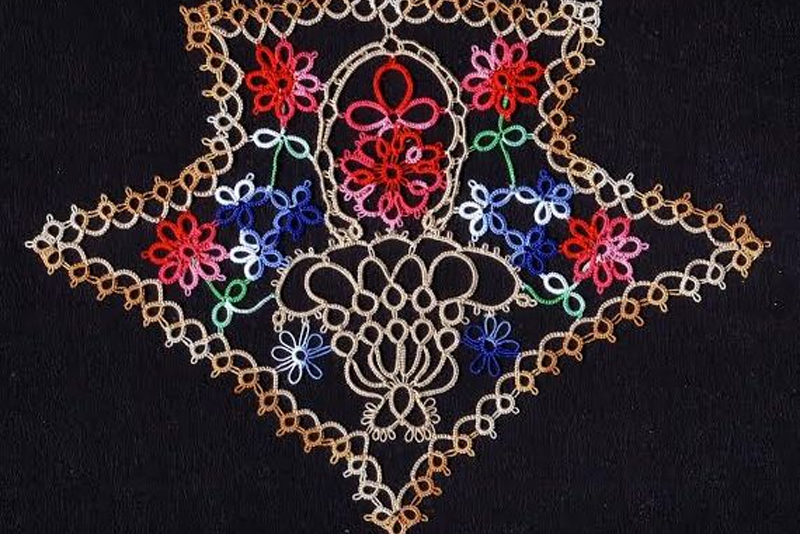
This week we are going to learn to make the Spoke Edge. This is a much more time consuming way of making a lace edging but it is so effective and once you can do it as long as you have a piece of linen or fine cotton handy you won't need to buy a ready made handkerchief again - unless you want to, of course.
The first thing of course is to prepare your lace and fabric as described in the first article in this series. Next, place your lace on the fabric, parallel to the grain (the direction of the threads) and cut out a piece a little larger than your lace all round.
Look at your lace on the fabric and choose a side to start with. Roughly at the point the inner edge starts, withdraw a thread along this edge. Baste the lace in place using the point at which the thread has been withdrawn as a guiding line. When you get to the corner, withdraw the thread for the next side at the point where the corner starts, and baste the lace in place as before. Repeat for the 3rd and 4th sides - you may have to "adjust" the fourth side a little to fit but it won't be noticeable at all. The illustration shows the lace basted in place as described.

Next, count 8 threads (or measure the distance you want) OUT from the point at which one of the threads was withdrawn and withdraw the 8th thread out. Count out another 8 threads (or measure) and withdraw the 8th thread. Repeat all round the edging. The illustration below shows the back of the mat with the threads withdrawn.

Next, you need to prepare the inner threads that will be gathered together when you make the hem.
Count 8 threads in from the hem edge, and withdraw the 8th thread and the next two in from that. Repeat all round the mat as shown below.

The next move is to select the thread you are going to use - I used DMC Brilliante No. 30 this time which is usually used for machine embroidery or bobbin lace but is an excellent thread for this purpose - and start to sew the lace in place. Starting somewhere in the middle of an edge, make a knot in the end of your thread and bring the needle up through a picot at the inside edge. The knot will be hidden inside the hem when you fold it over - it is on the side of the fabric that does not at present have any lace showing. It is the thread at the INSIDE of the innermost withdrawn thread that you sew the lace to, not the one just outside (as teacher did!!!). Take a double stitch through that picot, then take the stitch to the back and out through the next picot. Repeat all round but do NOT cut off the thread when you get back to the beginning because you can use it to stitch the edging.
Next, withdraw the basting threads as they are no longer needed, and, whilst holding the lace well out of the way, trim the fabric all round along the outermost withdrawn thread. Trim the corners by looking at the fabric to see the little group of four outermost squares forming one larger square and trim diagonally across from corner to corner.
The illustration shows the lace basted to the fabric and sewn in place with the edges and corners trimmed before beginning to make the hem.PLEASE be careful to hold the lace well out of the way when you trim the fabric, you will be a VERY unhappy lacemaker if you cut the lace at this stage!!

In the next step you fold the corners in just as you did for the Plain Hem. First of all, fold the trimmed corners in at a forty-five degree angle to the grain of the fabric (on the bias) as far as they will go. The actual fold is made at the point where the fabric was sewn to the lace. Pin in place as shown below.

Then fold the edges in by folding over twice at the point where threads have been withdrawn, as shown below:-

You can now start to do the actual sewing - an exciting moment!
Take the needle through the hem from the point where you finished sewing the lace to the fabric in the initial stages. If it's close to a corner count the threads in groups of three and bring it out at a point between two groups of three threads. Take the needle UNDER three threads of the withdrawn group of three threads and bring it out. Be careful not to catch the next thread with the needle as it will form part of the next group.

Pull the needle through and give the group a slight tug, repeat four times. It will form a neat "sheaf" of threads. Next, take the needle up through the hem between this group and the next group of stitches. Just catch a couple of threads as shown below:-

When you get to the corner, just make the mitre by taking tiny hem stitches to draw the two edges of the mitre together. You are supposed with this technique to make the spoke edge go right through the corner through all layers of fabric, but I find this is generally very difficult to do neatly and prefer to leave the corners with just a mitre in place.
Continue all round your mat. When you get to the corners you may find you have a group of four threads instead of three - just divide the group of four threads into two groups of two and proceed exactly as before - it will not show at all.
The finished mat is shown below.

Where did I get that pretty pattern? I made it up! It will appear in the Newsletter today but if you missed it, feel free to look up the back issue for Newsletter No. 5 in the Archive of Previous Features. Just one word of warning - it is NOT a good one to start with because the small rings caught constantly on the thread.
![]() | Mounting Tatting is Gillian Buchanan's first tatting book, covering a wide range of skills and techniques for mounting tatted lace. |


Save to Del.icio.us