Joins - Tied, Catherine Wheel, Alligator
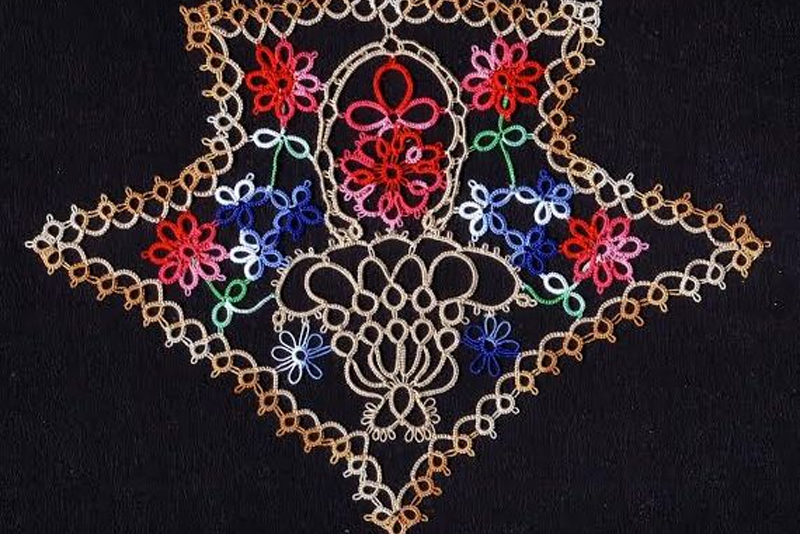
The join is a technique used in constructed large pieces of lace from smaller tatted bits. There are many types of join, i.e., up, down, shuttle lock join, onion ring, split ring, swirl, lark's head picot join (LHPJ), and many others.
The Tied Double Stitch Join
The TIED double stitch join is similar to a lark's head picot join and the catherine wheel join. Here two threads will be encapsulated at the same time by placing a double stitch over them and the shuttle/core thread (SH1) will still be moving.
In the manner of making a split chain stitch, the SH1 thread is positioned next to the picot so the threads are side by side. Reach through the picot and bring the SH2 thread up through it and to the front and slightly downwards. Bring SH2 over the work and down through this loop. Remove slack from the loop.
Reach this time through the picot from the back going to the front bringing the SH2 thread in a loop to the back side. Pull on the SH2 thread (you should hear a little "pop." Pull slightly to place the first half stitch in position. Next make a loop in a upward position and bring the SH2 thread from the front to the back through this loop and remove slack. That forms the second half of the tied double stitch.
The Catherine Wheel Join
The CATHERINE WHEEL encapsulates two threads at the same time. It is created in the manner of making the split chain stitch or the tied double stitch. It is often used when making tatted coils or wheels, thence the Catherine Wheel.
Drop a loop of the SH2 thread behind the core thread which is positioned above the point of attachment (the thread in the space between two double stitches of the previous round. Bring thread up through the work into a loop and put the shuttle through that loop. Remove only a little slack. Next form a loop on the front side and bring it to the back and put the shuttle through. Pull gently on the half stitch closest to the last ds made and snug up. Repeat with the other half. The double stitch on this round covers both the core thread and the thread from the previous round.
The Alligator Join
Known more properly as a capture join, the ALLIGATOR join is not a join at all. It is a method to cross one line of tatting over another by capturing the threads of a previously tatted element. The new tatting in progress approaches the previous tatting with one thread above it and one thread below it. Compare the upper thread to the upper jaw of an alligator and the lower thread to the lower jaw.
When the alligator closes its jaws, it "bites" the previously tatted element "capturing" it.
Holding the old tatting firmly, set the next double stitch very tightly snugging it up to the old tatting. Continue pattern
The Tied Double Stitch Join
The TIED double stitch join is similar to a lark's head picot join and the catherine wheel join. Here two threads will be encapsulated at the same time by placing a double stitch over them and the shuttle/core thread (SH1) will still be moving.
In the manner of making a split chain stitch, the SH1 thread is positioned next to the picot so the threads are side by side. Reach through the picot and bring the SH2 thread up through it and to the front and slightly downwards. Bring SH2 over the work and down through this loop. Remove slack from the loop.
Reach this time through the picot from the back going to the front bringing the SH2 thread in a loop to the back side. Pull on the SH2 thread (you should hear a little "pop." Pull slightly to place the first half stitch in position. Next make a loop in a upward position and bring the SH2 thread from the front to the back through this loop and remove slack. That forms the second half of the tied double stitch.
The Catherine Wheel Join
The CATHERINE WHEEL encapsulates two threads at the same time. It is created in the manner of making the split chain stitch or the tied double stitch. It is often used when making tatted coils or wheels, thence the Catherine Wheel.
Drop a loop of the SH2 thread behind the core thread which is positioned above the point of attachment (the thread in the space between two double stitches of the previous round. Bring thread up through the work into a loop and put the shuttle through that loop. Remove only a little slack. Next form a loop on the front side and bring it to the back and put the shuttle through. Pull gently on the half stitch closest to the last ds made and snug up. Repeat with the other half. The double stitch on this round covers both the core thread and the thread from the previous round.
The Alligator Join
Known more properly as a capture join, the ALLIGATOR join is not a join at all. It is a method to cross one line of tatting over another by capturing the threads of a previously tatted element. The new tatting in progress approaches the previous tatting with one thread above it and one thread below it. Compare the upper thread to the upper jaw of an alligator and the lower thread to the lower jaw.
When the alligator closes its jaws, it "bites" the previously tatted element "capturing" it.
Holding the old tatting firmly, set the next double stitch very tightly snugging it up to the old tatting. Continue pattern
You Should Also Read:
Joining Needle Tatted Rings

Related Articles
Editor's Picks Articles
Top Ten Articles
Previous Features
Site Map
Content copyright © 2023 by Georgia Seitz. All rights reserved.
This content was written by Georgia Seitz. If you wish to use this content in any manner, you need written permission. Contact Georgia Seitz for details.