Joins -Up, Down, Shuttle Lock Join
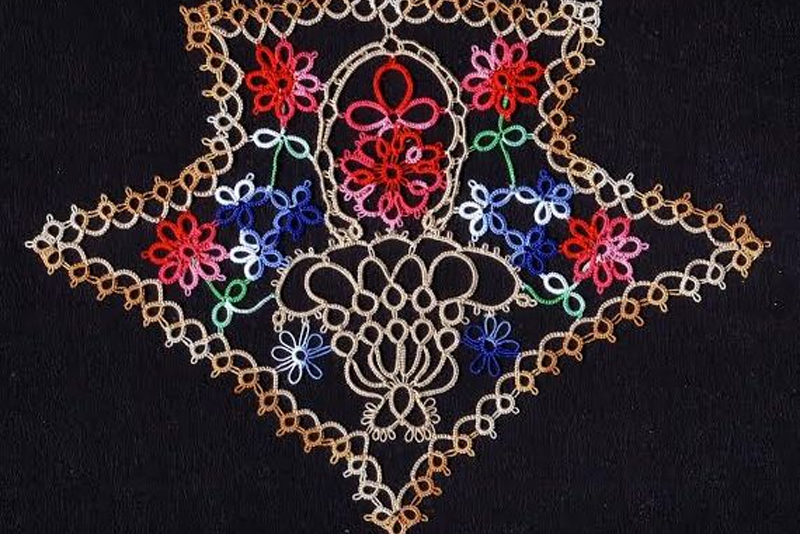
The join is a technique used in constructed large pieces of lace from smaller tatted bits. There are many types of join, i.e., up, down, shuttle lock join, onion ring, split ring, swirl, lark's head picot join (LHPJ), and many others.
The Basic Join: Up or Down.
The "UP" Join
The traditional join, the UP join, in tatting is made by laying the picot across the working thread, pulling the working thread up thru the picot and slipping the shuttle thru the loop thus formed and then the slack is pulled back down thru the picot and tightened up.
The join is counted as merely a space by many tatters. Other tatters follow the join with a half stitch. This method leaves a definite piece of thread showing thru the legs of the picot used to join. Only practice and experience will determine which method is best for you.
The "DOWN" Join
The DOWN join places the picot beneath the working thread which is then pulled down thru the picot and the shuttle slips thru the loop thus formed from front to back and then the slack is pulled up and tightened. This type of join may be followed by the first DS of the next set, or it may be counted as the first DS of the set or it may be followed by only a HS. Tatter's choice. This method leaves a barely visible horizontal piece of thread between the DS.
[Ed.'s note: The IOLI Journal from Fall 1993 referred to this technique as the Dem-Rice Join. It was popularized by Bobbie Demmer and Marie Rice. Later, however, Bobbie learned thru further research that it had been used in recent years by Pat Perry and decades earlier by Anne Orr as well. Bobbie Demmer feels it should be referred to simply as the "DOWN."]
The basic importance of the DOWN join is that it enhances the right side look of the tatting for those who create a definite front side back side to their tatting. Traditionally, rings were "front side" up and chains were "back side" up. The DOWN join changes that look so that the ring and chain are both "front side" up.
The Shuttle Lock Join
The "Shuttle Lock Join" (SLJ) is used when a join is needed below the line of progression. This join uses only the thread from the active shuttle (SH1) and does not involve the ring/working thread nor the ball thread. This join is often used when working rows of chains. The chain joins to a spot/picot on a previous round. The tatted element should be complete and correct BEFORE beginning the SLJ because the SLJ is difficult to undo.
Bring the tatted element over so that it physically touches the point of attachment (picot etc.) Take SH1 thread and place it below the picot. Pull the SH1 thread up thought the picot into a loop. Put SH1 through this loop. Gently remove the slack. Be careful that you do not leave a gap between the completed work and the join. Tighten the join down by pulling straight up in a 90° angle. If you are right-handed, you may work a right-handed slant into this join if you are not careful to pull straight up on the thread.
The Basic Join: Up or Down.
The "UP" Join
The traditional join, the UP join, in tatting is made by laying the picot across the working thread, pulling the working thread up thru the picot and slipping the shuttle thru the loop thus formed and then the slack is pulled back down thru the picot and tightened up.
The join is counted as merely a space by many tatters. Other tatters follow the join with a half stitch. This method leaves a definite piece of thread showing thru the legs of the picot used to join. Only practice and experience will determine which method is best for you.
The "DOWN" Join
The DOWN join places the picot beneath the working thread which is then pulled down thru the picot and the shuttle slips thru the loop thus formed from front to back and then the slack is pulled up and tightened. This type of join may be followed by the first DS of the next set, or it may be counted as the first DS of the set or it may be followed by only a HS. Tatter's choice. This method leaves a barely visible horizontal piece of thread between the DS.
[Ed.'s note: The IOLI Journal from Fall 1993 referred to this technique as the Dem-Rice Join. It was popularized by Bobbie Demmer and Marie Rice. Later, however, Bobbie learned thru further research that it had been used in recent years by Pat Perry and decades earlier by Anne Orr as well. Bobbie Demmer feels it should be referred to simply as the "DOWN."]
The basic importance of the DOWN join is that it enhances the right side look of the tatting for those who create a definite front side back side to their tatting. Traditionally, rings were "front side" up and chains were "back side" up. The DOWN join changes that look so that the ring and chain are both "front side" up.
The Shuttle Lock Join
The "Shuttle Lock Join" (SLJ) is used when a join is needed below the line of progression. This join uses only the thread from the active shuttle (SH1) and does not involve the ring/working thread nor the ball thread. This join is often used when working rows of chains. The chain joins to a spot/picot on a previous round. The tatted element should be complete and correct BEFORE beginning the SLJ because the SLJ is difficult to undo.
Bring the tatted element over so that it physically touches the point of attachment (picot etc.) Take SH1 thread and place it below the picot. Pull the SH1 thread up thought the picot into a loop. Put SH1 through this loop. Gently remove the slack. Be careful that you do not leave a gap between the completed work and the join. Tighten the join down by pulling straight up in a 90° angle. If you are right-handed, you may work a right-handed slant into this join if you are not careful to pull straight up on the thread.
You Should Also Read:
Joins - Tied, Catherine Wheel, Alligator
Onion Rings- Ball thread join

Related Articles
Editor's Picks Articles
Top Ten Articles
Previous Features
Site Map
Content copyright © 2023 by Georgia Seitz. All rights reserved.
This content was written by Georgia Seitz. If you wish to use this content in any manner, you need written permission. Contact Georgia Seitz for details.