Roll Tatting Round Medallion
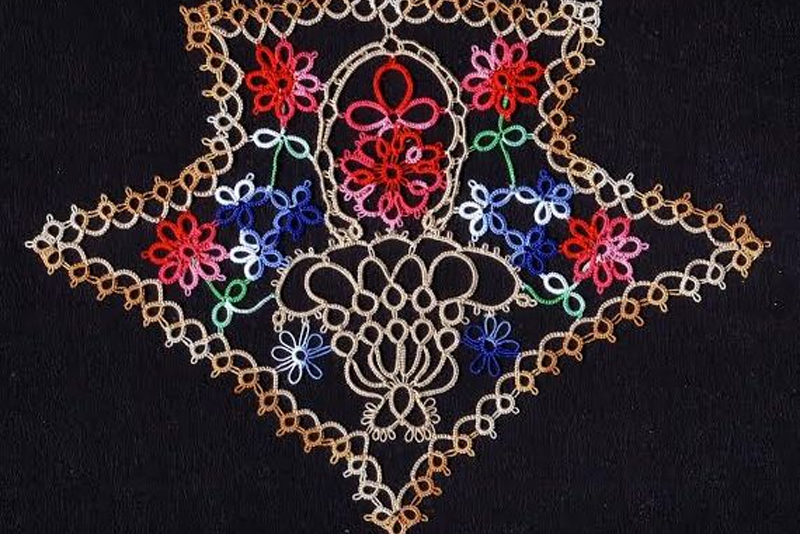
Roll tatting is a novelty stitch found in many vintage publications and explained also in more recent publications like Rebecca Jones' "The Complete Book of Tatting" and the tatting books of Mary Konior. See the BellaOnline.com roll tatting tutorial:
The roll stitch in tatting is not a stitch at all. It is only the thread from the shuttle being literally rolled around the ring thread and compressed back to the starting point. Begin the ring with a regular double stitch (DS.) Next take the shuttle and pass it under the working thread (ring thread) and over to the right and keep the shuttle thread straight. The loop does not flip or transfer. An half stitch is NOT formed.
It is necessary to frequently compress the rolls. Use finger tip or nail to slide the rolls down on the ring thread. If you ease up on the tension then the rolls will unwrap.
Continue bringing the shuttle under the ring thread and tightening the rolls back for the length needed. To create a picot, compress the rolls tightly and roll the last little bit between the fingers to get rid of slack. Tat a regular DS picot DS. Then return to the rolling of the thread. Finish the ring with a regular DS and close. It helps to prevent the initial and last DS from rolling around if you post the shuttle thread through the ring before closing.
Although I choose not to let go of the shuttle when I tat, there is another alternative to the "slip and slide" method I use. The tatter may take the shuttle and actually drop it down the center of the ring, do not flip or transfer the stitch, grasp the shuttle again and take it round the outside of the left hand and drop it down the middle again.

From an undated copy of "Home Arts Fancy Work," pg 24, we have an example of roll tatting in a round medallion.
R = ring CH = chain P or - = picot DS = double stitch CLR = close ring DNRW = do not reverse work RW = reverse work Numbers = the number of double stitches done in repetition unless otherwise noted
Roll = wrapping (rolling the thread around the core thread without transferring the loop, i.e., no half stitch in made.)
Center motif, first petal of the daisy
R *15 rolls, 1 - 2 - 2 - 1, 15 rolls, 1 clr drnw
* I believe this ring and all other roll tatted rings should begin and end with a full double stitch.
Second petal of the daisy
R 1, 15 rolls, 1 + (join to last picot of first petal) 2 - 2 - 1, 15 rolls, 1 clr dnrw
Repeat for a total of 12 petals joining last petal to the first picot of the first petal. Finish off ends.
Half daisy motif, first petal of the half daisy
R 1, 15 rolls, 1 - 2 - 2 - 1, 15 rolls, 1 clr drnw
R 1, 15 rolls, 1 + (join to last picot of first petal) 2 - 2 - 1, 15 rolls, 1 clr dnrw
Repeat for a total of 7 petals joining last petal to the first picot of the first petal.
Do not reverse work after the last petal is closed.
CH 7 rw
R 1, 10 rolls, 1 + (join to free picot of petal on center daisy) 1, 10 rolls, 1 clr rw
CH 7
Repeat around joining to every other petal of the center daisy. Finish off ends.
You Should Also Read:
Building a Tatting Library - Standards
Tatting vs Wrapping

Related Articles
Editor's Picks Articles
Top Ten Articles
Previous Features
Site Map
Content copyright © 2023 by Georgia Seitz. All rights reserved.
This content was written by Georgia Seitz. If you wish to use this content in any manner, you need written permission. Contact Georgia Seitz for details.