Irish Life In The 1800's
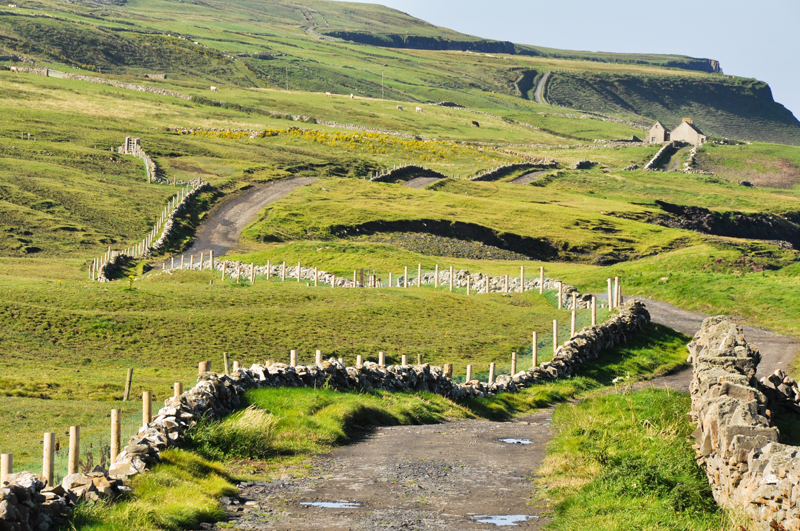
The Irish Peasantry in the 1800’s was still mostly a conglomerations of farmers and local trades-people, huddled together in villages, each with its own leadership and laws yet bound by the laws enacted by the English Crown.
Surrounding these ubiquitous hamlets and villages was a countryside almost exclusively dedicated to the growing of potatoes, which had become the staple diet of the populous. Along the coastal areas, an abundance of sea-weed or kelp was harvested, dried and mulched into fertilizer to make the potato crop better year after year.
At this time in Ireland, the societal strata was basically threefold and was composed of The English Landlord, the Tenant Farmer and the Laborer (or Peasant).
The Landlord at this time owned vast areas of the countryside, having received them mostly from the English crown for “services rendered“. These rich Gentry rarely lived in Ireland but usually left their estates in the care of very capable managers, who often ran a scheme of sub-letting the acreage down to five or six levels until the actual work of farming was done by the lowest tenant-farmer.
By the middle of the 1800’s however, these Landlords had built up so much debt that had been secured by their Irish estates, that many were forced to sell off the lands and often the Irish nationals were once again able to own their own properties .
The Tenant-Farmer lived often at the whims and mercy of his English Landlord. He held his position “at will” which meant that he could be hired and fired at the “will” of the owner. If more fortunate, he held a lease for both himself and his eldest son, which meant that as long as the rent was duly paid, there could be little chance of eviction. Perhaps the greatest burden the Tenant-Farmer faced was the “Tithe Tax” ----- a one tenth tax on the annual value of the farmland, equipment and estimated crop value ( with no regards to profits or losses). This was then used to pay the support of the Protestant clergy --- a situation of “adding insult to injury”, since most of the Tenant-Farmers paying the tax were Catholics.
The Irish Farm laborer was perhaps the lowest form of humanity in the Irish culture of that day. His meager wage might be 5 pennies a day with a potato meal thrown in for the evening. Many times during the off-season in Ireland he would have to ship across to work on the Landlord’s English estates, leaving his family in Ireland to fend for themselves by begging from neighbors and the church. Many “Estate” laborers were almost akin to the American Southern slaves and did not even receive a wage, but were only guaranteed a very basic roof over their head and a small plot of ground to grow their own food.
During most of the 19th Century, the status, wealth and personal security of any person in Ireland depended almost entirely on the land. Land and successful farming meant power. From the aristocratic Landed Gentry with many thousands of acres, building great wealth and prestige in English society, to the lowliest farm-laborer with only the smallest patch of land to eke out a simple existence, the land was center in people’s lives. It wasn’t until the potato plight hit in 1845 and the Great Irish Famine devastated the land, that the country began to look elsewhere for its wealth and economic stability and with the Industrial Revolution just around the corner, the whole of Ireland’s society was about to be set on its head.

Related Articles
Editor's Picks Articles
Top Ten Articles
Previous Features
Site Map
Content copyright © 2023 by Tony King. All rights reserved.
This content was written by Tony King. If you wish to use this content in any manner, you need written permission. Contact Bee Smith for details.