Interlocking Tatted Rings
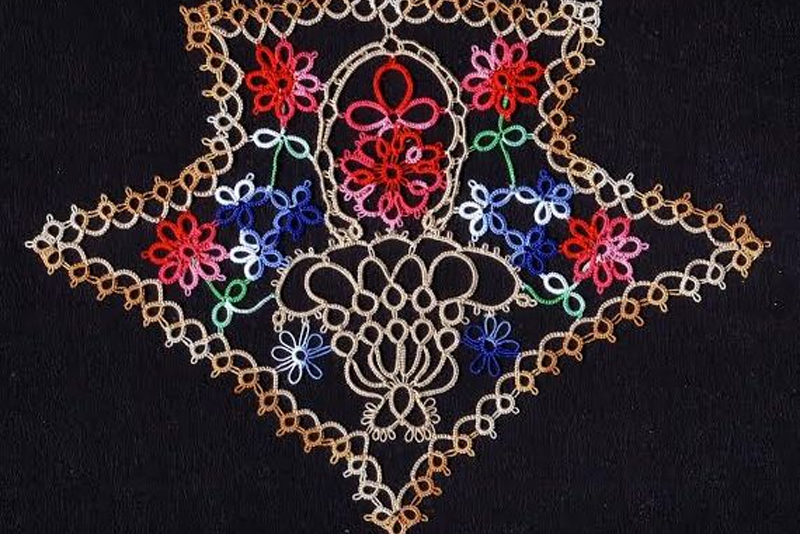
Instructions for interlocking tatted rings appeared in the Young Ladies Journal, 1869. This method was revived and reprinted in Tatting Knots and Notes, Nov. 1992 by the late Doretha Albee. (Doretha Albee, 1935 - 2011, IOLI member, was a Master Tatter and editor of Tatting Knots and Notes for many years. She shared a lovely doily pattern with us. https://www.bellaonline.com/articles/art1766.asp)
These vintage directions are shown without shuttles as in finger tatting. The core thread, or shuttle thread, is brought through the center of the first ring tatted normally but before that ring is closed. (The needle tatter may bring the needle through the center after the ring is closed as space is not a factor.) After the thread is through the center keep out a loop of thread as the ring is closed. This loop then becomes the loop around the left hand to form the next ring. Bring shuttle through the loop from
the back to the front and begin tatting. Leave a short bare thread space between the rings if you wish them to lay flat.

Right click and save this direction sheet to your computer for easy viewing later.
In more recent years, this interlocking rings technique has been modified and adapted to interlocking split rings in one or more colors. Edwige Renaudin, Master Tatter and author of "La Frivolité aux Navettes, Les Bases Fondamentales Perfectionnées Vol. 1,"(published by éditions didier carpentier, 2012, HB, more than 1000 photos and illustrations. See https://www.bellaonline.com/articles/art22678.asp), illustrated this method in her book on page 159. The Online Tatting Class recently studied this page and Stephanie Wilson has prepared some further photos to help us understand the method.

This photo shows a side by side comparison of interlocking rings made with two variations. On the left side the split ring is completed and then the second set of shuttles is brought through the unclosed ring UPWARDS. On the right side the split ring is completed and then the second set of shuttles is brought through the unclosed ring DOWNWARDS.
 |  |
In this pair of tutorial photos, the split ring is complete and the second pair of shuttles brought through the unclosed ring. Note how the thread from the second pair of shuttles lies on top of the ring thread on the left and below the ring thread on the right.
 |  |
In the last pair of tutorial photos, The following split ring is complete. Note how the thread from the second pair of shuttles lies on top of the ring on the left and below the ring on the right.
Now just imagine the possibilities if you added beads to the tatting!

Related Articles
Editor's Picks Articles
Top Ten Articles
Previous Features
Site Map
Content copyright © 2023 by Georgia Seitz. All rights reserved.
This content was written by Georgia Seitz. If you wish to use this content in any manner, you need written permission. Contact Georgia Seitz for details.