logo
g Text Version
Auto
Beauty & Self
Books & Music
Career
Computers
Education
Family
Food & Wine
Health & Fitness
Hobbies & Crafts
Home & Garden
Money
News & Politics
Relationships
Religion & Spirituality
Society & Culture
Sports
Travel & Leisure
TV & Movies

dailyclick
Bored? Games!
Postcards
Astrology
Take a Quiz
Rate My Photo

new
Jokes & Riddles
Astronomy
Philosophy
Public Health
Canadian Culture


dailyclick
All times in EST

Low Carb: 8:00 PM

Full Schedule
g
g Math Site
Beverly Mackie
BellaOnline's Math Editor

g

More Summer Math Books


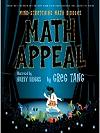
Math Appeal
Author: Greg Tang
Publisher: Scholastic Press, New York 2003
Ages: 7 - 10

Greg Tang is one of my favorite children book math authors. Math Appeal is a book of rhymes/riddles with helpful hints. On the left-hand side, a brain-teaser is presented in picture form. On the right-hand side, the problem and hints to solve it are within the riddle and suggests a variety of ways to solve the problem. In all of his books, he combines problem solving with arithmetic in a fun learning manner. In fact, Tang states he incorporates four concepts, “thinking outside of the box, finding strategic sums, using subtraction to add, and simplifying through patterns and symmetry.” In my opinion, he does just what he says. Meanwhile, you think you’re just having fun reading. Other books by Tang are

Grapes Of Math (introduction to multiplication)(ages 7 – 10)

Math For All Seasons (counting and arithmetic)(ages 5 – 8)

Math Fables (ages 3 – 6)

Math Terpieces (combines math and Art history)(ages 7-12)

Math Potatoes (problem solving combined with multiplication)(ages 8 – 13)

Math Fables Too (uses sciences to get kids attention) (ages 3 – 7)


Cheetah Math: Learning About Division From Baby Cheetahs
Author: Ann Whitehead Nagda
Publisher: Henry Holt and Company, New York 2007

Cheetah Math and three other books were written in collaboration with the San Diego Zoo. The San Diego Zoo’s Wild Animal Park has been the birthplace for over 130 cheetahs at time of publishing. When some of these cubs have to be “hand raised ,“
they are trained to become ambassadors to greet zoo visitors. In order to train them to become ambassadors, they are matched with a dog which helps train them. The author uses division to develop the true story between the cubs and dogs. If you want to only learn about the training of the cubs, then read only the right-hand side. Otherwise, read the left-hand pages to learn how math was used to care for the cheetahs. What a neat idea! I have to admit that I enjoyed the collaboration between the author and San Diego Zoo, and I learned something new. The other titles which use the same concept include...

Panda Math: Learning About Subtraction from Hua Mei and Mei Sheng

Chimp Math: Learning about Time from a Baby Chimpanzee

Polar Bear Math: Learning About Fractions from Klondike and Snow

Tiger Math: Learning to Graph from a Baby Tiger


Summer Reading With Math Flavor
Author's website with free signed bookmarks
RSS
Related Articles
Previous Features
Site Map


Content copyright © 2008 by Beverly Mackie. All rights reserved.
This content was written by Beverly Mackie. If you wish to use this content in any manner, you need written permission. Contact Beverly Mackie for details.
Digg! g delicious Save to Del.icio.us

g


For FREE email updates, subscribe to the Math Newsletter


Past Issues


print
Printer Friendly
bookmark
Bookmark
tell friend
Tell a Friend
forum
Forum
email
Email Editor

g features
Trick or Treat - Math Fun

Mean - Median - Mode - Range

Converting Decimals - Percents - Fractions

Archives | Site Map

forum
Forum
email
Contact

Past Issues
memberscenter


vote
Driving Amount
Much more
Slightly more
Slightly less
Much less

g


| About BellaOnline | Privacy Policy | Advertising | Become an Editor |
Website copyright © 2008 Minerva WebWorks LLC. All rights reserved.


BellaOnline Editor