Maintaining A Terrarium for Orchids
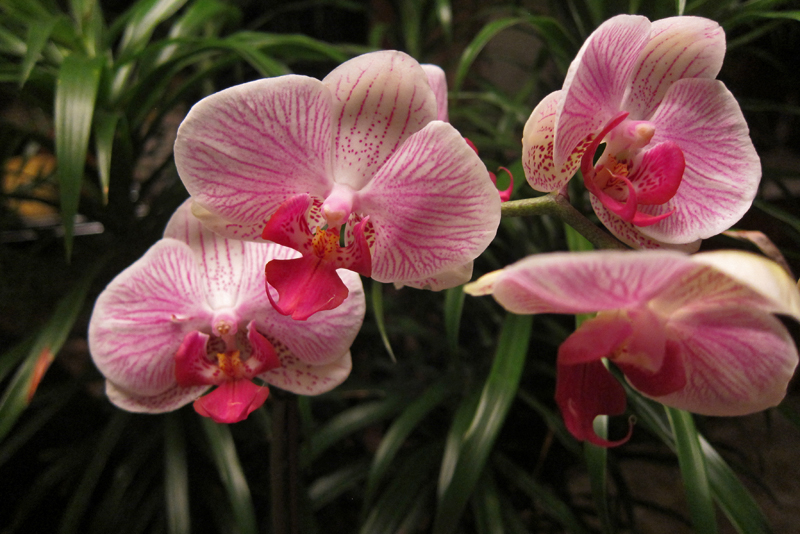
Once you have your terrarium set up for your orchids (see Setting Up a Terrarium for Orchids) maintaining happy and healthy plants is easy if you give them all the elements of their environment they need.
Depending upon the type of plants you have chosen for your terrarium, you will need to provide adequate light. It is important when you set it up to choose plants which require like temperatures and light for best growth. In addition, it is good to try to group your plants by their light requirements throughout the year. Many epiphytes come from equatorial areas which receive equal amounts of light year round with little change from summer to winter. Your lighting requirements are fairly straightforward in this case: 11 to 12 hours of light. If, however, you have plants such as Cattleyas or other light sensitive plants, you will have to follow a spring, summer, fall and winter schedule. In general, spring and fall should require approximately 12-13 hours of light; summer approximately 15-16 hours and winter approximately 10-11 hours.
Air circulation is a critical factor in maintaining a terrarium. If you do not keep the air moving, you run the risk of encouraging pathogens such as molds which will quickly kill your plants. If you have set up your own aquarium, small computer fans will provide enough circulation to keep your plants happy. If you’re lucky enough to have invested in a professional Wardian case or terrarium, then the fans should already be included. You should also have a vent of some sort to allow warmer air to be moved out of the environment and fresh air in.
Temperature is another area which requires control in a terrarium. Artificial lighting causes heat which can quickly rise in the enclosed environment. A minimum/maximum thermometer which also records humidity is an ideal instrument. You will want to keep the temperature in the 75 degree Fahrenheit, or ___ Centigrade, range for cool growers and 85 degrees Fahrenheit, or __ Centigrade, for intermediate growers. One great challenge for you will be to lower temperatures enough at night to get the diurnal drop that many orchids need at night. Turning off the lights will provide a relief from the heat they produce, but venting out that heat is the only way to really make a difference. Ideally, you will want a 10 degree Fahrenheit, or __ Centigrade, drop at night. In reality, this is very difficult to achieve. I’ve even heard of people who put ice cubes in their terrariums at night in order to force this to happen, with mixed results from their efforts.
Depending upon the type of plants you have chosen for your terrarium, you will need to provide adequate light. It is important when you set it up to choose plants which require like temperatures and light for best growth. In addition, it is good to try to group your plants by their light requirements throughout the year. Many epiphytes come from equatorial areas which receive equal amounts of light year round with little change from summer to winter. Your lighting requirements are fairly straightforward in this case: 11 to 12 hours of light. If, however, you have plants such as Cattleyas or other light sensitive plants, you will have to follow a spring, summer, fall and winter schedule. In general, spring and fall should require approximately 12-13 hours of light; summer approximately 15-16 hours and winter approximately 10-11 hours.
Air circulation is a critical factor in maintaining a terrarium. If you do not keep the air moving, you run the risk of encouraging pathogens such as molds which will quickly kill your plants. If you have set up your own aquarium, small computer fans will provide enough circulation to keep your plants happy. If you’re lucky enough to have invested in a professional Wardian case or terrarium, then the fans should already be included. You should also have a vent of some sort to allow warmer air to be moved out of the environment and fresh air in.
Temperature is another area which requires control in a terrarium. Artificial lighting causes heat which can quickly rise in the enclosed environment. A minimum/maximum thermometer which also records humidity is an ideal instrument. You will want to keep the temperature in the 75 degree Fahrenheit, or ___ Centigrade, range for cool growers and 85 degrees Fahrenheit, or __ Centigrade, for intermediate growers. One great challenge for you will be to lower temperatures enough at night to get the diurnal drop that many orchids need at night. Turning off the lights will provide a relief from the heat they produce, but venting out that heat is the only way to really make a difference. Ideally, you will want a 10 degree Fahrenheit, or __ Centigrade, drop at night. In reality, this is very difficult to achieve. I’ve even heard of people who put ice cubes in their terrariums at night in order to force this to happen, with mixed results from their efforts.
You Should Also Read:
Setting up a Terrarium for Orchids
Growing Orchids in a Terrarium or Wardian Case
Enough Light for Orchids

Related Articles
Editor's Picks Articles
Top Ten Articles
Previous Features
Site Map
Content copyright © 2023 by Susan Taylor. All rights reserved.
This content was written by Susan Taylor. If you wish to use this content in any manner, you need written permission. Contact Anu Dharmani for details.