Free Crochet Pattern - Cup Cozy
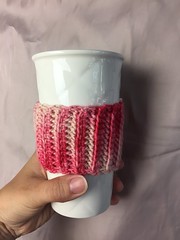 "
" A blogger friend of mine recently asked me to make her two cup cozies for her coffee on the go. Here in Canada, we love our coffee, and we love our cozy things! Combining the two just makes sense, and cup cozies have become more and more popular in the past handful of years.
She said she had bought two cute little applique patches to decorate the cozies with: one of a Boston terrier, because she is a Boston terrier mama, and one with an inspiring saying on it. I thought they were both lovely ideas, and got to work making a cozy that would be beautiful, stretch around most coffee to-go cups, and would be simple enough in design to allow her appliques to shine.
The pattern is below. I hope you'll find it quick and easy to make!
What You'll Need
- about 50 yards of worsted weight yarn
- 5 mm crochet hook
- tapestry needle for weaving in ends
- Scissors
Let's Get Started
1. Chain 9, skip 1st chain, SC in each chain across, back to initial knot.
2. Chain 1, turn, SC into back loops only of each stitch across, making your final stitch in the skipped chain from the previous row. In this way, you'll have 8 stitches in each row, plus the original chain 1.
3. Chain 1, turn, SC into back loops only of each stitch across, making final stitch in the Chain 1 stitch from previous row.
4-34. Repeat row 3. If you're making your cozy for a specific cup, just add rows or reduce rows to make it fit. Just be sure you give the cozy a definite negative give. You want it to stretch to fit the cup, so the tension of the stitches holds it in place.
Bring the initial chain row up to meet the top of your final row, and stitch together with either slip stitch or SC, picking up the one loop from each end as the foundation to your row. Alternatively, you could fasten off, leaving a tail long enough to sew the ends together using your tapestry needle. Joining by sewing can leave you with a seam that stretches more than a crocheted seam.
Weave in your ends.
And there you have it! I hope you enjoy making this simple and beautiful coffee (or tea) cup cozy! I'd love to see how creative you get with decorating it! Connect with me on Facebook and share your work, or drop me an email and say hello!
You Should Also Read:
Faux Knit Cowl

Related Articles
Editor's Picks Articles
Top Ten Articles
Previous Features
Site Map
Content copyright © 2023 by Holly Messenger Aamot. All rights reserved.
This content was written by Holly Messenger Aamot. If you wish to use this content in any manner, you need written permission. Contact Holly Messenger Aamot for details.