

School Counselor Tammy Beckelheimer

I interviewed Tammy Beckelheimer for those who may be interested in pursuing a school counseling career. Ms. Beckelheimer serves as the counselor for the 10th-grade girls and all of the 11th-grade students at Tunstall High School, in Dry Fork, VA.
Ms. Beckelheimer received her Bachelor of Arts in Speech Communications from the Pennsylvania State University and her Master of Arts degree in Secondary School Guidance from the Edinboro University of Pennsylvania. Ms. Beckelheimer always wanted to live in the South. Because she grew up in Pennsylvania, she decided to attend universities in Pennsylvania in order to pay an in-state tuition rate. However, since school counselor requirements vary from state to state, she researched requirements to ensure would be able to work as a school counselor in Southern states by contacting the American School Counseling Association.
After graduation, Ms. Beckelheimer accepted a position at Tunstall High School in Virginia. She continues to work at Tunstall because she enjoys the school and her work.
In Pennsylvania, school counseling programs are divided into elementary and secondary counseling. Ms. Beckelheimer chose to study secondary school counseling because she enjoys working with students in that age group and because she wanted to make a difference in their lives.
School counselors who completed their counseling master's degree program in Virginia are eligible to become licensed for kindergarten through 12th grade. One of their requirements is to complete an internship in both elementary and secondary education. Ms. Beckelheimer is licensed in Commonwealth of Virginia to serve as a school counselor for 8th- through 12th-grade students because her internship was only in secondary education.
As a school counselor, Ms. Beckelheimer works with students to help them plan their futures and to help them deal with personal issues. Her students face issues such as academic struggles, suicidal thoughts, bullying, and abuse.
In addition to her counseling duties, Ms. Beckelheimer coordinates several programs at the high school. She coordinates both college admissions testing and standardized course testing. She also serves as the school-level coordinator for the Commonwealth Scholars, a Virginia program that encourages students to challenging themselves during high school. In addition, she serves on the scholarship committees and the child-study team (a group of professionals who meet to decide on a course of action to help students who are experiencing difficulty).
Ms. Beckelheimer recommends that prospective school counselors spend some time volunteering with school-age children, especially at-risk children, to make sure that they will enjoy working with that age group. She explained that is a very rewarding job, but it can be very stressful and is not for everyone. Ms. Beckelheimer also recommends that students in the United States make sure they understand the school counseling licensure requirements for their desired state of residence.
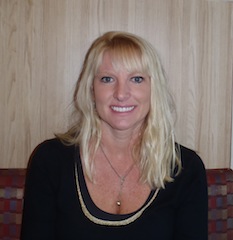
Photograph of Ms. Beckelheimer taken by the author with permission.
Ms. Beckelheimer received her Bachelor of Arts in Speech Communications from the Pennsylvania State University and her Master of Arts degree in Secondary School Guidance from the Edinboro University of Pennsylvania. Ms. Beckelheimer always wanted to live in the South. Because she grew up in Pennsylvania, she decided to attend universities in Pennsylvania in order to pay an in-state tuition rate. However, since school counselor requirements vary from state to state, she researched requirements to ensure would be able to work as a school counselor in Southern states by contacting the American School Counseling Association.
After graduation, Ms. Beckelheimer accepted a position at Tunstall High School in Virginia. She continues to work at Tunstall because she enjoys the school and her work.
In Pennsylvania, school counseling programs are divided into elementary and secondary counseling. Ms. Beckelheimer chose to study secondary school counseling because she enjoys working with students in that age group and because she wanted to make a difference in their lives.
School counselors who completed their counseling master's degree program in Virginia are eligible to become licensed for kindergarten through 12th grade. One of their requirements is to complete an internship in both elementary and secondary education. Ms. Beckelheimer is licensed in Commonwealth of Virginia to serve as a school counselor for 8th- through 12th-grade students because her internship was only in secondary education.
As a school counselor, Ms. Beckelheimer works with students to help them plan their futures and to help them deal with personal issues. Her students face issues such as academic struggles, suicidal thoughts, bullying, and abuse.
In addition to her counseling duties, Ms. Beckelheimer coordinates several programs at the high school. She coordinates both college admissions testing and standardized course testing. She also serves as the school-level coordinator for the Commonwealth Scholars, a Virginia program that encourages students to challenging themselves during high school. In addition, she serves on the scholarship committees and the child-study team (a group of professionals who meet to decide on a course of action to help students who are experiencing difficulty).
Ms. Beckelheimer recommends that prospective school counselors spend some time volunteering with school-age children, especially at-risk children, to make sure that they will enjoy working with that age group. She explained that is a very rewarding job, but it can be very stressful and is not for everyone. Ms. Beckelheimer also recommends that students in the United States make sure they understand the school counseling licensure requirements for their desired state of residence.
Photograph of Ms. Beckelheimer taken by the author with permission.
You Should Also Read:
School Social Worker Sue Cataen-Ingram

Related Articles
Editor's Picks Articles
Top Ten Articles
Previous Features
Site Map
Content copyright © 2023 by Susan D. Bates. All rights reserved.
This content was written by Susan D. Bates. If you wish to use this content in any manner, you need written permission. Contact Eliza Morrison Nimmich for details.
