

Acing Your College Application Book Review

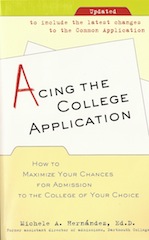
Acing the College Application: How to Maximize Your Chances for Admission to the College of Your Choice by Michele A. Hernandez, Ed.D. (2007) is a step-by-step admissions guide for prospective students applying to competitive colleges. It is designed to help college applicants improve their chances of admittance to their preferred college.
Dr. Hernandez is a former the assistant director of admissions at Darmouth College. Dr. Hernandez claims that although school counselors and others who advise prospective college students offer guidance, they do not know the whole "behind-the-scenes admissions story." I believe that point has some validity because it is necessary for prospective college students to view their applications from the admissions office’s point of view to create most effective applications. However, I believe that educational professionals outside of the admissions office often provide useful advice to prospective college students.
The main focus of the book is on completing the application and supplemental forms, such as essays and recommendations. The book includes detailed information about sections of the application and the forms and instructions on what information to include. It also offers advice from the author’s point of view throughout the book.
An example of the Dr. Hernandez’s advice is for applicants to complete their applications by hand and mail them in unless otherwise required by the college. The author recognizes that this advice is contrary to popular opinion and explains the benefits of completing the application by hand, such as listed by the author include appearing more personal, showing that the application was completed by the actual applicant, decreasing the likelihood that the applicants is using the same application to apply to multiple colleges, and conveying a sense of realness.
In my opinion, this advice and other advice in the book should be weighed against students’ own opinions and advice from other professions. Other admissions counselors may have a different perspective on this and other topics included in the book.
In addition to offering advice on completing a college application and required supplemental forms, the book offers advice on other topics including college interviews, ethical dilemmas, and making decisions after acceptance to college.
The chapters are as follows:
1. The Activity List
2. The Warm-Up Essays
3. The Warm-Up Essay Redux
4. The Main Essay
5. The Supplemental Essay
6. Oddball Essays
7. The “Why” Paragraph
8. A Step-By-Step Look At The Data Section of the Application
9. Putting It All Together
10. Teacher and Counselor Recommendations
11. The Optional Peer Recommendation
12. The Interview
13. Early Action Versus Early Decision – The Tradeoffs
14. Extra Materials – What to send and What Not to Send
15. Ethical Dilemmas and Explanatory Notes
16. What To Do If You Deferred or Wait-listed
17. Weighing Your Options Once You are Accepted
Overall, the book is a helpful tool for students applying to college because it offers detailed advice for every section of the application and guidance on related issues. While the book focuses on students applying to selective colleges, the book is still helpful for students applying to any competitive college because it walks applicants through sections of the application process that can be confusing and offers advice that can give them an advantage.
However, this book may turn off applicants who are not at the top of their class because it is written for the above-average student applying to highly selective colleges. The book may also convince applicants that they cannot gain acceptance into any college unless they are extraordinary. In reality, there are colleges with various degrees of selectivity and the majority of applicants are able to find a college suited them.
This book was purchased by the author of this review using her own funds.
Dr. Hernandez is a former the assistant director of admissions at Darmouth College. Dr. Hernandez claims that although school counselors and others who advise prospective college students offer guidance, they do not know the whole "behind-the-scenes admissions story." I believe that point has some validity because it is necessary for prospective college students to view their applications from the admissions office’s point of view to create most effective applications. However, I believe that educational professionals outside of the admissions office often provide useful advice to prospective college students.
The main focus of the book is on completing the application and supplemental forms, such as essays and recommendations. The book includes detailed information about sections of the application and the forms and instructions on what information to include. It also offers advice from the author’s point of view throughout the book.
An example of the Dr. Hernandez’s advice is for applicants to complete their applications by hand and mail them in unless otherwise required by the college. The author recognizes that this advice is contrary to popular opinion and explains the benefits of completing the application by hand, such as listed by the author include appearing more personal, showing that the application was completed by the actual applicant, decreasing the likelihood that the applicants is using the same application to apply to multiple colleges, and conveying a sense of realness.
In my opinion, this advice and other advice in the book should be weighed against students’ own opinions and advice from other professions. Other admissions counselors may have a different perspective on this and other topics included in the book.
In addition to offering advice on completing a college application and required supplemental forms, the book offers advice on other topics including college interviews, ethical dilemmas, and making decisions after acceptance to college.
The chapters are as follows:
1. The Activity List
2. The Warm-Up Essays
3. The Warm-Up Essay Redux
4. The Main Essay
5. The Supplemental Essay
6. Oddball Essays
7. The “Why” Paragraph
8. A Step-By-Step Look At The Data Section of the Application
9. Putting It All Together
10. Teacher and Counselor Recommendations
11. The Optional Peer Recommendation
12. The Interview
13. Early Action Versus Early Decision – The Tradeoffs
14. Extra Materials – What to send and What Not to Send
15. Ethical Dilemmas and Explanatory Notes
16. What To Do If You Deferred or Wait-listed
17. Weighing Your Options Once You are Accepted
Overall, the book is a helpful tool for students applying to college because it offers detailed advice for every section of the application and guidance on related issues. While the book focuses on students applying to selective colleges, the book is still helpful for students applying to any competitive college because it walks applicants through sections of the application process that can be confusing and offers advice that can give them an advantage.
However, this book may turn off applicants who are not at the top of their class because it is written for the above-average student applying to highly selective colleges. The book may also convince applicants that they cannot gain acceptance into any college unless they are extraordinary. In reality, there are colleges with various degrees of selectivity and the majority of applicants are able to find a college suited them.
This book was purchased by the author of this review using her own funds.
You Should Also Read:
Rules of College Admissions
Applying to College -- An Overview
The Common Application

Related Articles
Editor's Picks Articles
Top Ten Articles
Previous Features
Site Map
Content copyright © 2023 by Susan D. Bates. All rights reserved.
This content was written by Susan D. Bates. If you wish to use this content in any manner, you need written permission. Contact Eliza Morrison Nimmich for details.
