Martha Ess rev. Schiffchenspitzen,
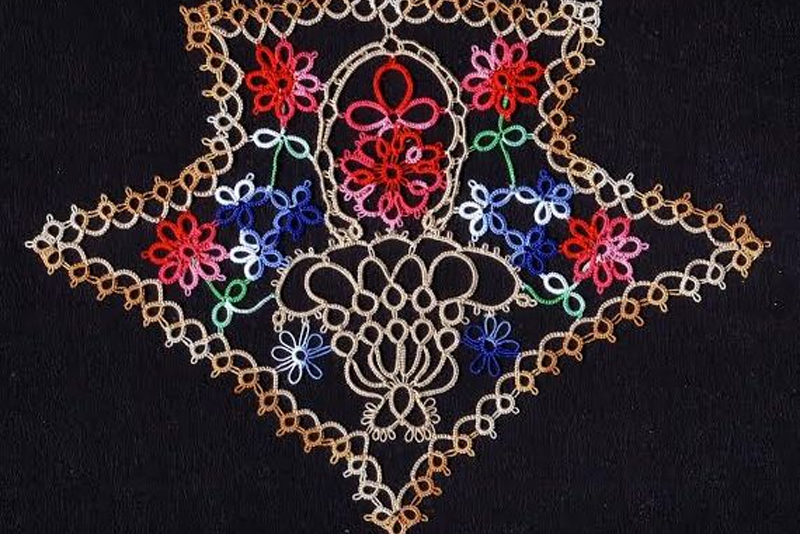
Frau Tina Frauberger's "Schiffchenspitzen," figure 78. Revised by Martha Ess
One of the projects being studied by the Online Tatting Class (which I have led for the last 14 years) is to modernize vintage patterns. All tatters will have read those older patterns that tell you to wind the shuttle and cut the thread. Then they follow that instruction by telling us to tie the tails together! That only creates an unnecessary extra set of tails to be hidden in the work. We seek ways to efficiently tat the pattern from the center outward or from row to row without cutting the thread. We have learned to employ the split ring, split chain and mock picot to do this. It is not always possible nor even sensible in some cases particularly if working in multiple colors. But study the pattern first before you cut.
Martha Ess, Master Tatter and the author and designer of several tatting books shares her work in modernizing one such pattern. This pattern is from the 1919 edition of Frau Tina Frauberger's "Schiffchenspitzen," figure 78. Martha has prepared two versions on the pattern. The last pattern shows how to tat the motif in one pass. Her comments and suggestions included.
 |  |
Schiffchenspitzen. Purists could argue that these are not true onion rings, since the inner ring is surrounded by a chain rather than another ring. You could work that chain as a ring with an onion ring join, but then the threads would not be in position for the next round, so I followed her lead and worked it as a chain as written in the original pattern.
My model, 4 1/2 inches across, in size 20
Frauberger's illustration
Center: Wind 2 shuttles CTM. Note: entire center is worked on the “front side.”
R: 11 vsp 11 clr DNRW
[SS R: 4 – 4 – 4 – 4 clr SS CH: 7] 2 times, LJ to vsp of 1st R, repeat 2 more times.
Cut and tie to base of 1st R

Outside: Wind 2 shuttles CTM
Ring Section
Rnd 1: R: 12 vsp 12 clr RW
Rnd 2: CH: 17 + LJ (to prev R) 17 + LJ (to base of R) RW SS
Rnd 3: CH: 8 SS
R: 4 – 4 ± 4 – 4 clr SS (picot on 1st repeat, later repeats join to inward ring of Connector)
CH: 7 ± 8 + LJ (to LJ), SS (picot on 1st repeat, later repeats join to adj R of prev Ring Section )
R: 5 – 5 ± 5 – 5 clr SS (alternating repeats will join to Center or make picot)
CH: 8 SS
R: 4 – 4 ± 4 – 4 clr SS (final repeat will join to 1st Ring Section)
CH: 7 SS
R: 4 – 4 – 4 – 4 clr SS
CH: 8 + LJ (to base of 1st R) turn, SS

Connector Section
CH: 8 – 8 RW
R: 6 + (to center p of prev R) 6 clr RW SS
R: 6 – 6 clr SS
CH: 8 – 8 RW
R: 6 ± 6 clr RW SS (final repeat will join to 1st Ring Section)
R10: 6 – 6 clr SS
CH: 8 – 8 RW
Make 8 repeats, ending with tie to base of 1st Ring Section

Entire motif, with single pattern repeat in black, center in blue.
One Pass Version
Since Georgia delights in finding ways to adapt old patterns without cut and ties, I worked out this variation. It’s fiddly with making sure the work isn’t twisted when making joins but works easily enough otherwise.
The center section will be worked last. Wind 2 shuttles CTM and hang a paper clip on the thread to hold open an initial vsp. Begin with the Connector Section and work until there are 7 Ring Sections and 8 Connector Sections. Join into the initial vsp and RW.
a SR: 12 / 12 RW
b CH: tiny vsp 17 + LJ (to bottom of SR) turn SS
c CH: 8 SS
d R: 4 – 4 + (to inward ring of Connector of previous repeat) 4 – 4 clr SS
e CH: 7 + (to adj R of prev Ring Section ) 8 + LJ (to vsp at top of SR)
f CH: 17 + LJ (to bottom of SR) turn SS
g CH: 8 SS
h R: 4 – 4 + (to inward ring of 1st Connector) 4 – 4 clr SS
i CH: 7 SS
j R: 4 – 4 + (to p of 1st Ring Section) 4 – 4 clr SS
k CH: 8 + LJ (to LJ at top of SR) turn
l SR: 5 – 5 / 5 – 5 clr
m SR: MP 4 – 4 / 4 – 4 clr
n R: 11 vsp 11 clr RW
[CH: 7 SS R: 4 – 4 + (skip one, join to next Ring Section) 4 – 4 clr SS] 2 times, LJ to center R
CH: 7 SS
R: 4 – 4 + (skip one, join to next Ring Section) 4 – 4 clr SS
CH: 7 Cut & tie to base of center R.

Diagram for one-pass version. Begin with Connector Section chain, and work around until last
repeat. See earlier diagrams for stitch counts.
R = ring, CH = Chain, - = picot, + = join, ± = picot on first pass but join on following passes,
LJ = lock join, SS = switch shuttles, clr = close ring, SR = split ring, MP = mock picot,
vsp = very small picot (for joining purposes), DNRW = do not reverse work, RW = reverse work,
CTM = Continuous Thread Method = wind the shuttle and begin tatting without cutting the thread to the ball or shuttle 2.
Tina Frauberger's book, Schiffchenspitzen, is available for free download:
https://www.bellaonline.com/subjects/3137.asp
You Should Also Read:
Flights of Fantasy - Martha Ess
Climbing Out from the center
Picot Play by Martha Ess

Related Articles
Editor's Picks Articles
Top Ten Articles
Previous Features
Site Map
Content copyright © 2023 by Georgia Seitz. All rights reserved.
This content was written by Georgia Seitz. If you wish to use this content in any manner, you need written permission. Contact Georgia Seitz for details.