VanDyke Edging by Sudie Sherrod
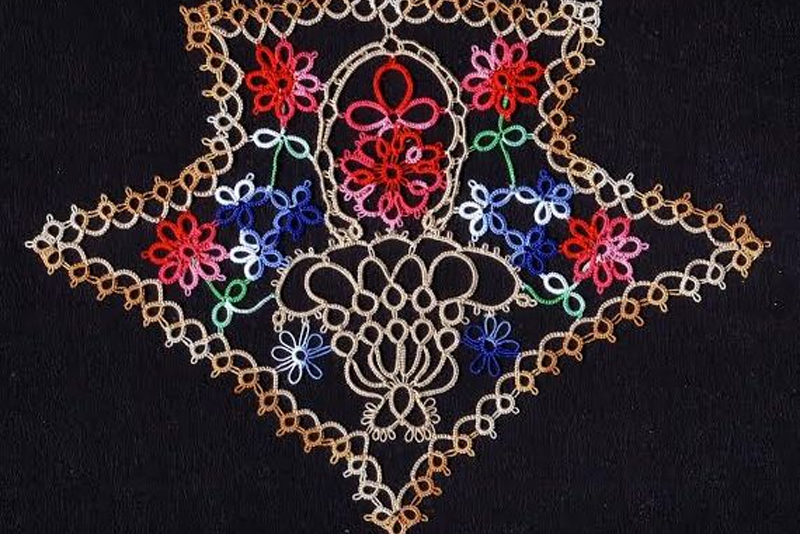
Sudie Sherrod Needlecraft Magazine April 1933 pg. 24
An Especially Pretty Van Dyke Border

Each triangle is tatted separately in the original method, however, using a split ring for the center of the corner trefoil, it is possible to make them in pairs. Needleweaving is done last.
Begin with trefoil at upper right corner:
R 4 - 4 - 4 - 4 clr dnrw leave no space
R 4 + 4 - 4 - 4 clr dnrw leave no space
R 4 + 4 - 4 - 4 clr rw
*CH 4 - 4 rw
R 4 + (join to last picot of trefoil) 4 - 4 - 4 clr rw
*Repeat from * for a total of 8 rings/chains going down to the point on the right side of the triangle.
Trefoil
R 4 + (join to last ring in the row) 4 - 4 - 4 clr dnrw leave no space
R 4 + 4 - 4 - 4 clr dnrw leave no space
R 4 + 4 - 4 - 4 clr rw
CH 4 + (join to previous chain) 4 rw
*R 4 + (join to last picot of trefoil) 4 - 4 - 4 clr rw
CH 4 - 4 rw
*Repeat from * for a total of 8 rings/chains going up to the corner on the left side of the triangle.
Trefoil
R 4 + (join to last ring in the row) 4 - 4 - 4 clr dnrw leave no space
R 4 + 4 - 4 - 4 clr dnrw leave no space
R 4 + 4 - 4 - 4 clr rw
CH 4 + (join to previous chain) 4 rw
*R 4 + (join to last picot of trefoil) 4 - 4 - 4 clr rw
CH 4 - 4 rw
*Repeat from * for a total of 7 rings/chains across the top of the triangle.
Join last ring to the first ring of the first trefoil and finish off ends.
Alternative method to make a pair without cutting the thread.
Begin trefoil with the last ring of the three and continue as above completely around the triangle.
After the last chain, make one more ring of the trefoil, joining to the previous ring.
Make center ring of the trefoil a split ring joining to the rings on both sides and climbing out with a mock picot into the new triangle at the upper left corner also with a split ring and continuing around in a like manner as the first triangle.
R = Ring CH = Chain RW = Reverse Work DNRW = Do Not Reverse Work - = Picot + = Join CLR = close ring
Note Bene: Although the original pattern used the term "cloverleaf" to describe the three ring joined together, in the Online Tatting Class, the word trefoil denotes 3 rings all the same size while clover or cloverleaf denotes 3 rings where the center ring is larger.

For Needleweaving ideas please visit the page for the Buttericks 1896 book.
An Especially Pretty Van Dyke Border
Each triangle is tatted separately in the original method, however, using a split ring for the center of the corner trefoil, it is possible to make them in pairs. Needleweaving is done last.
Begin with trefoil at upper right corner:
R 4 - 4 - 4 - 4 clr dnrw leave no space
R 4 + 4 - 4 - 4 clr dnrw leave no space
R 4 + 4 - 4 - 4 clr rw
*CH 4 - 4 rw
R 4 + (join to last picot of trefoil) 4 - 4 - 4 clr rw
*Repeat from * for a total of 8 rings/chains going down to the point on the right side of the triangle.
Trefoil
R 4 + (join to last ring in the row) 4 - 4 - 4 clr dnrw leave no space
R 4 + 4 - 4 - 4 clr dnrw leave no space
R 4 + 4 - 4 - 4 clr rw
CH 4 + (join to previous chain) 4 rw
*R 4 + (join to last picot of trefoil) 4 - 4 - 4 clr rw
CH 4 - 4 rw
*Repeat from * for a total of 8 rings/chains going up to the corner on the left side of the triangle.
Trefoil
R 4 + (join to last ring in the row) 4 - 4 - 4 clr dnrw leave no space
R 4 + 4 - 4 - 4 clr dnrw leave no space
R 4 + 4 - 4 - 4 clr rw
CH 4 + (join to previous chain) 4 rw
*R 4 + (join to last picot of trefoil) 4 - 4 - 4 clr rw
CH 4 - 4 rw
*Repeat from * for a total of 7 rings/chains across the top of the triangle.
Join last ring to the first ring of the first trefoil and finish off ends.
Alternative method to make a pair without cutting the thread.
Begin trefoil with the last ring of the three and continue as above completely around the triangle.
After the last chain, make one more ring of the trefoil, joining to the previous ring.
Make center ring of the trefoil a split ring joining to the rings on both sides and climbing out with a mock picot into the new triangle at the upper left corner also with a split ring and continuing around in a like manner as the first triangle.
R = Ring CH = Chain RW = Reverse Work DNRW = Do Not Reverse Work - = Picot + = Join CLR = close ring
Note Bene: Although the original pattern used the term "cloverleaf" to describe the three ring joined together, in the Online Tatting Class, the word trefoil denotes 3 rings all the same size while clover or cloverleaf denotes 3 rings where the center ring is larger.
For Needleweaving ideas please visit the page for the Buttericks 1896 book.
You Should Also Read:
Building a Tatting Library - Buttericks 1896
Van Dyke & Tatting

Related Articles
Editor's Picks Articles
Top Ten Articles
Previous Features
Site Map
Content copyright © 2023 by Georgia Seitz. All rights reserved.
This content was written by Georgia Seitz. If you wish to use this content in any manner, you need written permission. Contact Georgia Seitz for details.