Absolute Beginners - Observing the Moon
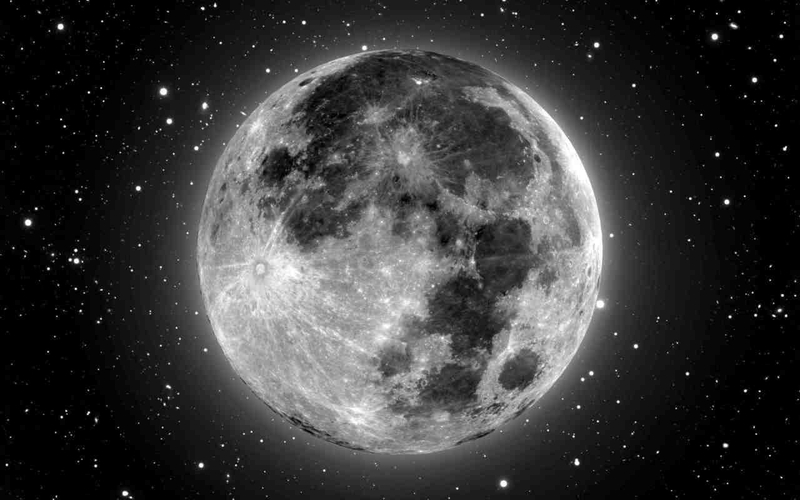
The Moon. [Credit: Wallpaper Safari]
Everyone has seen the Moon, but have you ever really looked at it? It's the closest natural object to the Earth, and we can see it – as our ancestors did – with no aid other than our eyes.
The Moon changes
Think about how the Moon seems to change color. It usually appears to be white, but effects in our atmosphere – for example, moisture and pollutants in the air – affect the color we see. I've seen the Moon pink or golden, not to mention the rusty brown Moon in a lunar eclipse. And have you seen it with a halo around it?
There are delicate changes as the Moon goes through its phases. Look at the change in shape and the change in definition of the lunar features. One effect that always delights me is a crescent Moon with earthshine. You can see the crescent Moon reflecting sunlight, but you can also see the full disk of the Moon in what is usually a pale gray. Sunlight reflects off the Earth to the Moon and back again. People used to call this “the old moon in the new moon’s arms.” [Photo: Bob King]
Have you ever wondered what causes that lopsided 'face' on the Moon? What you're seeing is darker areas on the Moon's surface – lowland plains filled with solidified volcanic lava, which contrasts with the brighter highlands around them.
Those lowlands are some of the oldest features on the Moon. They're so prominent you can see them with the unaided eye from here on Earth, nearly a quarter of a million miles away.
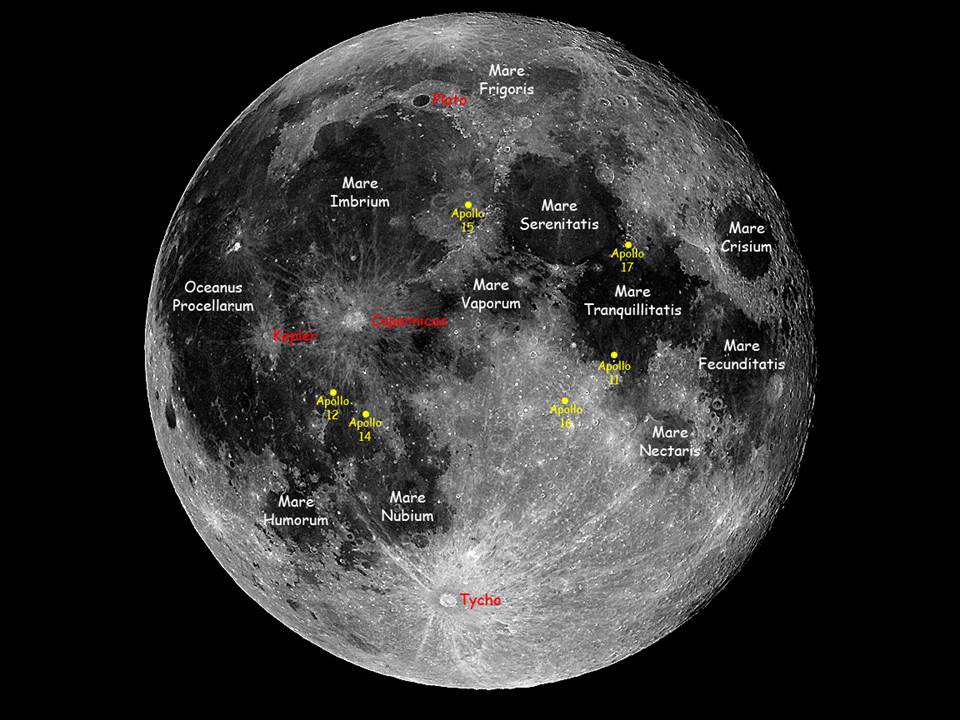
Using a lunar map, see if you can pick out some of the features on the Moon while you're looking at it. (There are a number of lunar maps online and in astronomy books.) By the way, although the maps show a full Moon, you don't have to wait for that.
A closer look
Do you have an old pair of binoculars for sport or nature watching? Use them to get a better view of the Moon's major features. It's quite safe – just don't ever turn binoculars on the Sun, for the Sun's brilliance magnified by a lens, can damage your eyesight immediately and permanently.
The best time to look is not at full moon, but when it's only partly illuminated. The features are flattened at the full moon and the brightness affects your night vision. At other times, however, you can see the surface in sharp relief along the dividing line between night and day, known as the terminator.
Although you can see the bright and dark features with the unaided eye, binoculars will show you more detail. The bright uplands are heavily cratered and the dark lowlands are smoother. The Moonscape appears stark because since there is no atmosphere, there aren't any clouds. The craters were formed by impacts from space debris long ago. The largest ones are over a hundred miles across.
Starting when the Moon is a crescent, watch from night to night as the terminator marches across the Moon, bringing different features into view.
At full moon, it's difficult to spot most of the craters that were so prominent a few days earlier. This is because there are no shadows. However a few craters become much brighter when the Moon is full.
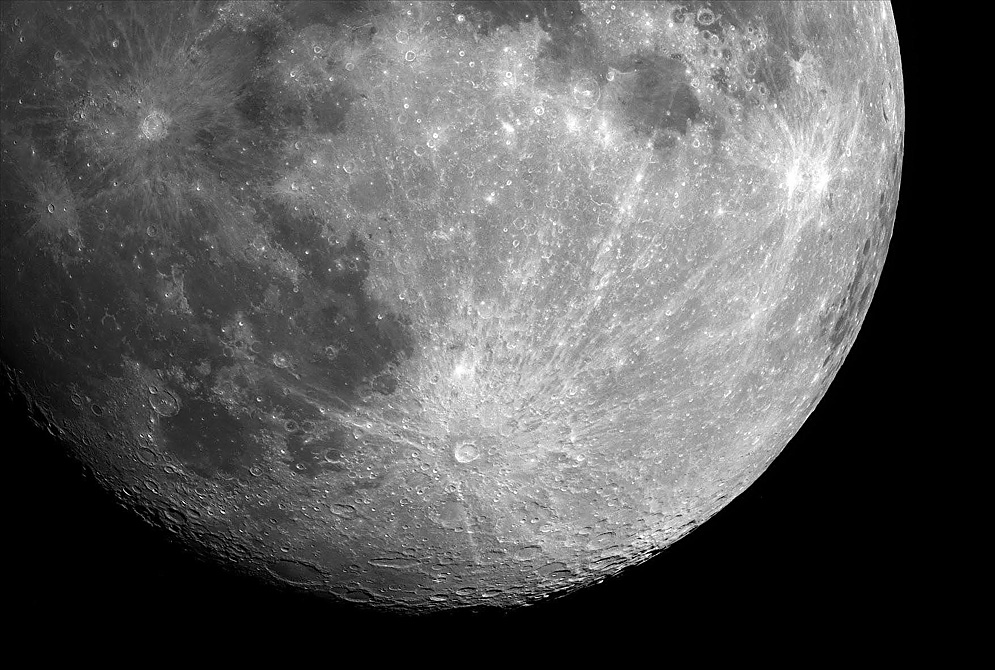
Two prominent craters are Tycho in the rugged southern hemisphere, and Copernicus, on a large lowland called Oceanus Procellarum. Copernicus is in the upper left of the picture and Tycho is bright in the lower right. Both craters are about sixty miles across, big enough to swallow a city. They are both surrounded by bright rays of broken-up rock splashed out by the force of the impacts that created them.
Like most lunar craters, Tycho and Copernicus are named after great astronomers of the past. It was Copernicus who proposed that the Sun, not the Earth, was the center of the Solar System. Tycho Brahe was one of the most brilliant observers of all time, and his careful observations enabled Kepler to show mathematically how the Copernican Solar System worked.
As you scan the Moon's forbidding surface, recall that 12 humans walked on it between 1969 and 1972 during the Apollo missions.
Everyone has seen the Moon, but have you ever really looked at it? It's the closest natural object to the Earth, and we can see it – as our ancestors did – with no aid other than our eyes.
The Moon changes
Think about how the Moon seems to change color. It usually appears to be white, but effects in our atmosphere – for example, moisture and pollutants in the air – affect the color we see. I've seen the Moon pink or golden, not to mention the rusty brown Moon in a lunar eclipse. And have you seen it with a halo around it?
There are delicate changes as the Moon goes through its phases. Look at the change in shape and the change in definition of the lunar features. One effect that always delights me is a crescent Moon with earthshine. You can see the crescent Moon reflecting sunlight, but you can also see the full disk of the Moon in what is usually a pale gray. Sunlight reflects off the Earth to the Moon and back again. People used to call this “the old moon in the new moon’s arms.” [Photo: Bob King]
Have you ever wondered what causes that lopsided 'face' on the Moon? What you're seeing is darker areas on the Moon's surface – lowland plains filled with solidified volcanic lava, which contrasts with the brighter highlands around them.
Those lowlands are some of the oldest features on the Moon. They're so prominent you can see them with the unaided eye from here on Earth, nearly a quarter of a million miles away.
Using a lunar map, see if you can pick out some of the features on the Moon while you're looking at it. (There are a number of lunar maps online and in astronomy books.) By the way, although the maps show a full Moon, you don't have to wait for that.
A closer look
Do you have an old pair of binoculars for sport or nature watching? Use them to get a better view of the Moon's major features. It's quite safe – just don't ever turn binoculars on the Sun, for the Sun's brilliance magnified by a lens, can damage your eyesight immediately and permanently.
The best time to look is not at full moon, but when it's only partly illuminated. The features are flattened at the full moon and the brightness affects your night vision. At other times, however, you can see the surface in sharp relief along the dividing line between night and day, known as the terminator.
Although you can see the bright and dark features with the unaided eye, binoculars will show you more detail. The bright uplands are heavily cratered and the dark lowlands are smoother. The Moonscape appears stark because since there is no atmosphere, there aren't any clouds. The craters were formed by impacts from space debris long ago. The largest ones are over a hundred miles across.
Starting when the Moon is a crescent, watch from night to night as the terminator marches across the Moon, bringing different features into view.
At full moon, it's difficult to spot most of the craters that were so prominent a few days earlier. This is because there are no shadows. However a few craters become much brighter when the Moon is full.
Two prominent craters are Tycho in the rugged southern hemisphere, and Copernicus, on a large lowland called Oceanus Procellarum. Copernicus is in the upper left of the picture and Tycho is bright in the lower right. Both craters are about sixty miles across, big enough to swallow a city. They are both surrounded by bright rays of broken-up rock splashed out by the force of the impacts that created them.
Like most lunar craters, Tycho and Copernicus are named after great astronomers of the past. It was Copernicus who proposed that the Sun, not the Earth, was the center of the Solar System. Tycho Brahe was one of the most brilliant observers of all time, and his careful observations enabled Kepler to show mathematically how the Copernican Solar System worked.
As you scan the Moon's forbidding surface, recall that 12 humans walked on it between 1969 and 1972 during the Apollo missions.
You Should Also Read:
Black Moon - Is That a Thing?
The Moon - Quiz
Moon Facts for Kids

Related Articles
Editor's Picks Articles
Top Ten Articles
Previous Features
Site Map
Content copyright © 2023 by Mona Evans. All rights reserved.
This content was written by Mona Evans. If you wish to use this content in any manner, you need written permission. Contact Mona Evans for details.