Moon Phases and Eclipses – Help for Teachers

Moon phases and eclipses are easily seen, but rather abstract to understand. The first section of this article lists the basic concepts with some links to diagrams. The sections that follow suggest resources for teachers, both lesson plans and short videos available online.
Concepts
The Moon is a bright object that seems to change shape.
It is a rocky spherical body that shines by reflected sunlight.
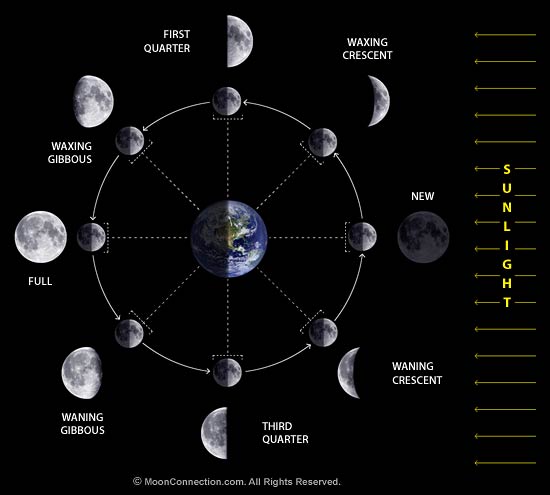
Half of the Moon is always illuminated by the Sun. But what we can see of the sunlit part depends on where the Moon is in its orbit.
The series of changes that occurs each month is known as the phases of the Moon. The Moon orbits the Earth in 27 days, but it takes 29.5 days to get from new moon to new moon. Since the Earth is moving in its orbit around the Sun, the Moon needs extra time to complete its cycle of phases.
The same side of the Moon always faces us.
This isn't because the Moon doesn't turn on its axis. It's because the Moon does rotate. It turns on its axis once in the time it takes to go around the Earth. If it didn't rotate, all parts of the Moon would be visible at some time.
The side of the Moon that never faces Earth isn't the “dark side”.
The side facing away from us is the far side. The dark side is the side facing away from the Sun at a given time – it's like the Earth's night side. It isn't permanently dark.
Eclipses can happen when the Sun, Earth and Moon are properly lined up.
They don't happen every month because usually the Sun, Earth and Moon aren't quite lined up. The Moon's orbit is slightly tilted with respect to Earth's orbit. The orbits cross at two points called nodes. If a full moon or a new moon occurs at these nodes, the three bodies are lined up for an eclipse.
In a lunar eclipse, the shadow of the Earth falls on the Moon. In a solar eclipse, the shadow of the Moon falls on the Earth.
NOTE about the diagram of the orbits. One orbit is labelled “Sun's path”. Of course, it's the Earth that's actually moving. The diagram shows the apparent path of the Sun in the sky as viewed from Earth.
Lesson plans
(1) The Lunar and Planetary Institute
https://www.lpi.usra.edu/education/resources/s_system/moon.shtml#phases
There are a number of activities here. For each one you are told for which age range it's suitable, the time and materials required, and how to run the lesson. You'll also find some material for teachers. Some of the links no longer work, but there's a lot of useful material here.
If you're going to include eclipses, you might like "Fruit Loops: Exploring our Moon's Phases and the Reason for Eclipses." Do use the hoops or rings. They're essential to show that the orbit of the Earth and the Moon are tilted with respect to each other, which is why we don't have eclipses every month.
For Grades 8 and above, consider "Golf Ball Phases and Embroidery Hoop Eclipses".
(2) 21 Super Activities for Teaching Moon Phases
https://www.teachjunkie.com/sciences/21-super-activities-teaching-moon-phases/
Short Videos
(1) Moon Phases Demonstration. https://www.youtube.com/watch?v=wz01pTvuMa0&feature=youtu.be Emily Morgan, author of Next Time You See the Moon, takes you through the phases of the Moon in a demonstration that will be easy to replicate in your own classroom.
(2) Why Does the Moon Look Like It Changes? https://www.youtube.com/watch?v=YdI1aDjWLlY&feature=related Ask an Astronomer and she'll tell you why the same side of the Moon always faces us, and that the apparent shape change is just a change in illumination. Only four of the moon phases are named and labelled. The animation moves very quickly.
(3) What Causes an Eclipse of the Moon? https://www.youtube.com/watch?v=wHxcWSiD_4E The astronomer explains how lunar eclipses are caused by Earth's shadow.
(4) Why Are Solar Eclipses Only Visible in Some Parts of the World? https://www.youtube.com/watch?v=1Gs02YQNckE&feature=related The astronomer shows how the small Moon can block the very large Sun.
Other resources
(1) Earth and Moon Viewer. This page shows the current moon phase. If you want to change the date, time or place, scroll down the page. https://www.fourmilab.ch/cgi-bin/Earth/action?opt=-m&img=MoonTopo.evif
(2) Here's an extension activity to (2). Apollo 11 astronaut Michael Collins used to have a little picture of a crescent-shaped body on his wall. Even though the coloring was wrong, people identified it as the Moon. It was the Earth. You can see the current phase of the Earth as viewed from the Moon. How are the phases of the two bodies related? https://www.fourmilab.ch/cgi-bin/Earth/action?opt=-m
(3) Enchanted Learning. Printable worksheets with diagrams of solar eclipses to label. https://www.enchantedlearning.com/subjects/astronomy/activities/label/solareclipse/ Also of lunar eclipses. https://www.enchantedlearning.com/subjects/astronomy/activities/label/lunareclipse/ Suitable for Grades 7-8.
(4) NASA Starchild. https://starchild.gsfc.nasa.gov/docs/StarChild/solar_system_level2/moonlight.html If you have computers in your classroom, this online quiz to identify and order Moon phases might be handy.
Concepts
The Moon is a bright object that seems to change shape.
It is a rocky spherical body that shines by reflected sunlight.
Half of the Moon is always illuminated by the Sun. But what we can see of the sunlit part depends on where the Moon is in its orbit.
The series of changes that occurs each month is known as the phases of the Moon. The Moon orbits the Earth in 27 days, but it takes 29.5 days to get from new moon to new moon. Since the Earth is moving in its orbit around the Sun, the Moon needs extra time to complete its cycle of phases.
The same side of the Moon always faces us.
This isn't because the Moon doesn't turn on its axis. It's because the Moon does rotate. It turns on its axis once in the time it takes to go around the Earth. If it didn't rotate, all parts of the Moon would be visible at some time.
The side of the Moon that never faces Earth isn't the “dark side”.
The side facing away from us is the far side. The dark side is the side facing away from the Sun at a given time – it's like the Earth's night side. It isn't permanently dark.
Eclipses can happen when the Sun, Earth and Moon are properly lined up.
They don't happen every month because usually the Sun, Earth and Moon aren't quite lined up. The Moon's orbit is slightly tilted with respect to Earth's orbit. The orbits cross at two points called nodes. If a full moon or a new moon occurs at these nodes, the three bodies are lined up for an eclipse.
In a lunar eclipse, the shadow of the Earth falls on the Moon. In a solar eclipse, the shadow of the Moon falls on the Earth.
NOTE about the diagram of the orbits. One orbit is labelled “Sun's path”. Of course, it's the Earth that's actually moving. The diagram shows the apparent path of the Sun in the sky as viewed from Earth.
Lesson plans
(1) The Lunar and Planetary Institute
https://www.lpi.usra.edu/education/resources/s_system/moon.shtml#phases
There are a number of activities here. For each one you are told for which age range it's suitable, the time and materials required, and how to run the lesson. You'll also find some material for teachers. Some of the links no longer work, but there's a lot of useful material here.
If you're going to include eclipses, you might like "Fruit Loops: Exploring our Moon's Phases and the Reason for Eclipses." Do use the hoops or rings. They're essential to show that the orbit of the Earth and the Moon are tilted with respect to each other, which is why we don't have eclipses every month.
For Grades 8 and above, consider "Golf Ball Phases and Embroidery Hoop Eclipses".
(2) 21 Super Activities for Teaching Moon Phases
https://www.teachjunkie.com/sciences/21-super-activities-teaching-moon-phases/
Short Videos
(1) Moon Phases Demonstration. https://www.youtube.com/watch?v=wz01pTvuMa0&feature=youtu.be Emily Morgan, author of Next Time You See the Moon, takes you through the phases of the Moon in a demonstration that will be easy to replicate in your own classroom.
(2) Why Does the Moon Look Like It Changes? https://www.youtube.com/watch?v=YdI1aDjWLlY&feature=related Ask an Astronomer and she'll tell you why the same side of the Moon always faces us, and that the apparent shape change is just a change in illumination. Only four of the moon phases are named and labelled. The animation moves very quickly.
(3) What Causes an Eclipse of the Moon? https://www.youtube.com/watch?v=wHxcWSiD_4E The astronomer explains how lunar eclipses are caused by Earth's shadow.
(4) Why Are Solar Eclipses Only Visible in Some Parts of the World? https://www.youtube.com/watch?v=1Gs02YQNckE&feature=related The astronomer shows how the small Moon can block the very large Sun.
Other resources
(1) Earth and Moon Viewer. This page shows the current moon phase. If you want to change the date, time or place, scroll down the page. https://www.fourmilab.ch/cgi-bin/Earth/action?opt=-m&img=MoonTopo.evif
(2) Here's an extension activity to (2). Apollo 11 astronaut Michael Collins used to have a little picture of a crescent-shaped body on his wall. Even though the coloring was wrong, people identified it as the Moon. It was the Earth. You can see the current phase of the Earth as viewed from the Moon. How are the phases of the two bodies related? https://www.fourmilab.ch/cgi-bin/Earth/action?opt=-m
(3) Enchanted Learning. Printable worksheets with diagrams of solar eclipses to label. https://www.enchantedlearning.com/subjects/astronomy/activities/label/solareclipse/ Also of lunar eclipses. https://www.enchantedlearning.com/subjects/astronomy/activities/label/lunareclipse/ Suitable for Grades 7-8.
(4) NASA Starchild. https://starchild.gsfc.nasa.gov/docs/StarChild/solar_system_level2/moonlight.html If you have computers in your classroom, this online quiz to identify and order Moon phases might be handy.
You Should Also Read:
Absolute Beginners – Observing the Moon
Are There Solar Eclipses on the Moon
The Moon - Quiz

Related Articles
Editor's Picks Articles
Top Ten Articles
Previous Features
Site Map
Content copyright © 2023 by Mona Evans. All rights reserved.
This content was written by Mona Evans. If you wish to use this content in any manner, you need written permission. Contact Mona Evans for details.