Uranus and Neptune - Twin Planets
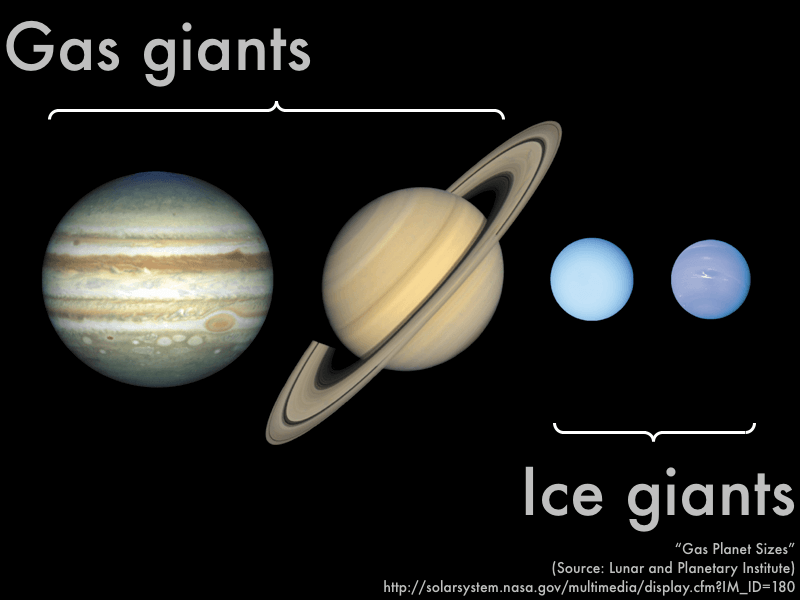
Two of the Solar System's four giant planets, Uranus and Neptune, are known as “ice giants”. [Credit: NASA; source: Lunar & Planetary Institute]
Five Solar System planets are visible to the unaided eye, and have been known since prehistory. However, Uranus and Neptune were discovered when telescopes were in use. Uranus was the first planet to be discovered telescopically, while Neptune was the first to be discovered mathematically.
Two discoveries
William Herschel discovered Uranus by chance in 1781 – until then people didn't think there were any planets beyond Saturn. After several decades of observation, astronomers realized that Uranus wasn't moving as expected. French astronomer Urbain LeVerrier thought this was due to the influence of an undiscovered planet. His calculation of its position enabled Johann Galle at the Berlin Observatory to find it in 1846.
Herschel named his planet after his patron George III, but his chosen name was not accepted internationally. Finally, German astronomer Johann Bode suggested Uranus, Roman sky god and father of Saturn. This caught on and maintained the classical theme of the names of the planets. There was also controversy about naming the planet discovered by Galle with LeVerrier's calculations. In the end, it also received a classical name: Neptune, after the Roman sea god.
Ice giants
Uranus and Neptune, like the other two giants, Jupiter and Saturn, don't have solid surfaces. Descending through the atmosphere, the pressure increases until the gases are liquefied. But unlike Jupiter and Saturn, between the atmosphere and an Earth-sized rocky core, there is a mantle consisting of water ice and other ices. This is why Uranus and Neptune are also known as ice giants.
The atmospheres of Uranus and Neptune are predominantly hydrogen and helium, but also contain 1-2% methane and traces of water, ammonia and other compounds. Methane crystals give the planets their blue color because it absorbs the red light and reflects the blue.
More similarities
These distant twins are similar in size – about 4.0 and 3.9 times the diameter of the Earth, respectively – and their days are of similar length, about 17.25 hours for Uranus and just over sixteen hours for Neptune.
In addition, each planet has a ring system and multiple moons. Uranus has fourteen known rings and Neptune five, all made of very dark material. Uranus has 27 known moons and they are, unusually, named for characters from Shakespeare and 18th-century poet Alexander Pope. Neptune has 14 moons, the largest of which, Triton, is thought to be a captured Kuiper Belt Object.
However they aren't identical twins.
The seasons differ
Neptune's axis is tilted about 28 degrees. The axis is an imaginary line connecting the poles, around which a body rotates. Earth's axis is tilted about 23 degrees, so Neptune would have seasonal variation similar to Earth's, though the climate is obviously less agreeable.
Probably due to an ancient collision, Uranus is tilted at 98 degrees, which has left it orbiting on its side. If it's midsummer in one hemisphere, the other is entirely dark. Even though overall the poles of Uranus receive more solar radiation than the equator does, its equator is still warmer. We don't know why, and its great distance makes it difficult to study.
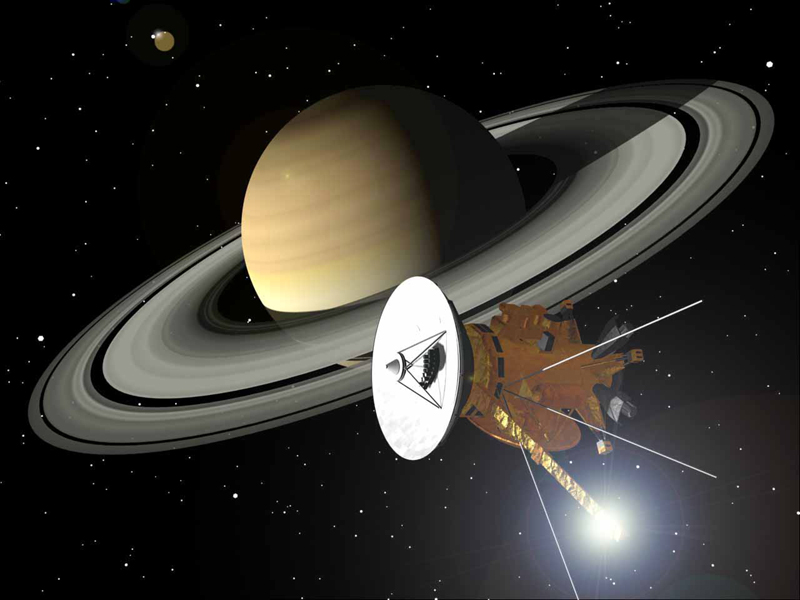
Most of what we know about the twin planets is from the Voyager 2 mission in the 1980s. However, during spring equinox in 2007, both Uranian hemispheres were in sunlight, presenting a good opportunity for observation.
Temperature and weather
Yet another surprise is that both planets have temperatures of -220 °C (-365 °F) at the cloud tops. Uranus is 19 AU from the Sun. An AU is the astronomical unit. It's equal to the distance from the Earth to the Sun, so Uranus is 19 times farther away from the Sun than Earth is.
But Neptune lies at 30 AU, so it should be colder than Uranus. In common with Jupiter and Saturn, Neptune must have some kind of internal heat source, because it radiates more heat energy than it receives from the Sun. We don't know why Uranus doesn't have one.
Although both Neptune and Uranus have cloud bands parallel to their equators, these are much more pronounced on Neptune. Neptune's atmosphere is highly active, showing rapidly changing patterns, including the highest winds of any Solar System planet – up to 2000 km/hr (1200 mph). That's over four times the estimates for the highest known wind speeds on Earth.
Five Solar System planets are visible to the unaided eye, and have been known since prehistory. However, Uranus and Neptune were discovered when telescopes were in use. Uranus was the first planet to be discovered telescopically, while Neptune was the first to be discovered mathematically.
Two discoveries
William Herschel discovered Uranus by chance in 1781 – until then people didn't think there were any planets beyond Saturn. After several decades of observation, astronomers realized that Uranus wasn't moving as expected. French astronomer Urbain LeVerrier thought this was due to the influence of an undiscovered planet. His calculation of its position enabled Johann Galle at the Berlin Observatory to find it in 1846.
Herschel named his planet after his patron George III, but his chosen name was not accepted internationally. Finally, German astronomer Johann Bode suggested Uranus, Roman sky god and father of Saturn. This caught on and maintained the classical theme of the names of the planets. There was also controversy about naming the planet discovered by Galle with LeVerrier's calculations. In the end, it also received a classical name: Neptune, after the Roman sea god.
Ice giants
Uranus and Neptune, like the other two giants, Jupiter and Saturn, don't have solid surfaces. Descending through the atmosphere, the pressure increases until the gases are liquefied. But unlike Jupiter and Saturn, between the atmosphere and an Earth-sized rocky core, there is a mantle consisting of water ice and other ices. This is why Uranus and Neptune are also known as ice giants.
The atmospheres of Uranus and Neptune are predominantly hydrogen and helium, but also contain 1-2% methane and traces of water, ammonia and other compounds. Methane crystals give the planets their blue color because it absorbs the red light and reflects the blue.
More similarities
These distant twins are similar in size – about 4.0 and 3.9 times the diameter of the Earth, respectively – and their days are of similar length, about 17.25 hours for Uranus and just over sixteen hours for Neptune.
In addition, each planet has a ring system and multiple moons. Uranus has fourteen known rings and Neptune five, all made of very dark material. Uranus has 27 known moons and they are, unusually, named for characters from Shakespeare and 18th-century poet Alexander Pope. Neptune has 14 moons, the largest of which, Triton, is thought to be a captured Kuiper Belt Object.
However they aren't identical twins.
The seasons differ
Neptune's axis is tilted about 28 degrees. The axis is an imaginary line connecting the poles, around which a body rotates. Earth's axis is tilted about 23 degrees, so Neptune would have seasonal variation similar to Earth's, though the climate is obviously less agreeable.
Probably due to an ancient collision, Uranus is tilted at 98 degrees, which has left it orbiting on its side. If it's midsummer in one hemisphere, the other is entirely dark. Even though overall the poles of Uranus receive more solar radiation than the equator does, its equator is still warmer. We don't know why, and its great distance makes it difficult to study.
Most of what we know about the twin planets is from the Voyager 2 mission in the 1980s. However, during spring equinox in 2007, both Uranian hemispheres were in sunlight, presenting a good opportunity for observation.
Temperature and weather
Yet another surprise is that both planets have temperatures of -220 °C (-365 °F) at the cloud tops. Uranus is 19 AU from the Sun. An AU is the astronomical unit. It's equal to the distance from the Earth to the Sun, so Uranus is 19 times farther away from the Sun than Earth is.
But Neptune lies at 30 AU, so it should be colder than Uranus. In common with Jupiter and Saturn, Neptune must have some kind of internal heat source, because it radiates more heat energy than it receives from the Sun. We don't know why Uranus doesn't have one.
Although both Neptune and Uranus have cloud bands parallel to their equators, these are much more pronounced on Neptune. Neptune's atmosphere is highly active, showing rapidly changing patterns, including the highest winds of any Solar System planet – up to 2000 km/hr (1200 mph). That's over four times the estimates for the highest known wind speeds on Earth.
You Should Also Read:
Who Discovered Neptune
Voyager 2 - the Grand Tour
Triton - Captive Moon of Neptune

Related Articles
Editor's Picks Articles
Top Ten Articles
Previous Features
Site Map
Content copyright © 2023 by Mona Evans. All rights reserved.
This content was written by Mona Evans. If you wish to use this content in any manner, you need written permission. Contact Mona Evans for details.