Night Sky Olympic Tribute

Planet Earth organizes a grand international sporting spectacular every four years, the Olympic Games. Even if you're not fond of sports, it's a marvelous pageant and a set of unfolding dramas that a scriptwriter could scarcely hope to emulate. Here is an astronomical tribute to this magnificent saga.
The Olympic rings
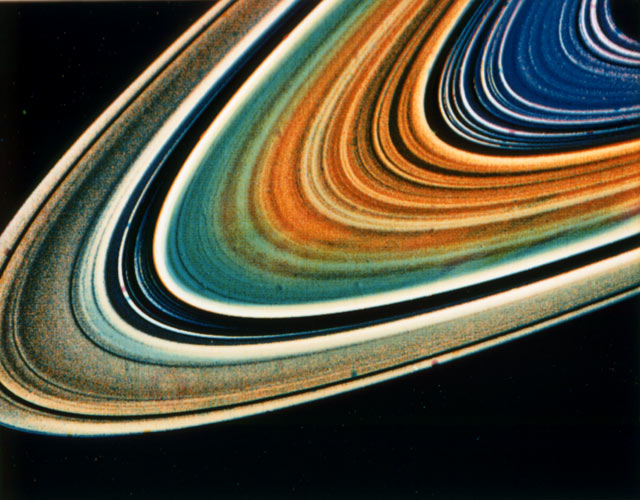
Saturn, Jupiter, Uranus and Neptune all have rings, but Saturn's are the prettiest. There are four groups of wide, bright rings and three groups of fainter ones, containing altogether thousands of rings. We should be able to borrow five of Saturn's rings. [The image – with extensive color enhancement – was made from Voyager probe images.]
The Olympic flame
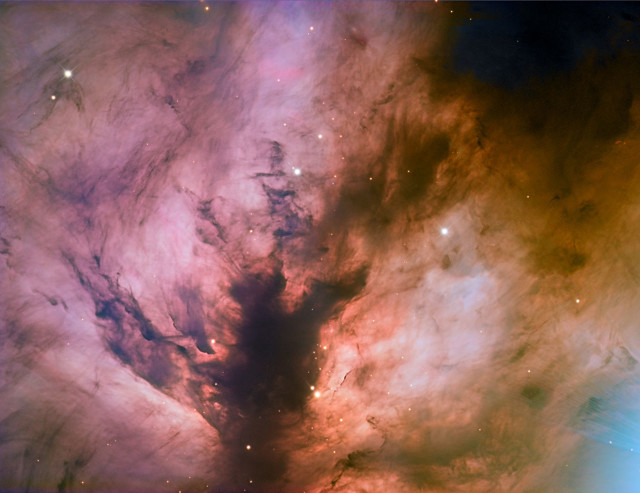
Stars burn brightly from nuclear fusion in their cores, and there are perhaps 200 billion of them in the Milky Way. But I'm going to go instead for the Flame Nebula (NGC 2024) in Orion. [Image: Adam Block/Mount Lemmon SkyCenter]
The nebula is near Alnitak, the easternmost star of Orion's belt. It gives out high-energy ultraviolet light that energizes the hydrogen gas and produces the nebula's red glow. The dark part to the nebula that looks a bit like a torch is a dark nebula, where the dust is so thick that visible light can't penetrate it. These cool dusty regions are stellar nurseries.
The opening ceremony
The whole sky is so dazzling that we don't need special effects. But I have in mind a special musical performance involving the constellation Lyra, the lyre. (A lyre is similar to a harp.) It was the instrument of Orpheus who played so sweetly that it charmed Hades himself, the lord of the underworld, into returning Orpheus's dead wife to him. (It all ended badly, but that's another story.)
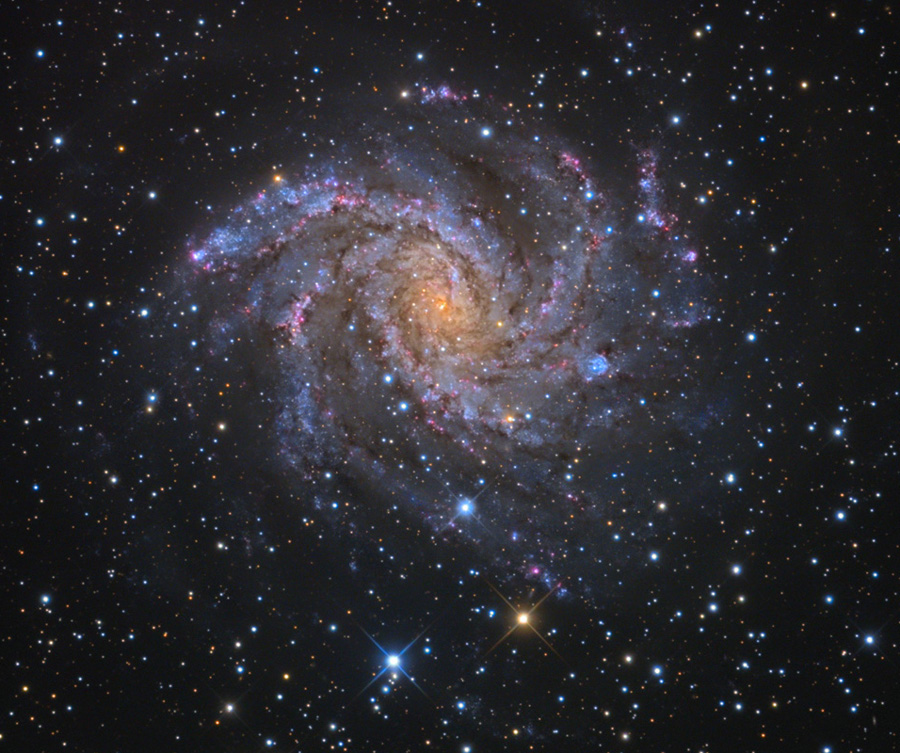
And, of course, there must be fireworks for the opening. The Fireworks Galaxy (NGC 6946), in the constellation Cepheus is a resplendent spiral galaxy face on to us.
You can tell how hot a star is by its color. Red is cooler than yellow and blue is the hottest. The colors in the Fireworks Galaxy show regions dominated by stars at different stages of development. The red areas along the spiral arms are expanses of new star formation – these are comparatively cool. The neighboring blue regions have significant populations of massive hot young stars, and the yellowish color of the galactic core shows that it's dominated by older stars.
The blue stars don't get old – by stellar standards – because they burn so brightly that they use up their fuel quickly. The Sun, for example, is five billion years old and only half way through its life cycle. It has already lived thousands of times longer than hot blue stars do.
A massive star ends its life in a supernova explosion. We see this, on average, once a century in the Milky Way, but nine have been observed in the Fireworks Galaxy during the past century. For a time, a supernova is as luminous as an entire galaxy. Those are some fireworks!
Events
Sailing
The mythic hero Jason in his ship the Argo would be an inspiration to the sailors. The southern constellation representing the ship, Argo Navis, was so large that it was finally divided into three: Carina (the keel), Puppis (the stern) and Vela (the sails). And the perfect venue for sailing in a heavenly Olympics? The Lagoon Nebula (NGC 6523), an enormous star-forming region in the constellation Sagittarius.
Equestrian
These events would be unique since we'd need three different categories: horses, winged horses and centaurs. Each has a heavenly representation.
Pegasus is the winged horse. In the northern skies you can see it as summer is ending and through the autumn. In the southern hemisphere, it shows up at the end of winter and through spring. As for horses without wings, there is the Great Dark Horse, a dark nebula in the constellation Ophiuchus (the serpent bearer).
The centaurs (part human, part horse) have their own constellation in the southern sky. The brightest star of Centaurus is Alpha Centauri (Rigil Kentaurus) which is also the nearest star system to us. Although Alpha Centauri looks like a single star, it's two stars orbiting each other closely plus a third at some distance.
Archery
Sagittarius is the heavenly archer and a constellation of the zodiac. When you look towards Sagittarius, you're looking towards the heart of the Milky Way. There are also many female archers in classical mythology. The Greek goddess Artemis (Diana to the Romans), who's associated with the Moon, was probably the greatest of them all, an inspiration to young sportswomen.
The gold medals
I was surprised to learn that Olympic gold medals are actually made of silver, though they're plated with gold. But you may be surprised to learn how the gold was made – not mined, but made. The elements hydrogen and helium were made in the Big Bang and other common elements are made by nuclear fusion in stars. Stars don't have enough energy to produce gold. It's created in supernova explosions.
Very few people have Olympic gold, but many of us have a bit of gold jewelry. If you do, you have a souvenir of a cataclysmic cosmic event that occurred billions of years ago and unimaginably far away from Earth.
The Olympic rings
Saturn, Jupiter, Uranus and Neptune all have rings, but Saturn's are the prettiest. There are four groups of wide, bright rings and three groups of fainter ones, containing altogether thousands of rings. We should be able to borrow five of Saturn's rings. [The image – with extensive color enhancement – was made from Voyager probe images.]
The Olympic flame
Stars burn brightly from nuclear fusion in their cores, and there are perhaps 200 billion of them in the Milky Way. But I'm going to go instead for the Flame Nebula (NGC 2024) in Orion. [Image: Adam Block/Mount Lemmon SkyCenter]
The nebula is near Alnitak, the easternmost star of Orion's belt. It gives out high-energy ultraviolet light that energizes the hydrogen gas and produces the nebula's red glow. The dark part to the nebula that looks a bit like a torch is a dark nebula, where the dust is so thick that visible light can't penetrate it. These cool dusty regions are stellar nurseries.
The opening ceremony
The whole sky is so dazzling that we don't need special effects. But I have in mind a special musical performance involving the constellation Lyra, the lyre. (A lyre is similar to a harp.) It was the instrument of Orpheus who played so sweetly that it charmed Hades himself, the lord of the underworld, into returning Orpheus's dead wife to him. (It all ended badly, but that's another story.)
And, of course, there must be fireworks for the opening. The Fireworks Galaxy (NGC 6946), in the constellation Cepheus is a resplendent spiral galaxy face on to us.
You can tell how hot a star is by its color. Red is cooler than yellow and blue is the hottest. The colors in the Fireworks Galaxy show regions dominated by stars at different stages of development. The red areas along the spiral arms are expanses of new star formation – these are comparatively cool. The neighboring blue regions have significant populations of massive hot young stars, and the yellowish color of the galactic core shows that it's dominated by older stars.
The blue stars don't get old – by stellar standards – because they burn so brightly that they use up their fuel quickly. The Sun, for example, is five billion years old and only half way through its life cycle. It has already lived thousands of times longer than hot blue stars do.
A massive star ends its life in a supernova explosion. We see this, on average, once a century in the Milky Way, but nine have been observed in the Fireworks Galaxy during the past century. For a time, a supernova is as luminous as an entire galaxy. Those are some fireworks!
Events
Sailing
The mythic hero Jason in his ship the Argo would be an inspiration to the sailors. The southern constellation representing the ship, Argo Navis, was so large that it was finally divided into three: Carina (the keel), Puppis (the stern) and Vela (the sails). And the perfect venue for sailing in a heavenly Olympics? The Lagoon Nebula (NGC 6523), an enormous star-forming region in the constellation Sagittarius.
Equestrian
These events would be unique since we'd need three different categories: horses, winged horses and centaurs. Each has a heavenly representation.
Pegasus is the winged horse. In the northern skies you can see it as summer is ending and through the autumn. In the southern hemisphere, it shows up at the end of winter and through spring. As for horses without wings, there is the Great Dark Horse, a dark nebula in the constellation Ophiuchus (the serpent bearer).
The centaurs (part human, part horse) have their own constellation in the southern sky. The brightest star of Centaurus is Alpha Centauri (Rigil Kentaurus) which is also the nearest star system to us. Although Alpha Centauri looks like a single star, it's two stars orbiting each other closely plus a third at some distance.
Archery
Sagittarius is the heavenly archer and a constellation of the zodiac. When you look towards Sagittarius, you're looking towards the heart of the Milky Way. There are also many female archers in classical mythology. The Greek goddess Artemis (Diana to the Romans), who's associated with the Moon, was probably the greatest of them all, an inspiration to young sportswomen.
The gold medals
I was surprised to learn that Olympic gold medals are actually made of silver, though they're plated with gold. But you may be surprised to learn how the gold was made – not mined, but made. The elements hydrogen and helium were made in the Big Bang and other common elements are made by nuclear fusion in stars. Stars don't have enough energy to produce gold. It's created in supernova explosions.
Very few people have Olympic gold, but many of us have a bit of gold jewelry. If you do, you have a souvenir of a cataclysmic cosmic event that occurred billions of years ago and unimaginably far away from Earth.
You Should Also Read:
Pegasus the Winged Horse
Lyra the Heavenly Harp
Nebulae

Related Articles
Editor's Picks Articles
Top Ten Articles
Previous Features
Site Map
Content copyright © 2023 by Mona Evans. All rights reserved.
This content was written by Mona Evans. If you wish to use this content in any manner, you need written permission. Contact Mona Evans for details.