What Is a Nebula

The Helix Nebula (also known as NGC 7293 or Caldwell 63), is a planetary nebula located in the constellation Aquarius. [Credit: NASA, ESA, C. R. O’Dell (Vanderbilt Uni), M. Meixner & P. McCullough (STScl)
The word nebula - plural nebulae - is Latin for cloud. Viewed in 17th and 18th century telescopes, they were just cloudy bits of sky, and most astronomers paid little attention to them. Charles Messier (1730-1817) only catalogued them so that they wouldn't be mistaken for comets.
William Herschel (1738-1822) and Caroline Herschel (1750-1848) were the first to take the nebulae seriously, cataloguing nearly 2500 of them from southern England. William's son John Herschel (1792-1871) later added nebulae of the southern hemisphere. Yet except for realizing that some nebulae were star clusters, more powerful telescopes were needed to learn more. Birr in Ireland saw such a telescope in 1845, built by William Parsons (1800-1867), the Earl of Rosse. He was the first to discover spiral structure in some of the nebulae.
Some of the “nebulae” turned out to be star clusters and some were distant galaxies, but what about true nebulae, the clouds of gas and dust in the spaces between stars?
Diffuse nebulae
The material in the nebulae is so tenuous that an industrial vacuum on Earth is denser. There is nonetheless a lot of matter in them because they're spread out over many light years. The Orion Nebula, for example, is about 150 light years across – that's at least 25 times the diameter of our Solar System.
Emission and reflection nebulae
Since gas and dust aren't luminous, nebulae were difficult to study. However, we now know that emission nebulae and reflection nebulae are made visible by the light from nearby stars. As shown in the header image, hydrogen gas in an emission nebula glows red when it's energized by ultraviolet light from nearby bright young stars.
A reflection nebula appears blue because dust scatters the blue light from a bright neighboring star, but the red part of the spectrum isn't much affected. The Witch Head Nebula is a good example of a reflection nebula. [Photo credit: NASA]
Dark nebulae
Dark nebulae are a third type of nebula. They are characterized by the thick dust that hides their interiors and obscures background objects. Yet they can be seen when their dark shapes stand out against a luminous background, for example, the Horsehead Nebula.
Dark nebulae haven't been a historic feature of western astronomy. The Herschel catalogs didn't include them, even though William Herschel did note the existence of "holes in the sky”. Yet Australian aboriginal astronomy does include dark nebulae. One of the best known is the Flying Emu, here imaged by Barnaby Norris. It's near the Southern Cross and Scorpius, and the dark Coalsack Nebula is its head. Terrestrial emus, of course, don't fly, being large flightless cousins to ostriches.
Starbirth
Stars can form from the vast accumulation of matter in these nebulae. Usually, the process begins with a disturbance that starts the gravitational collapse of the material. Since this occurs in different parts of the nebula, stars form in groups. Such an area of developing stars is often called a stellar nursery.
Most of the matter in nebulae is primordial hydrogen, which means that it formed shortly after the Big Bang. Heavier elements are made in stars, so nebulae are now enriched with elements from previous generations of stars. In fact, two further types of nebula are actually formed from dying stars.
Planetary nebulae
Planetary nebulae aren't related to planets. William Herschel gave them the name because they showed a planet-like disk in his telescope. Bigger and better telescopes, as well as an understanding of stellar evolution, has changed our view of these nebulae. But the name remains.
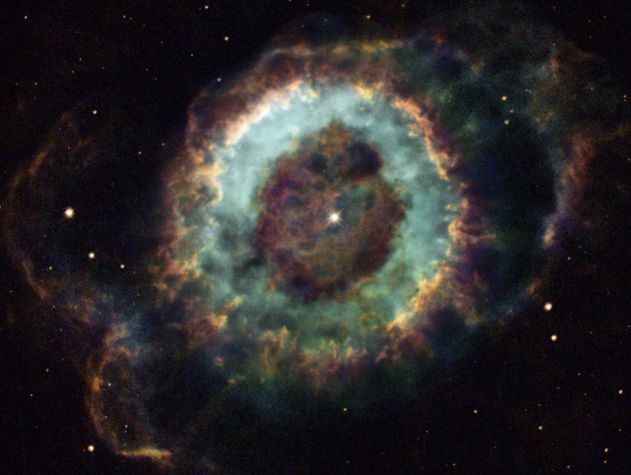
When a medium-sized star runs out of hydrogen fuel, it swells into a red giant and throws off the outer layers of its atmosphere. It will happen to the Sun several billion years from now. This can produce a number of interesting shapes, but it often occurs fairly symmetrically, leaving something like the Little Ghost Nebula. This is the sort of nebula that would have looked much like a planet in an 18th century telescope.
Supernova remnants
If a star is many times more massive than the Sun, when it finally runs out of nuclear fuel, it explodes as a supernova, releasing vast amounts of energy. For a time, a supernova shines as brightly as an entire galaxy. In such extreme conditions, some of the heaviest chemical elements are forged. Then, although the core of the star collapses into a neutron star or black hole, the outer layers form a nebula called a supernova remnant. Probably the most famous one is the Crab Nebula (Messier 1), which is the remnant of a supernova witnessed by Chinese astronomers in 1054.
With the advent of infrared telescopes, nebulae became a particularly promising field of study. For example, they can tell us something about the chemical elements of which we and our world are made. Astronomers are finding complex organic molecules in nebulae, suggesting that they might also have something to tell us about the origins of life in the Galaxy.
The word nebula - plural nebulae - is Latin for cloud. Viewed in 17th and 18th century telescopes, they were just cloudy bits of sky, and most astronomers paid little attention to them. Charles Messier (1730-1817) only catalogued them so that they wouldn't be mistaken for comets.
William Herschel (1738-1822) and Caroline Herschel (1750-1848) were the first to take the nebulae seriously, cataloguing nearly 2500 of them from southern England. William's son John Herschel (1792-1871) later added nebulae of the southern hemisphere. Yet except for realizing that some nebulae were star clusters, more powerful telescopes were needed to learn more. Birr in Ireland saw such a telescope in 1845, built by William Parsons (1800-1867), the Earl of Rosse. He was the first to discover spiral structure in some of the nebulae.
Some of the “nebulae” turned out to be star clusters and some were distant galaxies, but what about true nebulae, the clouds of gas and dust in the spaces between stars?
Diffuse nebulae
The material in the nebulae is so tenuous that an industrial vacuum on Earth is denser. There is nonetheless a lot of matter in them because they're spread out over many light years. The Orion Nebula, for example, is about 150 light years across – that's at least 25 times the diameter of our Solar System.
Emission and reflection nebulae
Since gas and dust aren't luminous, nebulae were difficult to study. However, we now know that emission nebulae and reflection nebulae are made visible by the light from nearby stars. As shown in the header image, hydrogen gas in an emission nebula glows red when it's energized by ultraviolet light from nearby bright young stars.
A reflection nebula appears blue because dust scatters the blue light from a bright neighboring star, but the red part of the spectrum isn't much affected. The Witch Head Nebula is a good example of a reflection nebula. [Photo credit: NASA]
Dark nebulae
Dark nebulae are a third type of nebula. They are characterized by the thick dust that hides their interiors and obscures background objects. Yet they can be seen when their dark shapes stand out against a luminous background, for example, the Horsehead Nebula.
Dark nebulae haven't been a historic feature of western astronomy. The Herschel catalogs didn't include them, even though William Herschel did note the existence of "holes in the sky”. Yet Australian aboriginal astronomy does include dark nebulae. One of the best known is the Flying Emu, here imaged by Barnaby Norris. It's near the Southern Cross and Scorpius, and the dark Coalsack Nebula is its head. Terrestrial emus, of course, don't fly, being large flightless cousins to ostriches.
Starbirth
Stars can form from the vast accumulation of matter in these nebulae. Usually, the process begins with a disturbance that starts the gravitational collapse of the material. Since this occurs in different parts of the nebula, stars form in groups. Such an area of developing stars is often called a stellar nursery.
Most of the matter in nebulae is primordial hydrogen, which means that it formed shortly after the Big Bang. Heavier elements are made in stars, so nebulae are now enriched with elements from previous generations of stars. In fact, two further types of nebula are actually formed from dying stars.
Planetary nebulae
Planetary nebulae aren't related to planets. William Herschel gave them the name because they showed a planet-like disk in his telescope. Bigger and better telescopes, as well as an understanding of stellar evolution, has changed our view of these nebulae. But the name remains.
When a medium-sized star runs out of hydrogen fuel, it swells into a red giant and throws off the outer layers of its atmosphere. It will happen to the Sun several billion years from now. This can produce a number of interesting shapes, but it often occurs fairly symmetrically, leaving something like the Little Ghost Nebula. This is the sort of nebula that would have looked much like a planet in an 18th century telescope.
Supernova remnants
If a star is many times more massive than the Sun, when it finally runs out of nuclear fuel, it explodes as a supernova, releasing vast amounts of energy. For a time, a supernova shines as brightly as an entire galaxy. In such extreme conditions, some of the heaviest chemical elements are forged. Then, although the core of the star collapses into a neutron star or black hole, the outer layers form a nebula called a supernova remnant. Probably the most famous one is the Crab Nebula (Messier 1), which is the remnant of a supernova witnessed by Chinese astronomers in 1054.
With the advent of infrared telescopes, nebulae became a particularly promising field of study. For example, they can tell us something about the chemical elements of which we and our world are made. Astronomers are finding complex organic molecules in nebulae, suggesting that they might also have something to tell us about the origins of life in the Galaxy.
You Should Also Read:
Starbirth
Death of a Massive Star
What Herschel Found in a Dark Cloud

Related Articles
Editor's Picks Articles
Top Ten Articles
Previous Features
Site Map
Content copyright © 2023 by Mona Evans. All rights reserved.
This content was written by Mona Evans. If you wish to use this content in any manner, you need written permission. Contact Mona Evans for details.