Jupiter - Facts for Kids
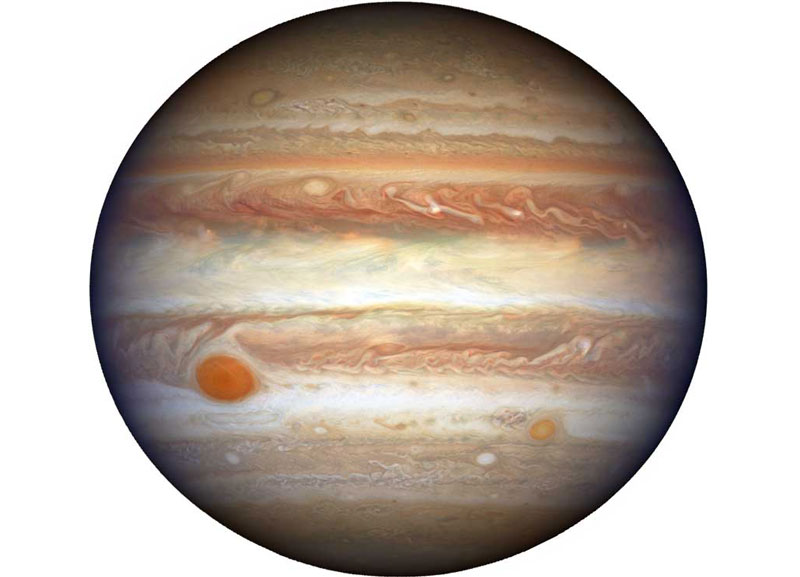
Jupiter [credit: Hubble Space Telescope]
The biggest planet in the Solar System.
Jupiter was named for the king of the ancient Roman gods. It's about 143,000 km in diameter (89,000 miles). That's 11 times bigger than the Earth. If we had a bubble as big as Jupiter, we could fit the other seven planets inside it, plus the moons, dwarf planets. asteroids and comets. After putting all that into our Jupiter-sized balloon, there would still be lots of room left over.
Jupiter is 5 AU away from the Sun.
An astronomical unit (AU) is the distance from the Earth to the Sun. Jupiter is 5 times farther from the Sun than Earth is.
Jupiter is a gas planet.
It doesn't have a solid surface we could stand on. If we dropped through its atmosphere, the air would get thicker and thicker, and the pressure would get bigger. We'd keep sinking until we were squashed.
You would weigh more on Jupiter than you do on Earth.
Jupiter's gravity is strong. Although you couldn't stand on Jupiter, if you were in the cloud tops, you would weigh more than twice as much as you do at home. Someone weighing 50 kg (110 lbs) on Earth would weigh a whopping 120 kg at the cloud tops. Deeper into the atmosphere your weight would increase. If you have trouble getting out of bed at home, imagine trying to get up in the morning on Jupiter.
The Great Red Spot is Jupiter's most famous feature.
You can see the spot in the image at the top of the page. It's an enormous storm that blows harder than a hurricane on Earth. It's so big you could line up three Earths across it. Over 350 years ago, English scientist Robert Hooke saw a red spot on Jupiter. It may be the same one that astronomers have observed since 1831.
Saturn has a beautiful set of rings. And surprise! Jupiter has rings too.
The Voyager spacecraft discovered Jupiter's rings in 1979. It was an exciting discovery, but they're pretty boring compared to Saturn's rings. The three thin rings are made mostly of dust, so they're hard to see.
Jupiter has a 79 known moons.
The four largest moons were discovered by Galileo Galilei in 1610. Only Saturn is known to have more moons. The biggest moon in the Solar System in Jupiter's moon Ganymede.
Jupiter has short days and long years.
A year is nearly 12 Earth years on Jupiter, so you wouldn't have birthdays very often. However, the days are the shortest of any Solar System planet – less than ten hours.
Observing Jupiter
When our distant ancestors observed the night sky, their eyes were drawn to this bright celestial object. You can easily see it, even in the city. Only the Moon and Venus look brighter. Good binoculars let you see the Galilean moons as points of light, and a small telescope can show you Jupiter's cloud bands.
The biggest planet in the Solar System.
Jupiter was named for the king of the ancient Roman gods. It's about 143,000 km in diameter (89,000 miles). That's 11 times bigger than the Earth. If we had a bubble as big as Jupiter, we could fit the other seven planets inside it, plus the moons, dwarf planets. asteroids and comets. After putting all that into our Jupiter-sized balloon, there would still be lots of room left over.
Jupiter is 5 AU away from the Sun.
An astronomical unit (AU) is the distance from the Earth to the Sun. Jupiter is 5 times farther from the Sun than Earth is.
Jupiter is a gas planet.
It doesn't have a solid surface we could stand on. If we dropped through its atmosphere, the air would get thicker and thicker, and the pressure would get bigger. We'd keep sinking until we were squashed.
You would weigh more on Jupiter than you do on Earth.
Jupiter's gravity is strong. Although you couldn't stand on Jupiter, if you were in the cloud tops, you would weigh more than twice as much as you do at home. Someone weighing 50 kg (110 lbs) on Earth would weigh a whopping 120 kg at the cloud tops. Deeper into the atmosphere your weight would increase. If you have trouble getting out of bed at home, imagine trying to get up in the morning on Jupiter.
The Great Red Spot is Jupiter's most famous feature.
You can see the spot in the image at the top of the page. It's an enormous storm that blows harder than a hurricane on Earth. It's so big you could line up three Earths across it. Over 350 years ago, English scientist Robert Hooke saw a red spot on Jupiter. It may be the same one that astronomers have observed since 1831.
Saturn has a beautiful set of rings. And surprise! Jupiter has rings too.
The Voyager spacecraft discovered Jupiter's rings in 1979. It was an exciting discovery, but they're pretty boring compared to Saturn's rings. The three thin rings are made mostly of dust, so they're hard to see.
Jupiter has a 79 known moons.
The four largest moons were discovered by Galileo Galilei in 1610. Only Saturn is known to have more moons. The biggest moon in the Solar System in Jupiter's moon Ganymede.
Jupiter has short days and long years.
A year is nearly 12 Earth years on Jupiter, so you wouldn't have birthdays very often. However, the days are the shortest of any Solar System planet – less than ten hours.
Observing Jupiter
When our distant ancestors observed the night sky, their eyes were drawn to this bright celestial object. You can easily see it, even in the city. Only the Moon and Venus look brighter. Good binoculars let you see the Galilean moons as points of light, and a small telescope can show you Jupiter's cloud bands.
You Should Also Read:
Jupiter's Moons – Facts for Kids
Biggest in the Solar System – Facts for Kids
Solar System – Tour for Kids

Related Articles
Editor's Picks Articles
Top Ten Articles
Previous Features
Site Map
Content copyright © 2023 by Mona Evans. All rights reserved.
This content was written by Mona Evans. If you wish to use this content in any manner, you need written permission. Contact Mona Evans for details.