Astronomy Photographer of the Year 2011
We see such fabulous images from space telescopes and large ground-based telescopes that it's easy to overlook the pictures that people are taking with their own equipment. Happily, the Astronomy Photographer of the Year competitions at the Royal Observatory in Greenwich, England celebrate and encourage amateur efforts. In 2010 there were over four hundred entries in the competition and in 2011 there were nearly eight hundred. It must have been an interesting, but difficult, job judging them.
The winner was an English astrophotographer's picture of Jupiter with two of its moons. When they showed Damien Peach's winning image at the award presentation, there was an audible gasp. Impressive? Definitely. If someone had saud that the picture had been taken with a big telescope, I wouldn't have questioned it.
Look at the detail in Jupiter's cloud bands. You can even see surface features on the moons. Io, which is highly volcanic, is the reddish moon in the lower left of the picture, and the larger one is Ganymede. The picture couldn't be taken in one shot; it's a montage. Jupiter is large and bright, so getting the moons into the same shot — especially with surface detail — would require a long exposure that would wash out the surface of Jupiter.
I love the Deep Space category, which usually has some of the most exquisite images. This year's winner was Italian astrophotographer Marco Lorenzi with a picture of the Vela Supernova Remnant.
Over ten thousand years ago a massive star exploded in the constellation Vela. A shock wave was created when the star's outer layers hit the material in interstellar space, and it's still expanding. That's the filigree in this beautiful image. The picture is a mosaic. No single shot could capture the whole nebula which extends across an area of sky equal to twenty full moons.
Marco Lorenzi was awarded another prize for his entry in a new category for images from robotic telescopes. You might think this is an odd category, but it emphasizes the importance of the processing of the images. Getting the picture is more than pointing the camera into the sky. CCDs electronically record the light they receive. The photographer uses software for cropping, improving the image quality, sharpening the contrast to emphasize structure or whatever else will turn the information into a memorable and useful image.
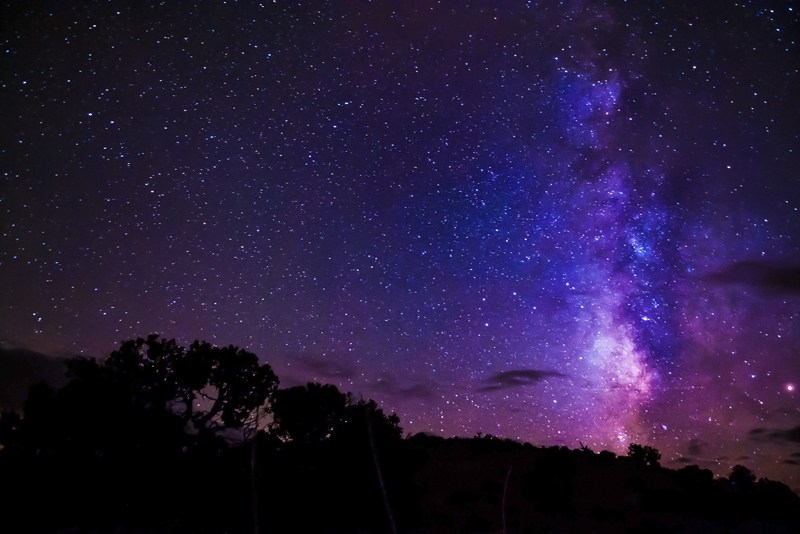
The Earth and Space category is for photos "that include landscape, people and other Earth-related things alongside an astronomical subject". The winner was Turkish astrophotographer Tunç Tezel with an image of the Milky Way above the exotic landscape of Mangaia in the Cook Islands. It clearly shows the dark nebulae which form the object known as the Emu in Australian Aboriginal astronomy.
The Young Astronomy Photographer of the Year, once again, showed that there is considerable talent among the young astronomers. The winner, Jathin Premjith (aged 15) from India, not only captured the red of the eclipsed Moon, but also caught a star just appearing from behind the orbiting Moon.
When the Moon is totally eclipsed, no sunlight can fall directly on it. However some sunlight is filtered through the Earth's atmosphere. The colors of a lunar eclipse vary depending on the atmospheric conditions, but the long journey through the atmosphere makes the light redder. This is because the bluer colors are scattered by the air molecules, while the red part of the spectrum is less affected. Sunsets are also red because the sunlight gets to us via the thickest part of the atmosphere.
One of the special awards was for People and Space. Jeffrey Sullivan of the USA won it with a nicely-done silhouette of himself seeming almost a part of the rocky landscape. Interestingly, his teenaged daughter Nicole Sullivan was the runner-up for the Young Astronomy Photographer. Obviously a family to watch.
However I wasn't anything like as impressed as the judges were with the runner-up in People in Space. Jean Baptise Feldmann's “Hunting Moon” was cute, showing a foreground figure with a net appearing to catch the moon. However I didn't think it was a great photograph and it's not even original, being almost identical to one of Laurent Laveder's “Moon Games” pictures taken several years ago.
The winner was an English astrophotographer's picture of Jupiter with two of its moons. When they showed Damien Peach's winning image at the award presentation, there was an audible gasp. Impressive? Definitely. If someone had saud that the picture had been taken with a big telescope, I wouldn't have questioned it.
Look at the detail in Jupiter's cloud bands. You can even see surface features on the moons. Io, which is highly volcanic, is the reddish moon in the lower left of the picture, and the larger one is Ganymede. The picture couldn't be taken in one shot; it's a montage. Jupiter is large and bright, so getting the moons into the same shot — especially with surface detail — would require a long exposure that would wash out the surface of Jupiter.
I love the Deep Space category, which usually has some of the most exquisite images. This year's winner was Italian astrophotographer Marco Lorenzi with a picture of the Vela Supernova Remnant.
Over ten thousand years ago a massive star exploded in the constellation Vela. A shock wave was created when the star's outer layers hit the material in interstellar space, and it's still expanding. That's the filigree in this beautiful image. The picture is a mosaic. No single shot could capture the whole nebula which extends across an area of sky equal to twenty full moons.
Marco Lorenzi was awarded another prize for his entry in a new category for images from robotic telescopes. You might think this is an odd category, but it emphasizes the importance of the processing of the images. Getting the picture is more than pointing the camera into the sky. CCDs electronically record the light they receive. The photographer uses software for cropping, improving the image quality, sharpening the contrast to emphasize structure or whatever else will turn the information into a memorable and useful image.
The Earth and Space category is for photos "that include landscape, people and other Earth-related things alongside an astronomical subject". The winner was Turkish astrophotographer Tunç Tezel with an image of the Milky Way above the exotic landscape of Mangaia in the Cook Islands. It clearly shows the dark nebulae which form the object known as the Emu in Australian Aboriginal astronomy.
The Young Astronomy Photographer of the Year, once again, showed that there is considerable talent among the young astronomers. The winner, Jathin Premjith (aged 15) from India, not only captured the red of the eclipsed Moon, but also caught a star just appearing from behind the orbiting Moon.
When the Moon is totally eclipsed, no sunlight can fall directly on it. However some sunlight is filtered through the Earth's atmosphere. The colors of a lunar eclipse vary depending on the atmospheric conditions, but the long journey through the atmosphere makes the light redder. This is because the bluer colors are scattered by the air molecules, while the red part of the spectrum is less affected. Sunsets are also red because the sunlight gets to us via the thickest part of the atmosphere.
One of the special awards was for People and Space. Jeffrey Sullivan of the USA won it with a nicely-done silhouette of himself seeming almost a part of the rocky landscape. Interestingly, his teenaged daughter Nicole Sullivan was the runner-up for the Young Astronomy Photographer. Obviously a family to watch.
However I wasn't anything like as impressed as the judges were with the runner-up in People in Space. Jean Baptise Feldmann's “Hunting Moon” was cute, showing a foreground figure with a net appearing to catch the moon. However I didn't think it was a great photograph and it's not even original, being almost identical to one of Laurent Laveder's “Moon Games” pictures taken several years ago.
You Should Also Read:
Photography and the Birth of Astrophysics
Astronomy Photographer of the Year 2010
Astronomy Photographer of the Year 2012

Related Articles
Editor's Picks Articles
Top Ten Articles
Previous Features
Site Map
Content copyright © 2023 by Mona Evans. All rights reserved.
This content was written by Mona Evans. If you wish to use this content in any manner, you need written permission. Contact Mona Evans for details.