

Dwarf Umbrella Plant
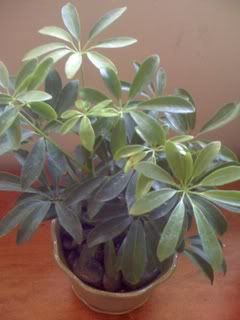
Schefflera arboricola is a nice, easy to care for plant. It is one of those plants that a lot of people enjoy growing because it is tolerant of a wide range of horticultural skill. I have seen it for sale in the most common places over the last several years; at florist’s shops, grocery stores, big-box stores and of course the specialty greenhouses. The most popular varieties of Schefflera arboricola include ‘Gold Capella’, ‘Dazzle’, ‘Samoa Snow’ and ‘Trinette’. Its wide availability combined with its forgiving nature has made it a plant that a lot of people are growing, and have occasional concerns about.
 Schefflera will be happy with any level of light, so long as it doesn’t get the scorching mid-day sun. Higher light is preferable, especially if you would like to see this plant bloom. Schefflera will still grow in very low light, just not as rapidly or densely. If your Umbrella Plant is thin and spindly, it may be telling you that it would like more sun.
Also, remember that the more sun your Schefflera gets the more water it will use. Schefflera like moist soil, but never leave it sitting in a saucer of water. This is another plant with which you can err on the side of dryness. Some people go a whole month sometimes without watering their Schefflera. It may not die, but it sure won’t be as healthy as if would be with more frequent watering. Whenever possible, water when the top inch of potting mix is dry.
Scheffleras don’t need much in the way of fertilizer, but you can give it some. I recommend weakly fertilizing at half the recommended dosage every two weeks while the plant is in active growth.
Something you should watch for is spider mites and scale. Spider mites are more common than scale, and of course other pests are possible, but these two are most often found on Schefflera. Spider mites will cause yellow stippling on the leaves, followed by webbing, and ending with brown, tented leaves. Scale can often go unnoticed until the plant really begins to suffer and die back, but if you keep an eye out for these scab-like, motionless insects, you should be able to eradicate them before your plant kicks off.
One last thing you should know about Umbrella Plant is that pruning is a must. Schefflera arboricola can grow to more than 10 feet tall if allowed, but you will achieve the most attractive plant if you regularly prune it to a nice form. Lending itself nicely to pruning, Schefflera arboricola is sometimes used in bonsai, so don’t be afraid to get out the pruners.
Keep and eye on your plant; it will let you know how you are doing. Your Schefflera will tell you if you are neglecting its water requirements. If the foliage appears to be crinkled, you aren’t providing sufficient water. If the leaves are yellowing or black and falling off, you are probably letting it sit in soil that is too moist. You will also be able to tell if you are providing too sunny a spot if brown patches develop on the leaves, especially around the edges. Pay attention, and you will be rewarded for many years to come!
Also, remember that the more sun your Schefflera gets the more water it will use. Schefflera like moist soil, but never leave it sitting in a saucer of water. This is another plant with which you can err on the side of dryness. Some people go a whole month sometimes without watering their Schefflera. It may not die, but it sure won’t be as healthy as if would be with more frequent watering. Whenever possible, water when the top inch of potting mix is dry.
Scheffleras don’t need much in the way of fertilizer, but you can give it some. I recommend weakly fertilizing at half the recommended dosage every two weeks while the plant is in active growth.
Something you should watch for is spider mites and scale. Spider mites are more common than scale, and of course other pests are possible, but these two are most often found on Schefflera. Spider mites will cause yellow stippling on the leaves, followed by webbing, and ending with brown, tented leaves. Scale can often go unnoticed until the plant really begins to suffer and die back, but if you keep an eye out for these scab-like, motionless insects, you should be able to eradicate them before your plant kicks off.
One last thing you should know about Umbrella Plant is that pruning is a must. Schefflera arboricola can grow to more than 10 feet tall if allowed, but you will achieve the most attractive plant if you regularly prune it to a nice form. Lending itself nicely to pruning, Schefflera arboricola is sometimes used in bonsai, so don’t be afraid to get out the pruners.
Keep and eye on your plant; it will let you know how you are doing. Your Schefflera will tell you if you are neglecting its water requirements. If the foliage appears to be crinkled, you aren’t providing sufficient water. If the leaves are yellowing or black and falling off, you are probably letting it sit in soil that is too moist. You will also be able to tell if you are providing too sunny a spot if brown patches develop on the leaves, especially around the edges. Pay attention, and you will be rewarded for many years to come!
This site needs an editor - click to learn more!
You Should Also Read:
Spider Mites
Recognizing and Treating Root Rot
Houseplants Newsletter
Related Articles
Editor's Picks Articles
Top Ten Articles
Previous Features
Site Map
Content copyright © 2023 by Lisa Beth Voldeck. All rights reserved.
This content was written by Lisa Beth Voldeck. If you wish to use this content in any manner, you need written permission. Contact
BellaOnline Administration
for details.
