Cygnus the Swan
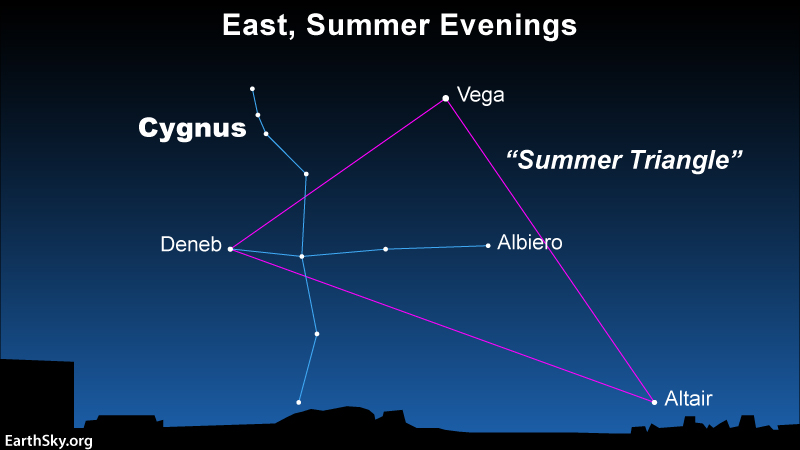
The constellation Cygnus and the asterism of the Summer Triangle [Image: Earthsky.org].
Cygnus the swan is a constellation that was already ancient when Ptolemy described it two thousand years ago in his work the Almagest.
There are many stories attached to Cygnus. The best known involves the liaison between Zeus, disguised as a swan, and Queen Leda. The unusual outcome was Leda's giving birth to an egg. In some versions, it's two eggs, with twins hatching from each: Castor and Pollux from one and Helen of Troy and her sister Clytemnestra from the other.
The constellation
Most constellations don't look much like what they represent. However, Cygnus does rather look like a swan with outstretched wings. Part of the constellation is also known as the asterism of the Northern Cross. An asterism is a recognizable star grouping that isn't a constellation. Note that the cross is opposite in orientation to the swan.
The stars
Deneb (Alpha Cygni) is at the top of the cross, which is the swan's tail. It's a supergiant, a hot young star with a diameter a hundred times that of the Sun. It's quite bright, which is suprising as it's so far away that its light takes some 1500 years to reach us. The secret is that although it's far away, it's also around 50,000 times brighter than the Sun.
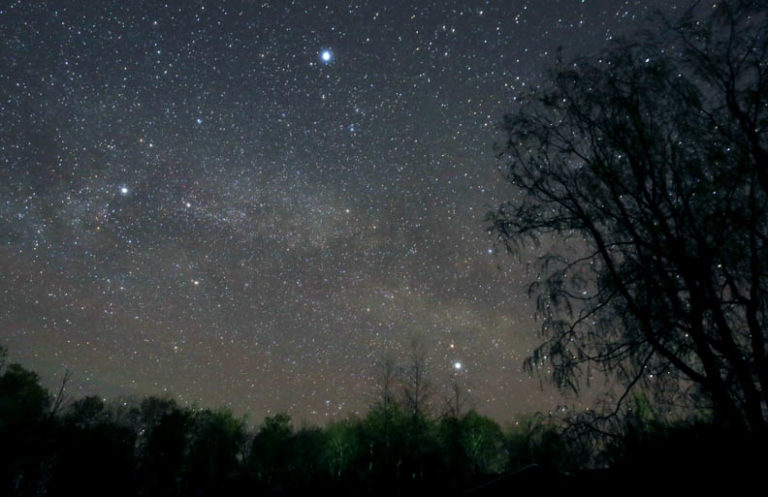
Besides the Northern Cross asterism, Deneb is also part of another asterism, the Summer Triangle. In the photo, Deneb is the bright star on the left. The other two stars in the triangle are Vega (in Lyra, at the top of the photo) and Altair (in Aquila, near the horizon). [Photo: Bob King]
At the foot of the cross – the swan's head – is Albireo. It's about halfway between Vega and Altair, seeming to be a single star. However, it is one of the most beautiful double stars in the sky. Even a small telescope can resolve it into two stars, one amber and one blue.
Nebulae
Nebulae are great clouds of gas between the stars. Cygnus contains a number of them. One is the Veil Nebula, discovered by William Herschel in the 18th century. It's a supernova remnant, the remains of a giant star that exploded thousands of years ago. This will be Deneb's fate one day.
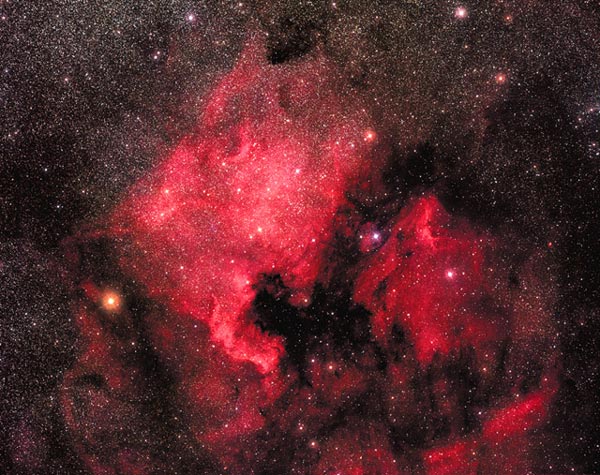
Another nebula discovered by Herschel is NGC 7000, the North America nebula. It was just a fuzzy object in Herschel's telescope, but the reason for its nickname is evident in this photo of NGC 7000 taken by Jason Ware. It has a nice Gulf of Mexico, though it gets lost in the west and undefined up towards Canada. The red color shows that it's an emission nebula. An emission nebula glows because it's energized by a nearby bright star. This is common in regions where new stars are forming.
Exoplanets
Many exoplanets have been discovered in Cygnus, because the Kepler space telescope monitored part of the constellation. Overall the Kepler mission found a few thousand planets.
One of the new planets was discovered even before Kepler went to work. It's called 16 Cygni Bb and it orbits the star 16 Cygni B, a sunlike star that's part of a triple star system. 16 Cygni A is also a sunlike star and 16 Cygni C is a red dwarf.
The gravitational forces on 16 Cygni Bb are complex, and its orbit is highly elongated. When it's closest to its star, it's about a million miles closer than Mercury is to the Sun. And scorchingly hot. Then it swings out on its long orbit to a distance that would take it into Jupiter's orbit in our Solar System. It could still have a moon where simple life forms might survive. However the planet itself, in addition to its crazy seasons, is most likely a gas giant.
Cygnus X-1
The strong X-ray source Cygnus X-1 is a dense unseen object with a mass at least eight times the mass of the Sun. It is a black hole.
The black hole forms a binary system with a blue supergiant. They both orbit a common center of mass about once every five and a half days. The black hole's strong gravity pulls gas from its companion onto a disk of gas called an accretion disk. As matter spirals from this disk into the black hole itself, it heats up so much that high energy radiation such as X-rays and gamma rays is given off.
Cygnus the swan is a constellation that was already ancient when Ptolemy described it two thousand years ago in his work the Almagest.
There are many stories attached to Cygnus. The best known involves the liaison between Zeus, disguised as a swan, and Queen Leda. The unusual outcome was Leda's giving birth to an egg. In some versions, it's two eggs, with twins hatching from each: Castor and Pollux from one and Helen of Troy and her sister Clytemnestra from the other.
The constellation
Most constellations don't look much like what they represent. However, Cygnus does rather look like a swan with outstretched wings. Part of the constellation is also known as the asterism of the Northern Cross. An asterism is a recognizable star grouping that isn't a constellation. Note that the cross is opposite in orientation to the swan.
The stars
Deneb (Alpha Cygni) is at the top of the cross, which is the swan's tail. It's a supergiant, a hot young star with a diameter a hundred times that of the Sun. It's quite bright, which is suprising as it's so far away that its light takes some 1500 years to reach us. The secret is that although it's far away, it's also around 50,000 times brighter than the Sun.
Besides the Northern Cross asterism, Deneb is also part of another asterism, the Summer Triangle. In the photo, Deneb is the bright star on the left. The other two stars in the triangle are Vega (in Lyra, at the top of the photo) and Altair (in Aquila, near the horizon). [Photo: Bob King]
At the foot of the cross – the swan's head – is Albireo. It's about halfway between Vega and Altair, seeming to be a single star. However, it is one of the most beautiful double stars in the sky. Even a small telescope can resolve it into two stars, one amber and one blue.
Nebulae
Nebulae are great clouds of gas between the stars. Cygnus contains a number of them. One is the Veil Nebula, discovered by William Herschel in the 18th century. It's a supernova remnant, the remains of a giant star that exploded thousands of years ago. This will be Deneb's fate one day.
Another nebula discovered by Herschel is NGC 7000, the North America nebula. It was just a fuzzy object in Herschel's telescope, but the reason for its nickname is evident in this photo of NGC 7000 taken by Jason Ware. It has a nice Gulf of Mexico, though it gets lost in the west and undefined up towards Canada. The red color shows that it's an emission nebula. An emission nebula glows because it's energized by a nearby bright star. This is common in regions where new stars are forming.
Exoplanets
Many exoplanets have been discovered in Cygnus, because the Kepler space telescope monitored part of the constellation. Overall the Kepler mission found a few thousand planets.
One of the new planets was discovered even before Kepler went to work. It's called 16 Cygni Bb and it orbits the star 16 Cygni B, a sunlike star that's part of a triple star system. 16 Cygni A is also a sunlike star and 16 Cygni C is a red dwarf.
The gravitational forces on 16 Cygni Bb are complex, and its orbit is highly elongated. When it's closest to its star, it's about a million miles closer than Mercury is to the Sun. And scorchingly hot. Then it swings out on its long orbit to a distance that would take it into Jupiter's orbit in our Solar System. It could still have a moon where simple life forms might survive. However the planet itself, in addition to its crazy seasons, is most likely a gas giant.
Cygnus X-1
The strong X-ray source Cygnus X-1 is a dense unseen object with a mass at least eight times the mass of the Sun. It is a black hole.
The black hole forms a binary system with a blue supergiant. They both orbit a common center of mass about once every five and a half days. The black hole's strong gravity pulls gas from its companion onto a disk of gas called an accretion disk. As matter spirals from this disk into the black hole itself, it heats up so much that high energy radiation such as X-rays and gamma rays is given off.
You Should Also Read:
What are Constellations
Summer Triangle
What Is a Nebula

Related Articles
Editor's Picks Articles
Top Ten Articles
Previous Features
Site Map
Content copyright © 2023 by Mona Evans. All rights reserved.
This content was written by Mona Evans. If you wish to use this content in any manner, you need written permission. Contact Mona Evans for details.