Mercury - 10 Facts for Kids
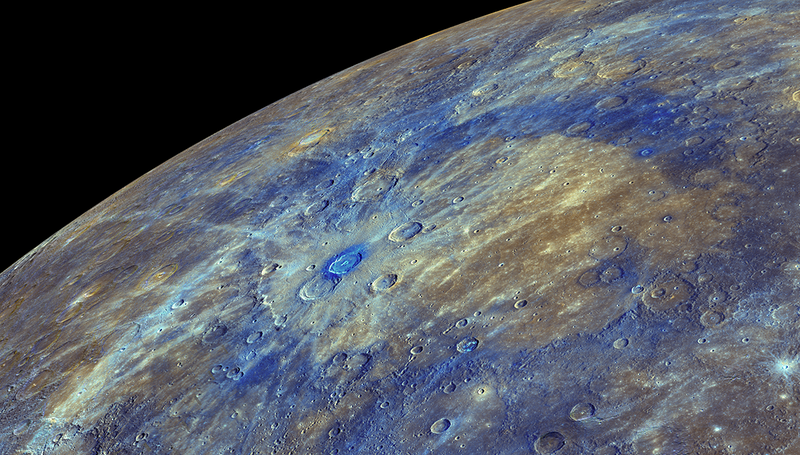
Enhanced color image of Mercury. Credit: NASA/JHUAPL/Carnegie Institution of Washington
Mercury's day side is hot enough to melt lead, but there's ice at the poles. Before we had space probes, Mercury was a mystery hidden in the Sun's glare, but that's changed now.
1. Mercury is the smallest Solar System planet.
Now that Pluto is a dwarf planet, Mercury is the baby of the planets. Even Jupiter's moon Ganymede and Saturn's moon Titan are bigger than Mercury.
2. Mercury used to be bigger — and it's still shrinking.
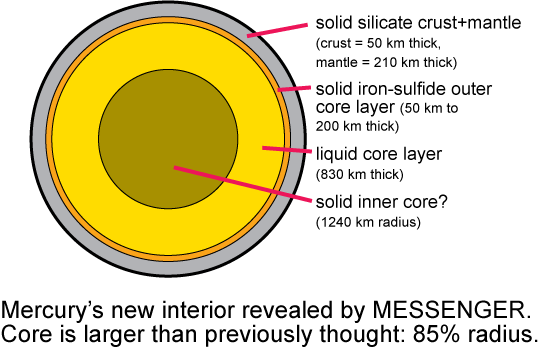
Mercury is like a moon-sized metal ball with a rocky crust. The core is made of iron, and it takes up most of the planet. This is unusual and means that Mercury used to be bigger. In the distant past, a collision knocked off away the outer layer. Mercury is also very slowly shrinking. This is because the hot iron core contracts as it cools. [diagram: astronomynotes.com]
3. Mercury is so close to the Sun that it's hard to observe from Earth.
We used to know almost nothing about Mercury. It's so close to the Sun that astronomers have to observe Mercury in twilight. Unfortunately, it's then low in the sky and its features aren't clear. In 1974-5, flybys by Mariner 10 gave us the first good look at Mercury. However, each flyby saw the same half of the planet. It wasn't until 2008 that we got a good look at Mercury when the Messenger mission orbited it for over four years.
4. Astronomers used to think that Mercury didn't turn on its axis.
Since Mercury is close to the Sun, we could expect it to keep the same side facing the Sun, the way the Moon does as it orbits Earth. However, in 1965, astronomers studied the planet with radar. They discovered that it rotates three times every two years.
5. Mercury has a very elliptical orbit. An ellipse is a squashed circle.
The average distance between Mercury and the Sun is 58 million km (36 million miles). But it gets as far away as 70 million km (40 million mi) and as near as 46 million km (29 million miles). If you could stand on Mercury when it's closest to the Sun, the Sun would look three times as big as it does from Earth.
6. Mercury is the fastest-moving Solar System planet.
Mercury's average speed is 107,000 km per hour (67,000 mph). It's so close to the Sun that it has to move fast to keep from being pulled in by the Sun's gravity. If you could move that fast, you could get all the way around the Earth in less than 25 seconds.
7. A day on Mercury is longer than a year on Mercury.
The time it takes a planet to go once around the Sun is a year. A year on Mercury is very short, only 88 Earth days long. A useful way of measuring day length is the time from one noon to the next noon. On Earth that's 24 hours. However, on Mercury it's 176 Earth days. That makes a Mercury day two Mercury years long.
8. Mercury has enormous temperature changes during a day.
The day side can heat up to 430°C (800°F). On the night side, the temperature can drop to -179°C (-290°F). This is as cold as some of the moons of Saturn, even though they are more than twelve times farther from the Sun than Mercury is.
9. There is ice on Mercury.
NASA's Messenger probe detected ice at the poles. There are craters on Mercury that never get direct sunlight, so they always stay extremely cold.
10. One of the biggest impact craters in the Solar System is on Mercury.
Like the Moon, Mercury is heavily cratered. And something pretty big hit Mercury in its early days, making the hole called the Caloris Basin. This impact crater is about 1550 km (960 miles) across. That's more than the distance from New York City to Chicago or from London to Rome.
Mercury's day side is hot enough to melt lead, but there's ice at the poles. Before we had space probes, Mercury was a mystery hidden in the Sun's glare, but that's changed now.
1. Mercury is the smallest Solar System planet.
Now that Pluto is a dwarf planet, Mercury is the baby of the planets. Even Jupiter's moon Ganymede and Saturn's moon Titan are bigger than Mercury.
2. Mercury used to be bigger — and it's still shrinking.
Mercury is like a moon-sized metal ball with a rocky crust. The core is made of iron, and it takes up most of the planet. This is unusual and means that Mercury used to be bigger. In the distant past, a collision knocked off away the outer layer. Mercury is also very slowly shrinking. This is because the hot iron core contracts as it cools. [diagram: astronomynotes.com]
3. Mercury is so close to the Sun that it's hard to observe from Earth.
We used to know almost nothing about Mercury. It's so close to the Sun that astronomers have to observe Mercury in twilight. Unfortunately, it's then low in the sky and its features aren't clear. In 1974-5, flybys by Mariner 10 gave us the first good look at Mercury. However, each flyby saw the same half of the planet. It wasn't until 2008 that we got a good look at Mercury when the Messenger mission orbited it for over four years.
4. Astronomers used to think that Mercury didn't turn on its axis.
Since Mercury is close to the Sun, we could expect it to keep the same side facing the Sun, the way the Moon does as it orbits Earth. However, in 1965, astronomers studied the planet with radar. They discovered that it rotates three times every two years.
5. Mercury has a very elliptical orbit. An ellipse is a squashed circle.
The average distance between Mercury and the Sun is 58 million km (36 million miles). But it gets as far away as 70 million km (40 million mi) and as near as 46 million km (29 million miles). If you could stand on Mercury when it's closest to the Sun, the Sun would look three times as big as it does from Earth.
6. Mercury is the fastest-moving Solar System planet.
Mercury's average speed is 107,000 km per hour (67,000 mph). It's so close to the Sun that it has to move fast to keep from being pulled in by the Sun's gravity. If you could move that fast, you could get all the way around the Earth in less than 25 seconds.
7. A day on Mercury is longer than a year on Mercury.
The time it takes a planet to go once around the Sun is a year. A year on Mercury is very short, only 88 Earth days long. A useful way of measuring day length is the time from one noon to the next noon. On Earth that's 24 hours. However, on Mercury it's 176 Earth days. That makes a Mercury day two Mercury years long.
8. Mercury has enormous temperature changes during a day.
The day side can heat up to 430°C (800°F). On the night side, the temperature can drop to -179°C (-290°F). This is as cold as some of the moons of Saturn, even though they are more than twelve times farther from the Sun than Mercury is.
9. There is ice on Mercury.
NASA's Messenger probe detected ice at the poles. There are craters on Mercury that never get direct sunlight, so they always stay extremely cold.
10. One of the biggest impact craters in the Solar System is on Mercury.
Like the Moon, Mercury is heavily cratered. And something pretty big hit Mercury in its early days, making the hole called the Caloris Basin. This impact crater is about 1550 km (960 miles) across. That's more than the distance from New York City to Chicago or from London to Rome.
You Should Also Read:
Transit of Mercury
Absolute Beginners - Seeing Mercury and Venus
Jupiter's Moons - Facts for Kids

Related Articles
Editor's Picks Articles
Top Ten Articles
Previous Features
Site Map
Content copyright © 2023 by Mona Evans. All rights reserved.
This content was written by Mona Evans. If you wish to use this content in any manner, you need written permission. Contact Mona Evans for details.