

Revisiting The Menopause Makeover

If menopause has you feeling tired, worn out, confused and frustrated, it is time for The Menopause Makeover Challenge!
The Menopause Makeover, written by Staness Jonekos and Dr. Wendy Klein, is your menopause planner designed to guide you through ‘the change.’ This book contains practical advice and medical expertise to help you learn more about what is happening during menopause and how to cope with this time of transition. This first in a series of articles will explain what The Menopause Makeover is about and what it can do for you.
The Menopause Makeover Challenge
Designed to help you make real changes in your life during menopause and beyond, this book makes menopause more manageable. Through a series of eight steps that will take you about twelve weeks, you get real advice to deal with menopause. By using the easy to follow charts and planners in the book, you can actually see your progress and measure your results. This makes taking The Menopause Makeover Challenge a fun and realistic way to make positive changes in your life.
The Eight Steps of the Menopause Makeover Challenge
The articles are written to correspond with the order of the steps in The Menopause Makeover:
1. Understanding Menopause
2. Feeding the New You
3. Exercise it Off!
4. Beauty Advice
5. Emotional Rollercoaster
6. Your Relationships
7. Change and Spirituality
8. Creating Happiness
The Menopause Makeover Challenge articles
This is not a blog. The purpose of this series is to let you explore the steps involved and learn about how they will help you. My goal for each of you is to learn the ways that The Menopause Makeover Challenge will work for you. Reading about someone else’s experience is not always helpful if you find it difficult to relate. This is for you and about you!
Each step can be tailored to meet your specific needs during menopause. No two women have the same menopause experience. Every woman will need a solution that works for her specific situation. This is why The Menopause Makeover works so well; it is designed to let you customize your makeover based on what is happening to you during menopause. Whether your symptoms are mild or severe, you will have a set of tools to help you make changes that will help you with menopause.
Menopause and your health
But menopause is not always to blame for many of the health issues you may have. The various choices you have made in the past may be catching up with you during menopause. This means that you can make new choices to improve your health such as eating a healthy diet, exercising and dealing with stress.
Challenges of the Menopause Makeover Challenge
In each article you will read about the possible challenges associated with each step. This varies widely among women because you may find a particular step easy where others may have greater difficulties. Each step has been approached as objectively as possible and written with readers in mind. While working through The Menopause Makeover Challenge I do not want readers to be influenced by my personal experiences.
Editor’s notes for The Menopause Makeover Challenge
As your menopause editor, I have included a very short item at the end of each article to share a little of my observations as I undertake The Menopause Makeover Challenge. I include this to let you know that I only recommend something because I have put it to the test but ultimately I want readers to identify with The Menopause Makeover for them and them alone.
As author Jonekos points out there are no quick fixes in menopause. You will need to put in some effort and make a commitment to yourself to complete The Menopause Makeover. The result will be a healthier you who is able to cope with menopause and its challenges. As well, you will be preparing yourself for the years beyond menopause. This transitional phase is your time for self-discovery. Until now you have been left to figure it out on your own. Now with The Menopause Makeover you have a guide to take control of your menopause.
**Harlequin Enterprises Ltd. provided this review copy of The Menopause Makeover to me completely free of charge.**
The Menopause Makeover, Staness Jonekos with Wendy Klein, M.D., Harlequin Enterprises Ltd., New York, 2010, 302 pp.
Please visit www.menopausemakeover.com
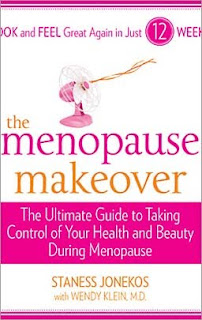
The Menopause Makeover, written by Staness Jonekos and Dr. Wendy Klein, is your menopause planner designed to guide you through ‘the change.’ This book contains practical advice and medical expertise to help you learn more about what is happening during menopause and how to cope with this time of transition. This first in a series of articles will explain what The Menopause Makeover is about and what it can do for you.
The Menopause Makeover Challenge
Designed to help you make real changes in your life during menopause and beyond, this book makes menopause more manageable. Through a series of eight steps that will take you about twelve weeks, you get real advice to deal with menopause. By using the easy to follow charts and planners in the book, you can actually see your progress and measure your results. This makes taking The Menopause Makeover Challenge a fun and realistic way to make positive changes in your life.
The Eight Steps of the Menopause Makeover Challenge
The articles are written to correspond with the order of the steps in The Menopause Makeover:
1. Understanding Menopause
2. Feeding the New You
3. Exercise it Off!
4. Beauty Advice
5. Emotional Rollercoaster
6. Your Relationships
7. Change and Spirituality
8. Creating Happiness
The Menopause Makeover Challenge articles
This is not a blog. The purpose of this series is to let you explore the steps involved and learn about how they will help you. My goal for each of you is to learn the ways that The Menopause Makeover Challenge will work for you. Reading about someone else’s experience is not always helpful if you find it difficult to relate. This is for you and about you!
Each step can be tailored to meet your specific needs during menopause. No two women have the same menopause experience. Every woman will need a solution that works for her specific situation. This is why The Menopause Makeover works so well; it is designed to let you customize your makeover based on what is happening to you during menopause. Whether your symptoms are mild or severe, you will have a set of tools to help you make changes that will help you with menopause.
Menopause and your health
But menopause is not always to blame for many of the health issues you may have. The various choices you have made in the past may be catching up with you during menopause. This means that you can make new choices to improve your health such as eating a healthy diet, exercising and dealing with stress.
Challenges of the Menopause Makeover Challenge
In each article you will read about the possible challenges associated with each step. This varies widely among women because you may find a particular step easy where others may have greater difficulties. Each step has been approached as objectively as possible and written with readers in mind. While working through The Menopause Makeover Challenge I do not want readers to be influenced by my personal experiences.
Editor’s notes for The Menopause Makeover Challenge
As your menopause editor, I have included a very short item at the end of each article to share a little of my observations as I undertake The Menopause Makeover Challenge. I include this to let you know that I only recommend something because I have put it to the test but ultimately I want readers to identify with The Menopause Makeover for them and them alone.
As author Jonekos points out there are no quick fixes in menopause. You will need to put in some effort and make a commitment to yourself to complete The Menopause Makeover. The result will be a healthier you who is able to cope with menopause and its challenges. As well, you will be preparing yourself for the years beyond menopause. This transitional phase is your time for self-discovery. Until now you have been left to figure it out on your own. Now with The Menopause Makeover you have a guide to take control of your menopause.
**Harlequin Enterprises Ltd. provided this review copy of The Menopause Makeover to me completely free of charge.**
The Menopause Makeover, Staness Jonekos with Wendy Klein, M.D., Harlequin Enterprises Ltd., New York, 2010, 302 pp.
Please visit www.menopausemakeover.com

This site needs an editor - click to learn more!

Related Articles
Editor's Picks Articles
Top Ten Articles
Previous Features
Site Map
Content copyright © 2023 by Tammy Elizabeth Southin. All rights reserved.
This content was written by Tammy Elizabeth Southin. If you wish to use this content in any manner, you need written permission. Contact
BellaOnline Administration
for details.
