

Book review You The Owner's Manual

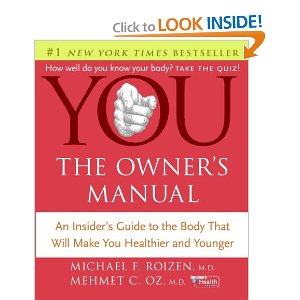
If only the human body came with a guidebook or an owner’s manual. Help has arrived in the form of ‘You The Owner’s Manual’ written by popular healthcare experts Dr. Michael F. Roizen and Dr. Mehmet C. Oz. For the past decade, these two dedicated doctors have helped educate readers about how to look after their bodies and their book is designed to help you get the most out of your healthcare management.
Most readers will recognize the work of these two doctors through the breakthrough Real Age concept. Real Age takes into account various genetic and lifestyle components to arrive at a body’s ‘true’ age; a patient aged 40 may be younger or older according to Real Age based present health conditions and habits. But readers want to know what can be done to help improve their health, and they want it in a user-friendly format.
‘You The Owner’s Manual’ first appeared on bookshelves in 2005 and has been subsequently updated to keep patients informed about the latest healthcare breakthroughs. By following their advice, Drs. Roizen and Oz aim to deliver practical tips and solid information to allow patients to better understand their bodies and how to take better care of themselves.
Following in the old adage ‘an ounce of prevention is worth a pound of cure’, this guidebook examines the many ways that a healthy diet, exercise, and regular physical check-ups can help maintain a healthy body throughout life.
But with so many books dedicated to having a better and healthier body clogging up bookstore shelves, what makes ‘You The Owner’s Manual’ stand out?
After beginning with a quiz to help readers discover how familiar they may or may not be with their health, the book settles into a series of chapters dedicated to delivering sound healthcare advice.
Among the highlights:
‘You The Owner’s Manual’ presents complicated medical information in an easy to understand format. No doctor-jargon here. The workings of the human body are presented in a light-hearted matter to help address the fact that most readers would have difficulty with a typical medical textbook. At the same time, this book avoids talking down to readers. Today’s patient is much more media savvy and less likely to take any advice at face value. Readers get the information that they need to make better choices.
Healthcare issues are surrounded by many myths. ‘You The Owner’s Manual’ works to separate fact from fiction by clearing up popular misconceptions. Will you really know when you are having a heart attack? Does being a non-smoker really mean that you have nothing to worry about? The answers to these and other questions may surprise you.
Just like an owner’s manual for your car or major appliance, ‘You The Owner’s Manual’ contains sections to help maintain your body. A section devoted to nutrition features food selections and recipes to help you get your body into optimum health. A further section includes a selection of exercises designed to keep your body in top form. Finally, updated versions have a series of questions from patients who want answers to some of their most troubling and sometimes most embarrassing health issues.
Being written for the general masses, ‘You The Owner’s Manual’ delivers medical discoveries based on numerous research studies. The one drawback for those who are seeking further self-research is that there is no compilation of where and by whom these studies were conducted. For most readers this is not a problem but for aspiring medical students or those looking for reference material to substantiate the advice, this book does not fit the usual academic standards.
‘You The Owner’s Manual’ will help readers understand how their bodies work, how to best look after those bodies, and to try to prevent or at least mitigate serious health issues. The book’s introduction urges patients to see their doctors as teachers. With this book, readers have a good head start on their homework.
I selected and purchased this copy of ‘You The Owner’s Manual’ and received no compensation or recognition for this review.
Most readers will recognize the work of these two doctors through the breakthrough Real Age concept. Real Age takes into account various genetic and lifestyle components to arrive at a body’s ‘true’ age; a patient aged 40 may be younger or older according to Real Age based present health conditions and habits. But readers want to know what can be done to help improve their health, and they want it in a user-friendly format.
‘You The Owner’s Manual’ first appeared on bookshelves in 2005 and has been subsequently updated to keep patients informed about the latest healthcare breakthroughs. By following their advice, Drs. Roizen and Oz aim to deliver practical tips and solid information to allow patients to better understand their bodies and how to take better care of themselves.
Following in the old adage ‘an ounce of prevention is worth a pound of cure’, this guidebook examines the many ways that a healthy diet, exercise, and regular physical check-ups can help maintain a healthy body throughout life.
But with so many books dedicated to having a better and healthier body clogging up bookstore shelves, what makes ‘You The Owner’s Manual’ stand out?
After beginning with a quiz to help readers discover how familiar they may or may not be with their health, the book settles into a series of chapters dedicated to delivering sound healthcare advice.
Among the highlights:
‘You The Owner’s Manual’ presents complicated medical information in an easy to understand format. No doctor-jargon here. The workings of the human body are presented in a light-hearted matter to help address the fact that most readers would have difficulty with a typical medical textbook. At the same time, this book avoids talking down to readers. Today’s patient is much more media savvy and less likely to take any advice at face value. Readers get the information that they need to make better choices.
Healthcare issues are surrounded by many myths. ‘You The Owner’s Manual’ works to separate fact from fiction by clearing up popular misconceptions. Will you really know when you are having a heart attack? Does being a non-smoker really mean that you have nothing to worry about? The answers to these and other questions may surprise you.
Just like an owner’s manual for your car or major appliance, ‘You The Owner’s Manual’ contains sections to help maintain your body. A section devoted to nutrition features food selections and recipes to help you get your body into optimum health. A further section includes a selection of exercises designed to keep your body in top form. Finally, updated versions have a series of questions from patients who want answers to some of their most troubling and sometimes most embarrassing health issues.
Being written for the general masses, ‘You The Owner’s Manual’ delivers medical discoveries based on numerous research studies. The one drawback for those who are seeking further self-research is that there is no compilation of where and by whom these studies were conducted. For most readers this is not a problem but for aspiring medical students or those looking for reference material to substantiate the advice, this book does not fit the usual academic standards.
‘You The Owner’s Manual’ will help readers understand how their bodies work, how to best look after those bodies, and to try to prevent or at least mitigate serious health issues. The book’s introduction urges patients to see their doctors as teachers. With this book, readers have a good head start on their homework.
I selected and purchased this copy of ‘You The Owner’s Manual’ and received no compensation or recognition for this review.
This site needs an editor - click to learn more!

Related Articles
Editor's Picks Articles
Top Ten Articles
Previous Features
Site Map
Content copyright © 2023 by Tammy Elizabeth Southin. All rights reserved.
This content was written by Tammy Elizabeth Southin. If you wish to use this content in any manner, you need written permission. Contact
BellaOnline Administration
for details.
