Caroline Herschel
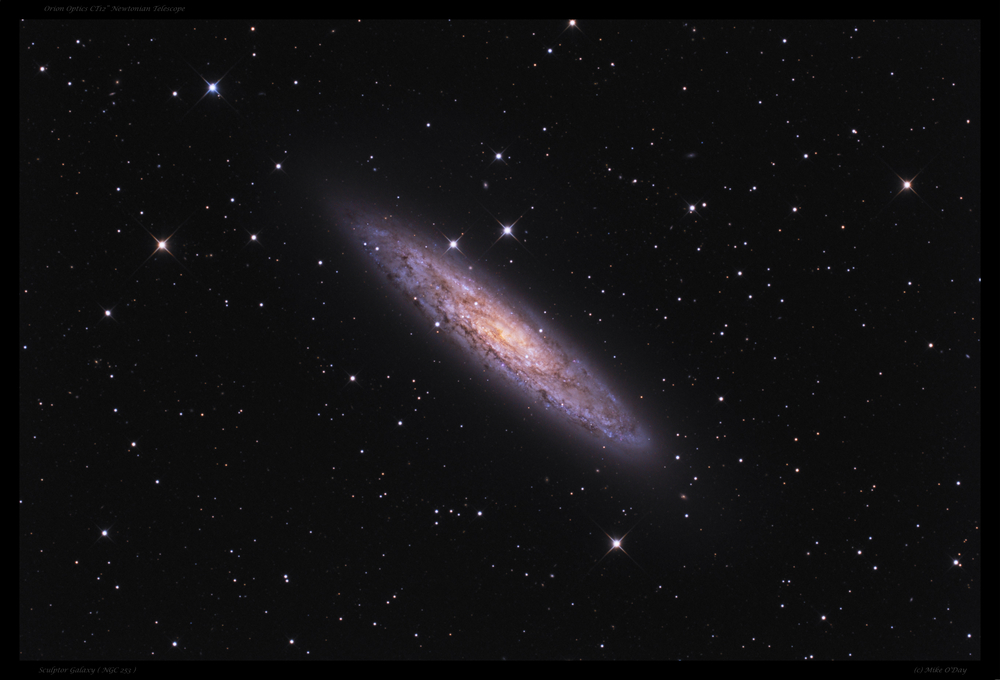
Sculptor Galaxy, discovered by Caroline Herschel. [image credit: Mike O'Day]
Caroline Herschel was born on March 16, 1750 in Hanover in Germany.
Her father, a military bandsman, taught his six children music and got them the best education that he could. Unfortunately, Caroline's mother Anna had contrary views, especially about education for girls.
Caroline bore the scars of childhood smallpox, and her growth was stunted by typhus. It was clear that she was not going to be marriage material, so Anna determined that Caroline's role would be as her household help. Nonetheless she did grudgingly allow her husband to send the child to the garrison school. The instruction there was minimal — the girls didn't even learn arithmetic.
Despite the 12-year age gap between them, Caroline and her brother William had an affectionate relationship. Without him, the life of this intelligent young woman would have been wasted as a servant in her own home. But when William was earning a good living in Bath, England, he proposed that Caroline come to train as a musician. By offering to pay for a servant, he won over his mother, and Caroline was freed.
In England, Caroline's lovely soprano voice was trained well enough to perform a major solo in a performance of Handel's Messiah. On the strength of this performance she was asked to perform elsewhere, but turned it down.
In addition to her music lessons, William also taught Caroline arithmetic for household accounting, and later, the math needed for astronomy. When William's interest in astronomy became a passion, Caroline was also co-opted.
The turning point in their lives was William's discovery of Uranus. It was the first planet to be discovered by telescope, and he achieved international celebrity. More importantly, King George III rewarded him with a salaried job.
With William contracted to show the royal family interesting things through the telescope, he would have to move near to Windsor where the royal court was. Caroline had a great life in Bath, but she had already given up her chance for a musical career, so off they went.
In their new home, Caroline remained in charge of the household and helped with telescope-making. But it was pretty dull after Bath, so William gave her a telescope and showed her how to use it to sweep for comets and other unusual objects. When she wasn't needed to help her brother, Caroline made her own observations. She wasn't really interested at first, but later turned into a keen observer.
Comets were popular at the time, and comet-hunters had to learn the Messier objects, a catalog of fuzzy objects that might be mistaken for comets. The objects were called nebulae, though today we call them deep sky objects. They include true nebulae (clouds of gas and dust), star clusters and galaxies.
Caroline's first discovery was the star cluster now often called Caroline's Cluster. During that year 1783 she discovered seven more clusters and the Sculptor Galaxy. She also got William interested in the nebulous objects, and he decided to make a comprehensive survey of them.
The sky survey was harder than expected. A modern observer uses red light to make notes at the telescope, because it doesn't ruin the eye's dark adaptation. But William was sweeping by observing as many objects as he could remember, then going inside to write it all down. Then he had to wait for his eyes to re-adapt.
They devised a system in which Caroline sat indoors by a window and William called out his observations from the telescope. She took down his observations and in the morning wrote them up neatly, and did the calculations to turn the numbers into actual coordinates.
As William observed, Caroline used a copy of Flamsteed's star atlas to pick out bright reference stars. John Flamsteed was the first Astronomer Royal. His 1792 Atlas Coelestis was the most accurate star atlas of the time, and remained the leading atlas for nearly a century.
In the summer of 1786 the king sent William abroad on business. While he was away, Caroline discovered a comet which people called "the first lady's comet". She was more famous than she ever would have been as a singer.
William's aim wasn't just to collect objects, but to use data to understand the structure of the cosmos. For this he needed a bigger telescope and got money from the king to build what would be the biggest-ever telescope. At some point he needed to ask for more money, and part of the final deal included a salary for Caroline as William's assistant. This made her one of the first woman professionals in astronomy.
Caroline Herschel went on to discover several more comets, but was well known to other astronomers for her index to Flamsteed's atlas, which corrected many errors and omissions and made it easier to use.
As William grew old, he persuaded his son John to continue the work he and Caroline had begun. They had cataloged over two thousand nebulae - all in the northern hemisphere — but the southern skies were uncharted.
When William died Caroline returned to Hanover. An odd choice, since she'd been miserable there half a century before. But she returned in triumph and lived until she was nearly 98.
In Hanover Caroline carried out some work to assist her nephew John, for which she was awarded the Gold Medal of the Royal Astronomical Society. She and Mary Somerville (a prominent scientific writer) became the first women to be made honorary fellows of the Royal Astronomical Society. Caroline was also elected to the Royal Irish Academy and given a Gold Medal for science by the King of Prussia.
The work done by the partnership of William and Caroline Herschel helped to redefine the science of astronomy. Their contribution to astronomy was recognized in 2009 when the European Space Agency named their new space telescope the Herschel Space Observatory in their honor.
Caroline Herschel was born on March 16, 1750 in Hanover in Germany.
Her father, a military bandsman, taught his six children music and got them the best education that he could. Unfortunately, Caroline's mother Anna had contrary views, especially about education for girls.
Caroline bore the scars of childhood smallpox, and her growth was stunted by typhus. It was clear that she was not going to be marriage material, so Anna determined that Caroline's role would be as her household help. Nonetheless she did grudgingly allow her husband to send the child to the garrison school. The instruction there was minimal — the girls didn't even learn arithmetic.
Despite the 12-year age gap between them, Caroline and her brother William had an affectionate relationship. Without him, the life of this intelligent young woman would have been wasted as a servant in her own home. But when William was earning a good living in Bath, England, he proposed that Caroline come to train as a musician. By offering to pay for a servant, he won over his mother, and Caroline was freed.
In England, Caroline's lovely soprano voice was trained well enough to perform a major solo in a performance of Handel's Messiah. On the strength of this performance she was asked to perform elsewhere, but turned it down.
In addition to her music lessons, William also taught Caroline arithmetic for household accounting, and later, the math needed for astronomy. When William's interest in astronomy became a passion, Caroline was also co-opted.
The turning point in their lives was William's discovery of Uranus. It was the first planet to be discovered by telescope, and he achieved international celebrity. More importantly, King George III rewarded him with a salaried job.
With William contracted to show the royal family interesting things through the telescope, he would have to move near to Windsor where the royal court was. Caroline had a great life in Bath, but she had already given up her chance for a musical career, so off they went.
In their new home, Caroline remained in charge of the household and helped with telescope-making. But it was pretty dull after Bath, so William gave her a telescope and showed her how to use it to sweep for comets and other unusual objects. When she wasn't needed to help her brother, Caroline made her own observations. She wasn't really interested at first, but later turned into a keen observer.
Comets were popular at the time, and comet-hunters had to learn the Messier objects, a catalog of fuzzy objects that might be mistaken for comets. The objects were called nebulae, though today we call them deep sky objects. They include true nebulae (clouds of gas and dust), star clusters and galaxies.
Caroline's first discovery was the star cluster now often called Caroline's Cluster. During that year 1783 she discovered seven more clusters and the Sculptor Galaxy. She also got William interested in the nebulous objects, and he decided to make a comprehensive survey of them.
The sky survey was harder than expected. A modern observer uses red light to make notes at the telescope, because it doesn't ruin the eye's dark adaptation. But William was sweeping by observing as many objects as he could remember, then going inside to write it all down. Then he had to wait for his eyes to re-adapt.
They devised a system in which Caroline sat indoors by a window and William called out his observations from the telescope. She took down his observations and in the morning wrote them up neatly, and did the calculations to turn the numbers into actual coordinates.
As William observed, Caroline used a copy of Flamsteed's star atlas to pick out bright reference stars. John Flamsteed was the first Astronomer Royal. His 1792 Atlas Coelestis was the most accurate star atlas of the time, and remained the leading atlas for nearly a century.
In the summer of 1786 the king sent William abroad on business. While he was away, Caroline discovered a comet which people called "the first lady's comet". She was more famous than she ever would have been as a singer.
William's aim wasn't just to collect objects, but to use data to understand the structure of the cosmos. For this he needed a bigger telescope and got money from the king to build what would be the biggest-ever telescope. At some point he needed to ask for more money, and part of the final deal included a salary for Caroline as William's assistant. This made her one of the first woman professionals in astronomy.
Caroline Herschel went on to discover several more comets, but was well known to other astronomers for her index to Flamsteed's atlas, which corrected many errors and omissions and made it easier to use.
As William grew old, he persuaded his son John to continue the work he and Caroline had begun. They had cataloged over two thousand nebulae - all in the northern hemisphere — but the southern skies were uncharted.
When William died Caroline returned to Hanover. An odd choice, since she'd been miserable there half a century before. But she returned in triumph and lived until she was nearly 98.
In Hanover Caroline carried out some work to assist her nephew John, for which she was awarded the Gold Medal of the Royal Astronomical Society. She and Mary Somerville (a prominent scientific writer) became the first women to be made honorary fellows of the Royal Astronomical Society. Caroline was also elected to the Royal Irish Academy and given a Gold Medal for science by the King of Prussia.
The work done by the partnership of William and Caroline Herschel helped to redefine the science of astronomy. Their contribution to astronomy was recognized in 2009 when the European Space Agency named their new space telescope the Herschel Space Observatory in their honor.
You Should Also Read:
Mary Somerville and the World of Science - book
Herschel Museum of Astronomy
William Herschel

Related Articles
Editor's Picks Articles
Top Ten Articles
Previous Features
Site Map
Content copyright © 2023 by Mona Evans. All rights reserved.
This content was written by Mona Evans. If you wish to use this content in any manner, you need written permission. Contact Mona Evans for details.