Neptune - Facts for Kids
/https://public-media.si-cdn.com/filer/74/c1/74c1b9a7-c69f-49b4-9ba8-67b52a5e1d6d/neptune_pia02210.jpg )
Neptune, the Solar System's most distant planet (Image: NASA/JPL)
Neptune was discovered because of Uranus, the planet William Herschel discovered in 1781.
After many years of observing Uranus, astronomers noted that it wasn't moving in its orbit as expected. Perhaps the gravity of an unseen planet was pulling on it? In 1846, French astronomer Urbain Le Verrier used his understanding of gravity and orbits to work out where the unseen planet might be. He asked Johann Galle at the Berlin Observatory to look. Galle found it that night.
Astronomers disagreed about naming the new planet, but finally they accepted Neptune, the Roman sea god.
Neptune is about thirty times farther from the Sun than Earth is.
If you were at Neptune, the Sun would look like just another bright star. But since it's much closer than stars outside the Solar System, it would hurt your eyes to look at it. Neptune's orbit takes it on a long journey around the Sun – its year is 165 Earth years long.
Although Neptune's years are long, its days are short.
A day on Neptune [the time it takes to spin on its axis] lasts a bit over 16 hours.
Neptune and Uranus are about the same size, and they have cloud-top temperatures of around -220° C (-365° F).
What's odd about that? Neptune is much farther from the Sun than Uranus, so it should be colder. Neptune must give out more heat energy that it gets from the Sun. Scientists aren't sure exactly what's happening.
Neptune is an ice giant.
Like Uranus, Neptune isn't a gas giant. It's called an ice giant for its icy layer of frozen water, ammonia and methane.
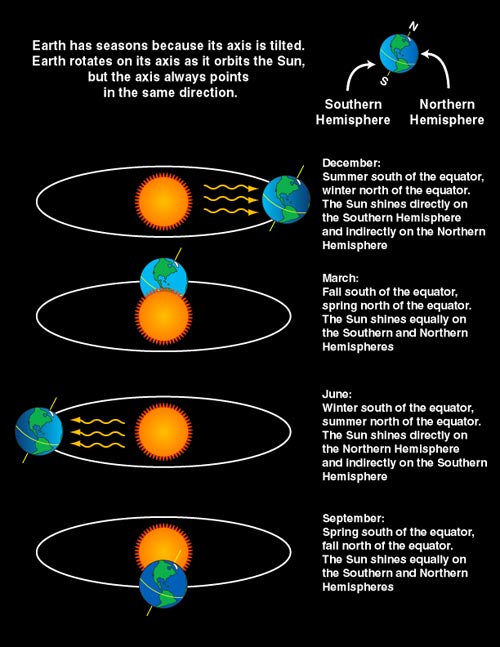
Neptune has seasons like Earth does, but a lot colder!
Earth has four seasons because of the tilt of its axis. For example, the first drawing shows the northern hemisphere tilted away from the Sun in winter. At the same time, the southern hemisphere is tilted so that it get lots of sunlight. Neptune's axis is tilted in a similar way, but each season lasts for more than forty years.
Neptune is blue.
Neptune's atmosphere is almost all hydrogen and helium, but it also has clouds of frozen methane. The methane soaks up red light and reflects blue light.
Neptune has at 14 known moons.
The names of the moons come from classical mythology and are related to Neptune or to the Greek sea god Poseidon. The biggest moon is Triton, a formerly separate object that was captured by Neptune's gravity. It's similar to Pluto in many ways, but it's bigger than Pluto – about 2700 km (1700 mi) across.
The second biggest moon is Proteus, which is 420 km (260 mi) across. The smallest five are 62 km (39 mi) or smaller. Only Triton was discovered before the 20th century.
Neptune has six known rings.
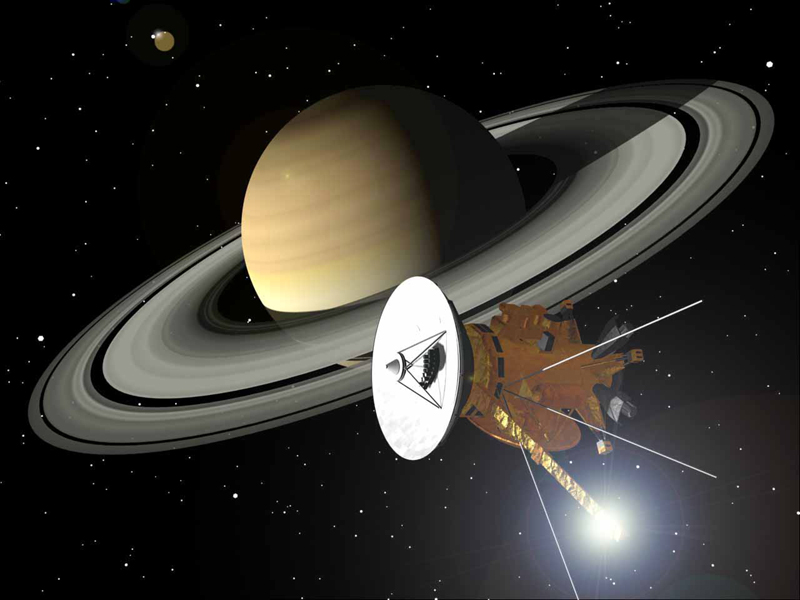
Unlike Saturn's beautiful rings, Neptune's rings are thin and dark. They don't shine like Saturn's icy rings, and are probably made of rocks and dust.
Neptune is the windiest planet in the Solar System.
Neptune's atmosphere is very active, with rapidly changing patterns. It also has the highest winds of any Solar System planet – up to 2000 km/hr (1200 mph). This is five times the highest wind speed ever recorded on Earth.
Neptune was discovered because of Uranus, the planet William Herschel discovered in 1781.
After many years of observing Uranus, astronomers noted that it wasn't moving in its orbit as expected. Perhaps the gravity of an unseen planet was pulling on it? In 1846, French astronomer Urbain Le Verrier used his understanding of gravity and orbits to work out where the unseen planet might be. He asked Johann Galle at the Berlin Observatory to look. Galle found it that night.
Astronomers disagreed about naming the new planet, but finally they accepted Neptune, the Roman sea god.
Neptune is about thirty times farther from the Sun than Earth is.
If you were at Neptune, the Sun would look like just another bright star. But since it's much closer than stars outside the Solar System, it would hurt your eyes to look at it. Neptune's orbit takes it on a long journey around the Sun – its year is 165 Earth years long.
Although Neptune's years are long, its days are short.
A day on Neptune [the time it takes to spin on its axis] lasts a bit over 16 hours.
Neptune and Uranus are about the same size, and they have cloud-top temperatures of around -220° C (-365° F).
What's odd about that? Neptune is much farther from the Sun than Uranus, so it should be colder. Neptune must give out more heat energy that it gets from the Sun. Scientists aren't sure exactly what's happening.
Neptune is an ice giant.
Like Uranus, Neptune isn't a gas giant. It's called an ice giant for its icy layer of frozen water, ammonia and methane.
Neptune has seasons like Earth does, but a lot colder!
Earth has four seasons because of the tilt of its axis. For example, the first drawing shows the northern hemisphere tilted away from the Sun in winter. At the same time, the southern hemisphere is tilted so that it get lots of sunlight. Neptune's axis is tilted in a similar way, but each season lasts for more than forty years.
Neptune is blue.
Neptune's atmosphere is almost all hydrogen and helium, but it also has clouds of frozen methane. The methane soaks up red light and reflects blue light.
Neptune has at 14 known moons.
The names of the moons come from classical mythology and are related to Neptune or to the Greek sea god Poseidon. The biggest moon is Triton, a formerly separate object that was captured by Neptune's gravity. It's similar to Pluto in many ways, but it's bigger than Pluto – about 2700 km (1700 mi) across.
The second biggest moon is Proteus, which is 420 km (260 mi) across. The smallest five are 62 km (39 mi) or smaller. Only Triton was discovered before the 20th century.
Neptune has six known rings.
Unlike Saturn's beautiful rings, Neptune's rings are thin and dark. They don't shine like Saturn's icy rings, and are probably made of rocks and dust.
Neptune is the windiest planet in the Solar System.
Neptune's atmosphere is very active, with rapidly changing patterns. It also has the highest winds of any Solar System planet – up to 2000 km/hr (1200 mph). This is five times the highest wind speed ever recorded on Earth.
You Should Also Read:
Saturn - Facts for Kids
Moons of Uranus - Facts for Kids
Kuiper Belt - Facts for Kids

Related Articles
Editor's Picks Articles
Top Ten Articles
Previous Features
Site Map
Content copyright © 2023 by Mona Evans. All rights reserved.
This content was written by Mona Evans. If you wish to use this content in any manner, you need written permission. Contact Mona Evans for details.