Jupiter the Giant Planet
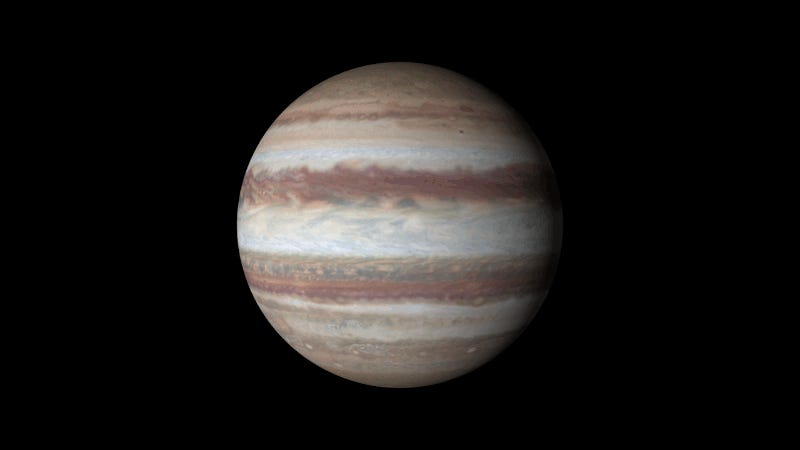
Almost everything about Jupiter is a superlative. The Solar System's biggest planet also has 79 known moons, and its magnetic influence extends well over a million miles into space. It's appropriately named for the mighty king of the classical Roman gods.
Introducing Jupiter
Gravity
Gravity is essential to planet formation. It's gravity that pulls the matter together into a rounded shape. As the body contracts, it heats up. Later, its cooling rate depends a lot on its mass. Jupiter's mass is so great that it's still contracting and releasing heat.
Gravity pulls on your mass to produce your weight. So you'd expect Jupiter's gravity to be impressive. Yet at the cloud-tops, it's only two and a half times Earth's gravitational pull. The pull if a body's gravity depends on its density – the amount of matter in a given volume – and your distance from its center of mass. Not only is Earth denser than Jupiter, but Jupiter's cloud-tops are a long way from its center of mass. Gravitational force drops rapidly with distance. If you double the distance, the force isn't halved, it drops to a quarter.
Beneath the clouds
But we needn't wonder how much we'd weigh on the surface of Jupiter, because Jupiter has no surface.
There's the cloud layer with its colored bands moving parallel to the equator. Beneath that, Jupiter's atmosphere is mostly hydrogen. As the depth increases, the pressure increases and the atmosphere thickens. This diagram shows that there's a deep layer of metallic hydrogen. The atoms in the metallic hydrogen state are so squashed together that hydrogen behaves like a liquid metal – it even conducts electricity. In the center of the planet, there's probably a dense rocky core with a mass of around 10-15 or more Earths.
Moons and rings
All four of the giant planets have ring systems, though none is as spectacular as Saturn's. Jupiter has three main rings, all quite faint and made mostly of dust.
Its rings may not be much, but Jupiter is rich in moons. Galileo discovered the four largest ones in 1610. By the end of 2018, 79 moons were known. Many are less than 10 km (6 miles) in diameter and were discovered in the last several decades. Of the Galilean moons, only Europa is smaller than our Moon, and Ganymede is the largest moon in the Solar System.
Observing Jupiter
When our distant ancestors observed the night sky, their eyes were drawn to this shining celestial object. With binoculars you can see the Galilean moons as points of light, and a small telescope can show the cloud bands of the planet's weather system.
Prize-winning astrophotographer Damian Peach produced this image of Jupiter and its moons Io and Ganymede. During several centuries of observing Jupiter, the widths of the white, red, brown and orange bands, and the intensity of the colors have varied. Nonetheless the general pattern of these zones (the lighter regions) and belts (the darker regions) has been been remarkably stable.
The most famous of Jupiter's features is the Great Red Spot, a giant storm with winds whirling around at 360 km/h (225 mph). It's so big you could line up three Earths across it. English scientist Robert Hooke saw a red spot as long ago as 1664. However, the first recorded observation of the current spot was in 1831, and we know It's persisted since then.
Now, in addition to ground-based telescopes, we have images from the Hubble Space Telescope and space probes. Jupiter's rings were discovered in 1979 by the Voyager spacecraft. Since 2016, NASA's Juno mission has been studying Jupiter closer than any mission before it.
An intense magnetic field
We're grateful for Earth's magnetic field. It protects us and our atmosphere from dangerous particles from the Sun. Earth's magnetosphere is puny in comparison to Jupiter's which is, on average, about 5.3 million kilometers (3.3 million miles) wide. If we could see Jupiter's magnetosphere, it would be an enormous structure in the night sky, larger than a full Moon.
Alas for Jupiter, rather than deflecting solar radiation, it traps it in deadly radiation belts. NASA's Juno mission's orbits are planned to minimize its time in the radiation belts, and the instruments had to be carefully shielded.
Introducing Jupiter
- Jupiter is nearly 143,000 km (90,000 mi) in diameter at the equator. A hollow Jupiter would have space for 1300 Earths.
- The Sun contains nearly all of the Solar System's mass, and Jupiter has most of the remainder. If we could recycle the matter in Jupiter, we'd have enough mass to replicate the other planets, moons, dwarf planets, and asteroids, etc. In fact, we could do this twice and still have material left over.
- Jupiter is five times farther from the Sun than Earth is, and its year is twelve Earth years long. But Jupiter doesn't have much in the way of seasons, because its axis is only slightly tilted. In contrast to Earth's seasonal changes, the amount of sunlight reaching a given latitude on Jupiter changes very little as the planet orbits the Sun.
- Jupiter has long years, but short days. Earth takes 24 hours to rotate once, but despite its greater size, Jupiter turns so fast that its day is only ten hours long.
- At Jupiter's distance, it's not surprising that the cloud-top temperature is a chilly -140°C (-230°F). Yet its core temperature may be around 24,000°C (43,000°F). The surface of the Sun is only about a quarter of that temperature. Jupiter emits almost as much heat energy as it receives from the Sun, a feature shared with Saturn and Neptune.
Gravity
Gravity is essential to planet formation. It's gravity that pulls the matter together into a rounded shape. As the body contracts, it heats up. Later, its cooling rate depends a lot on its mass. Jupiter's mass is so great that it's still contracting and releasing heat.
Gravity pulls on your mass to produce your weight. So you'd expect Jupiter's gravity to be impressive. Yet at the cloud-tops, it's only two and a half times Earth's gravitational pull. The pull if a body's gravity depends on its density – the amount of matter in a given volume – and your distance from its center of mass. Not only is Earth denser than Jupiter, but Jupiter's cloud-tops are a long way from its center of mass. Gravitational force drops rapidly with distance. If you double the distance, the force isn't halved, it drops to a quarter.
Beneath the clouds
But we needn't wonder how much we'd weigh on the surface of Jupiter, because Jupiter has no surface.
There's the cloud layer with its colored bands moving parallel to the equator. Beneath that, Jupiter's atmosphere is mostly hydrogen. As the depth increases, the pressure increases and the atmosphere thickens. This diagram shows that there's a deep layer of metallic hydrogen. The atoms in the metallic hydrogen state are so squashed together that hydrogen behaves like a liquid metal – it even conducts electricity. In the center of the planet, there's probably a dense rocky core with a mass of around 10-15 or more Earths.
Moons and rings
All four of the giant planets have ring systems, though none is as spectacular as Saturn's. Jupiter has three main rings, all quite faint and made mostly of dust.
Its rings may not be much, but Jupiter is rich in moons. Galileo discovered the four largest ones in 1610. By the end of 2018, 79 moons were known. Many are less than 10 km (6 miles) in diameter and were discovered in the last several decades. Of the Galilean moons, only Europa is smaller than our Moon, and Ganymede is the largest moon in the Solar System.
Observing Jupiter
When our distant ancestors observed the night sky, their eyes were drawn to this shining celestial object. With binoculars you can see the Galilean moons as points of light, and a small telescope can show the cloud bands of the planet's weather system.
Prize-winning astrophotographer Damian Peach produced this image of Jupiter and its moons Io and Ganymede. During several centuries of observing Jupiter, the widths of the white, red, brown and orange bands, and the intensity of the colors have varied. Nonetheless the general pattern of these zones (the lighter regions) and belts (the darker regions) has been been remarkably stable.
The most famous of Jupiter's features is the Great Red Spot, a giant storm with winds whirling around at 360 km/h (225 mph). It's so big you could line up three Earths across it. English scientist Robert Hooke saw a red spot as long ago as 1664. However, the first recorded observation of the current spot was in 1831, and we know It's persisted since then.
Now, in addition to ground-based telescopes, we have images from the Hubble Space Telescope and space probes. Jupiter's rings were discovered in 1979 by the Voyager spacecraft. Since 2016, NASA's Juno mission has been studying Jupiter closer than any mission before it.
An intense magnetic field
We're grateful for Earth's magnetic field. It protects us and our atmosphere from dangerous particles from the Sun. Earth's magnetosphere is puny in comparison to Jupiter's which is, on average, about 5.3 million kilometers (3.3 million miles) wide. If we could see Jupiter's magnetosphere, it would be an enormous structure in the night sky, larger than a full Moon.
Alas for Jupiter, rather than deflecting solar radiation, it traps it in deadly radiation belts. NASA's Juno mission's orbits are planned to minimize its time in the radiation belts, and the instruments had to be carefully shielded.
You Should Also Read:
Jupiter's Galilean Moons
Robert Hooke – England's Leonardo
Voyagers – Preparing for the Grand Tour

Related Articles
Editor's Picks Articles
Top Ten Articles
Previous Features
Site Map
Content copyright © 2023 by Mona Evans. All rights reserved.
This content was written by Mona Evans. If you wish to use this content in any manner, you need written permission. Contact Mona Evans for details.