Jupiter's Galilean Moons

As befits the colossus of the Solar System, Jupiter has four of the system's largest moons: Ganymede, Callisto, Io and Europa.
History
Galileo discovered Jupiter's moons in January 1610 and was quick to publish his findings. It was a sensation, because they were the first known moons of another planet. In addition, since they were orbiting Jupiter, it challenged the orthodoxy that everything in the Solar System revolved around the Earth.
Four years later German astronomer Simon Marius published an account claiming that he had discovered the moons first. He didn't get the credit, but the names in use today are those suggested by Marius. They are names of amorous conquests of Zeus (the Greek equivalent of Jupiter). Collectively, we know them as the Galilean moons.
The moons
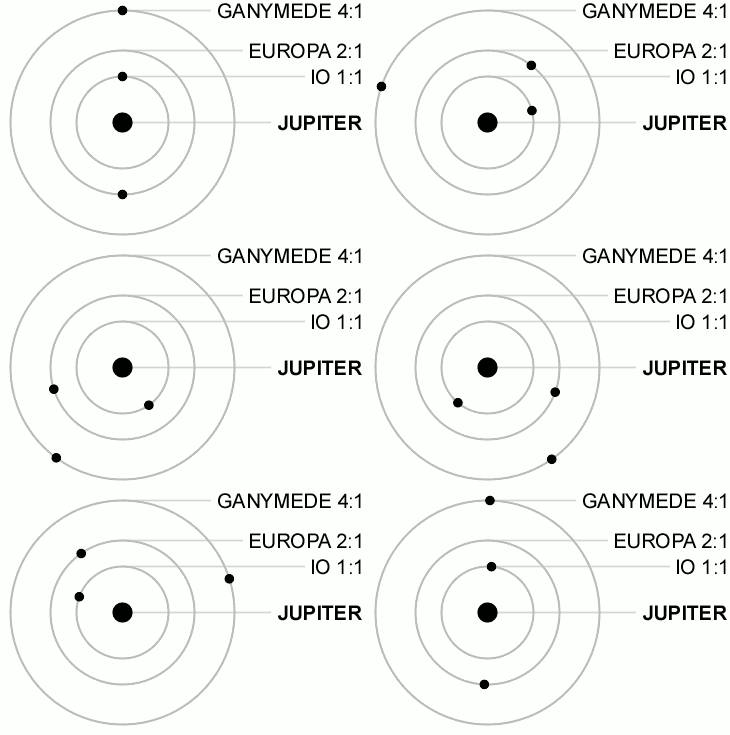
Like our moon, the Galilean moons are tidally locked, which means they keep the same face towards the planet as they orbit. In addition, the three inner moons orbit in what's called a 1:2:4 resonance. This is created by a combination of Jupiter's gravity and the gravity of the moons themselves. Each time Ganymede orbits Jupiter, Europa orbits twice and Io four times.
All of the moons have extremely thin atmospheres. Io's is mostly sulfur dioxide, those of Europa and Ganymede are oxygen, and Callisto's is carbon dioxide. Io, Europa and Ganymede have internal layers (core, mantle and crust), as planets do, but Callisto has a more primitive structure.
Io
My favorite is Io, and not just because it reminds me of a pizza. It's the most volcanically active body in the Solar System, and very interesting.
Io is about the same size as the Moon and orbits at about the same distance from Jupiter as the Moon does from Earth. Yet it has over 400 volcanoes, and a "month" on Io lasts only 42 hours. This is all down to gravity. Caught between Jupiter's strong gravity and that of its companions Callisto and Ganymede, Io is mercilessly squeezed. This raises large land tides in which the surface is pulled up and down as much as 100m (330 ft). The resulting friction releases considerable heat.
The moon's surface is a rugged one with over 100 mountains, some of them taller than Everest. On the other hand, impact craters are absent, as the volcanic activity has renewed the surface.
Europa
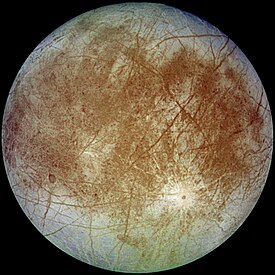
A complete contrast to fiery, mountainous Io, Europa is covered in ice, and is one of the smoothest objects in the Solar System. The small number of craters shows that the surface is young, possibly as young as 100 million years. (That is young, geologically.) You can see cracks and streaks on Europa's surface. The cracking is caused by tidal heating, but we don't know exactly what the staining is.
The exciting thing about Europa is a deep liquid ocean under the ice. It's about 100 km (60 miles) deep and warmed by the tidal heating. Deep in Earth's oceans there are hydrothermal vents where heat and minerals pour out of the planet's interior. Life has evolved there to use chemical energy rather than the energy of sunlight. Astrobiologists think that if life has evolved elsewhere in the Solar System, then Europa's ocean is one of the likeliest places to find it.
Ganymede
Ganymede is bigger than Mercury and the known dwarf planets. However its lower density means it has only half Mercury's mass. Ganymede has a liquid iron core and is the only moon in the Solar System to have its own magnetic field. Hubble Space Telescope data convinced astronomers in 2015 that there is a very large salty ocean underneath the surface of Ganymede. It could contain more water than all of Earth's surface water combined, but more evidence is needed for that.
The terrain is varied, but broadly, Ganymede has two different types. The dark regions are heavily cratered, evidence of great age. These regions could date back four billion years to the time of heavy bombardment in the early Solar System. The brighter regions show patterns of ridges and grooves which go on for thousands of miles, suggesting later geological activity. Yet the pattern of cratering shows that although they're younger than the dark regions, they're still ancient.
Callisto
Callisto seems to be the odd one out. It's far enough away that it isn't part of the orbital resonance, and its interior isn't warmed by tidal heating. It's also the least dense of the moons, and shows the least internal layering.
But each of the four moons has a superlative feature and Callisto's distinction is that it's the most heavily cratered satellite in the Solar System. There aren't any notable features related to internal activity - its surface has apparently been primarily shaped by impacts. The largest impact crater is called Valhalla. The crater itself is 360 km (225 miles) across and the rings extend to 1900 km (1190 miles) from its center.
Our Moon's surface is a record of the history of the inner Solar System but Callisto's surface is probably even older, dating back to the beginning of the Solar System.
References:
(1) NASA, “Solar System Exploration” https://solarsystem.nasa.gov/planets/profile.cfm?Object=Jupiter&Display=Sats
(2) Nick Strobel https://www.astronomynotes.com/solarsys/s14.htm
History
Galileo discovered Jupiter's moons in January 1610 and was quick to publish his findings. It was a sensation, because they were the first known moons of another planet. In addition, since they were orbiting Jupiter, it challenged the orthodoxy that everything in the Solar System revolved around the Earth.
Four years later German astronomer Simon Marius published an account claiming that he had discovered the moons first. He didn't get the credit, but the names in use today are those suggested by Marius. They are names of amorous conquests of Zeus (the Greek equivalent of Jupiter). Collectively, we know them as the Galilean moons.
The moons
Like our moon, the Galilean moons are tidally locked, which means they keep the same face towards the planet as they orbit. In addition, the three inner moons orbit in what's called a 1:2:4 resonance. This is created by a combination of Jupiter's gravity and the gravity of the moons themselves. Each time Ganymede orbits Jupiter, Europa orbits twice and Io four times.
All of the moons have extremely thin atmospheres. Io's is mostly sulfur dioxide, those of Europa and Ganymede are oxygen, and Callisto's is carbon dioxide. Io, Europa and Ganymede have internal layers (core, mantle and crust), as planets do, but Callisto has a more primitive structure.
Io
My favorite is Io, and not just because it reminds me of a pizza. It's the most volcanically active body in the Solar System, and very interesting.
Io is about the same size as the Moon and orbits at about the same distance from Jupiter as the Moon does from Earth. Yet it has over 400 volcanoes, and a "month" on Io lasts only 42 hours. This is all down to gravity. Caught between Jupiter's strong gravity and that of its companions Callisto and Ganymede, Io is mercilessly squeezed. This raises large land tides in which the surface is pulled up and down as much as 100m (330 ft). The resulting friction releases considerable heat.
The moon's surface is a rugged one with over 100 mountains, some of them taller than Everest. On the other hand, impact craters are absent, as the volcanic activity has renewed the surface.
Europa
A complete contrast to fiery, mountainous Io, Europa is covered in ice, and is one of the smoothest objects in the Solar System. The small number of craters shows that the surface is young, possibly as young as 100 million years. (That is young, geologically.) You can see cracks and streaks on Europa's surface. The cracking is caused by tidal heating, but we don't know exactly what the staining is.
The exciting thing about Europa is a deep liquid ocean under the ice. It's about 100 km (60 miles) deep and warmed by the tidal heating. Deep in Earth's oceans there are hydrothermal vents where heat and minerals pour out of the planet's interior. Life has evolved there to use chemical energy rather than the energy of sunlight. Astrobiologists think that if life has evolved elsewhere in the Solar System, then Europa's ocean is one of the likeliest places to find it.
Ganymede
Ganymede is bigger than Mercury and the known dwarf planets. However its lower density means it has only half Mercury's mass. Ganymede has a liquid iron core and is the only moon in the Solar System to have its own magnetic field. Hubble Space Telescope data convinced astronomers in 2015 that there is a very large salty ocean underneath the surface of Ganymede. It could contain more water than all of Earth's surface water combined, but more evidence is needed for that.
The terrain is varied, but broadly, Ganymede has two different types. The dark regions are heavily cratered, evidence of great age. These regions could date back four billion years to the time of heavy bombardment in the early Solar System. The brighter regions show patterns of ridges and grooves which go on for thousands of miles, suggesting later geological activity. Yet the pattern of cratering shows that although they're younger than the dark regions, they're still ancient.
Callisto
Callisto seems to be the odd one out. It's far enough away that it isn't part of the orbital resonance, and its interior isn't warmed by tidal heating. It's also the least dense of the moons, and shows the least internal layering.
But each of the four moons has a superlative feature and Callisto's distinction is that it's the most heavily cratered satellite in the Solar System. There aren't any notable features related to internal activity - its surface has apparently been primarily shaped by impacts. The largest impact crater is called Valhalla. The crater itself is 360 km (225 miles) across and the rings extend to 1900 km (1190 miles) from its center.
Our Moon's surface is a record of the history of the inner Solar System but Callisto's surface is probably even older, dating back to the beginning of the Solar System.
References:
(1) NASA, “Solar System Exploration” https://solarsystem.nasa.gov/planets/profile.cfm?Object=Jupiter&Display=Sats
(2) Nick Strobel https://www.astronomynotes.com/solarsys/s14.htm
You Should Also Read:
Jupiter the Giant Planet
Enceladus - 10 Amazing Facts
What Is Astrobiology

Related Articles
Editor's Picks Articles
Top Ten Articles
Previous Features
Site Map
Content copyright © 2023 by Mona Evans. All rights reserved.
This content was written by Mona Evans. If you wish to use this content in any manner, you need written permission. Contact Mona Evans for details.