

Poinsettia
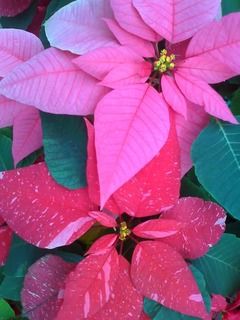
The Poinsettia, or Euphorbia pulcherrima, is in-arguably the most popular holiday plant for Christmastime. Most often people gravitate towards traditional colors such as red or white, though they are also available in very attractive yellow, pink, orange and green. Some poinsettias are speckled or streaked and if that's not enough for you, many growers even use dyes to create purple or blue poinsettias and add festive glitter.
 Bright, indirect light is preferable for poinsettias. This can be provided in a window that gets morning sun or in a window that gets sun all day but is filtered by a curtain. A window that gets no direct sun at all can even be sufficient, especially if light is reflected off a nearby building or water. Direct midday sunlight on the leaves can result in brown patches, or scorching. Scorching of the leaves is permanent and the leaves may either be removed or left where they are, depending on which one will have the more pleasing appearance in the plant-owner's opinion.
Water can be a delicate matter; poinsettias do not like to ever be too dry and never too wet. Poinsettias that get too dry quickly lose their leaves and their stems go limp. Poinsettias that sit in standing water quickly rot. Neither scenario is good; over-dry poinsettias may eventually recover, but are often very unsightly afterward. Rotten poinsettias are, well...rotten. They don't come back. To prevent over-watering, be sure to remove any decorative wrapping on the pot and don't let the plant sit in a tray of water. Water it thoroughly, so that water runs freely from the bottom of the pot. When the water stops draining, it can then be placed back in its decorative container.
There is a longstanding old wives tale that poinsettias are toxic or poisonous and dangerous to keep in a home with pets or children. It is entirely untrue. More than one poinsettia grower has been known to eat bracts in front of touring spectators to demonstrate the harmlessness of the plant. This does not mean the plant is edible; eating large quantities isn't recommended as it isn't the most digestible foliage. Due to the awful, bitter taste, it is highly unlikely that anyone, especially a small child, would venture more than a small bite. As far as pets are concerned, the ASPCA affirms that poinsettias are not poisonous, but "irritating to the mouth and stomach, sometimes causing vomiting, but generally over-rated in toxicity".
Water can be a delicate matter; poinsettias do not like to ever be too dry and never too wet. Poinsettias that get too dry quickly lose their leaves and their stems go limp. Poinsettias that sit in standing water quickly rot. Neither scenario is good; over-dry poinsettias may eventually recover, but are often very unsightly afterward. Rotten poinsettias are, well...rotten. They don't come back. To prevent over-watering, be sure to remove any decorative wrapping on the pot and don't let the plant sit in a tray of water. Water it thoroughly, so that water runs freely from the bottom of the pot. When the water stops draining, it can then be placed back in its decorative container.
There is a longstanding old wives tale that poinsettias are toxic or poisonous and dangerous to keep in a home with pets or children. It is entirely untrue. More than one poinsettia grower has been known to eat bracts in front of touring spectators to demonstrate the harmlessness of the plant. This does not mean the plant is edible; eating large quantities isn't recommended as it isn't the most digestible foliage. Due to the awful, bitter taste, it is highly unlikely that anyone, especially a small child, would venture more than a small bite. As far as pets are concerned, the ASPCA affirms that poinsettias are not poisonous, but "irritating to the mouth and stomach, sometimes causing vomiting, but generally over-rated in toxicity".
This site needs an editor - click to learn more!
You Should Also Read:
Caring for Houseplants in Winter
Spider Mites
Christmas Cactus
Related Articles
Editor's Picks Articles
Top Ten Articles
Previous Features
Site Map
Content copyright © 2023 by Lisa Beth Voldeck. All rights reserved.
This content was written by Lisa Beth Voldeck. If you wish to use this content in any manner, you need written permission. Contact
BellaOnline Administration
for details.
