Staking Orchid Flowers
Staking your inflorescences so that the flowers can be presented and shown to their best effect is an art into itself. If you go to an orchid show or society meeting where blooming plants are displayed, you will see all kinds of different staking methods depending upon the type of orchid.
Staking should be started as soon as the inflorescence is about 6 inches, or 15 centimeters, high. Place the stake as close to the bottom of the inflorescence of pseudobulb as possible without damaging roots. Choose a stake that will be appropriate for the flower – heavier stakes are necessary for bigger plants. Metal stakes work best for tall inflorescences such as Oncidiums.
Use clips, twist ties, raffia, or plant tape to hold the inflorescence to the stake. Remember that the inflorescence grows from the tip and that you will need to check the staking on a weekly basis. This is best done in the late afternoon or evening as the plant is at its most pliable then. They can be very brittle and break off easily if you attempt moving and tying in the early morning hours.
Once an inflorescence has started to grow it is best to leave the plant facing the same direction so that you do not get twisting of the stem or flowers. Some growers will put a piece of colored tape on the front of the plant so they know just how to replace the plant if it has to be moved for watering.
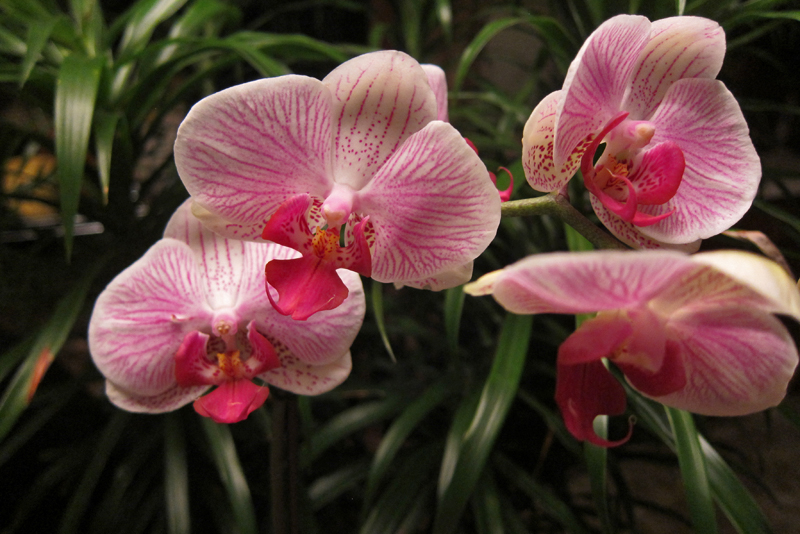
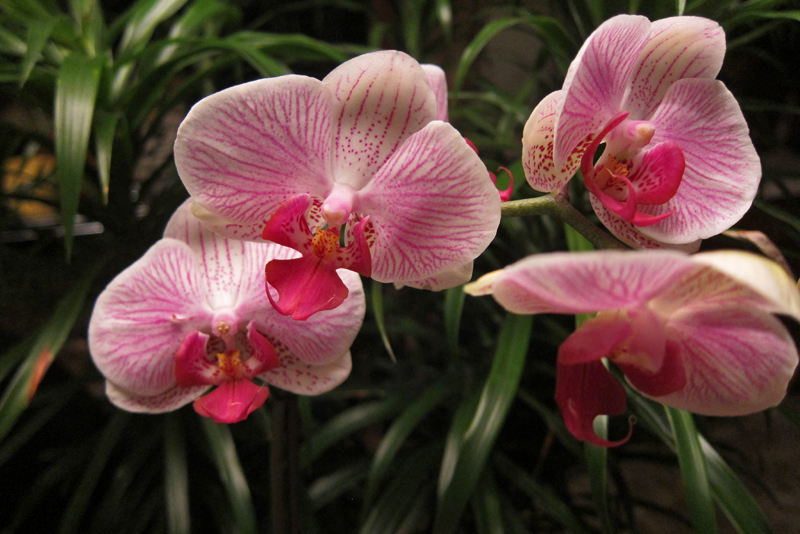
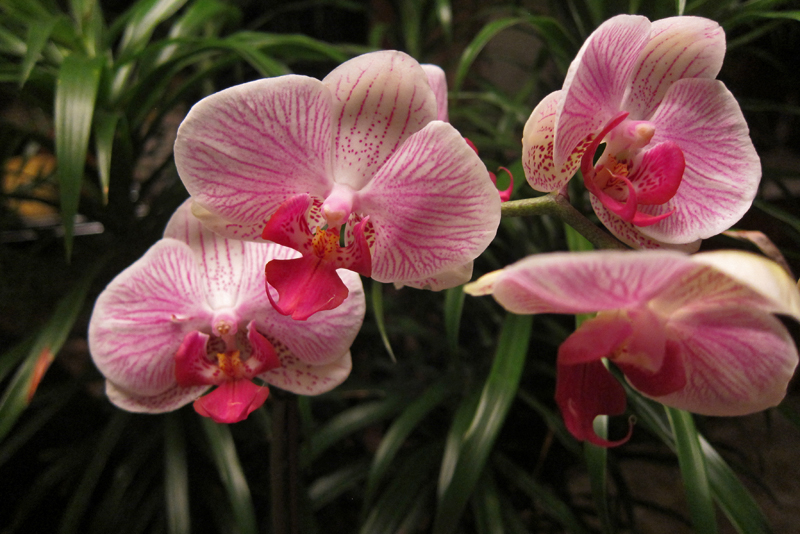
Cattleya Alliance plants are generally staked vertically so that the flower is shown directly facing the viewer. If necessary use a clip to hold the flower to the stake at the top to achieve this. Oncidiums are generally staked almost to the top so that their thin inflorescences will not break. They also tend to try to intertwine if many inflorescences are grown and staking will keep them separated. Dendrobiums pose a slightly different problem. I prefer to stake the plant rather and let the inflorescence bend naturally to present the flowers. Some people do stake them with metal spikes all the way to the end. If you are transporting the plants, this is often necessary to preserve the flowers. Phalaenopsis are generally staked to just below the first flower and then allowed to naturally arch gracefully. For transporting the plants some growers will use a metal stake which is inserted into the pot, attached to the inflorescence and then bends down so that the metal touches the ground and supports the whole inflorescence for moving at all. Paphiopedilums come in two major varieties – the multi-florals with long inflorescences and the individual flowered types. The multi-florals need to be staked so that the upward growth of the spike can be staked as each flower opens. The best staking I’ve seen for the individual flowered types are metal stakes made by bending wire that holds an individual flower.
Staking should be started as soon as the inflorescence is about 6 inches, or 15 centimeters, high. Place the stake as close to the bottom of the inflorescence of pseudobulb as possible without damaging roots. Choose a stake that will be appropriate for the flower – heavier stakes are necessary for bigger plants. Metal stakes work best for tall inflorescences such as Oncidiums.
Use clips, twist ties, raffia, or plant tape to hold the inflorescence to the stake. Remember that the inflorescence grows from the tip and that you will need to check the staking on a weekly basis. This is best done in the late afternoon or evening as the plant is at its most pliable then. They can be very brittle and break off easily if you attempt moving and tying in the early morning hours.
Once an inflorescence has started to grow it is best to leave the plant facing the same direction so that you do not get twisting of the stem or flowers. Some growers will put a piece of colored tape on the front of the plant so they know just how to replace the plant if it has to be moved for watering.
Cattleya Alliance plants are generally staked vertically so that the flower is shown directly facing the viewer. If necessary use a clip to hold the flower to the stake at the top to achieve this. Oncidiums are generally staked almost to the top so that their thin inflorescences will not break. They also tend to try to intertwine if many inflorescences are grown and staking will keep them separated. Dendrobiums pose a slightly different problem. I prefer to stake the plant rather and let the inflorescence bend naturally to present the flowers. Some people do stake them with metal spikes all the way to the end. If you are transporting the plants, this is often necessary to preserve the flowers. Phalaenopsis are generally staked to just below the first flower and then allowed to naturally arch gracefully. For transporting the plants some growers will use a metal stake which is inserted into the pot, attached to the inflorescence and then bends down so that the metal touches the ground and supports the whole inflorescence for moving at all. Paphiopedilums come in two major varieties – the multi-florals with long inflorescences and the individual flowered types. The multi-florals need to be staked so that the upward growth of the spike can be staked as each flower opens. The best staking I’ve seen for the individual flowered types are metal stakes made by bending wire that holds an individual flower.
You Should Also Read:
Tying and Staking Your Orchids
Reflowering Your Phalaenopsis
Orchid Growing Tips #21

Related Articles
Editor's Picks Articles
Top Ten Articles
Previous Features
Site Map
Content copyright © 2023 by Susan Taylor. All rights reserved.
This content was written by Susan Taylor. If you wish to use this content in any manner, you need written permission. Contact Anu Dharmani for details.